

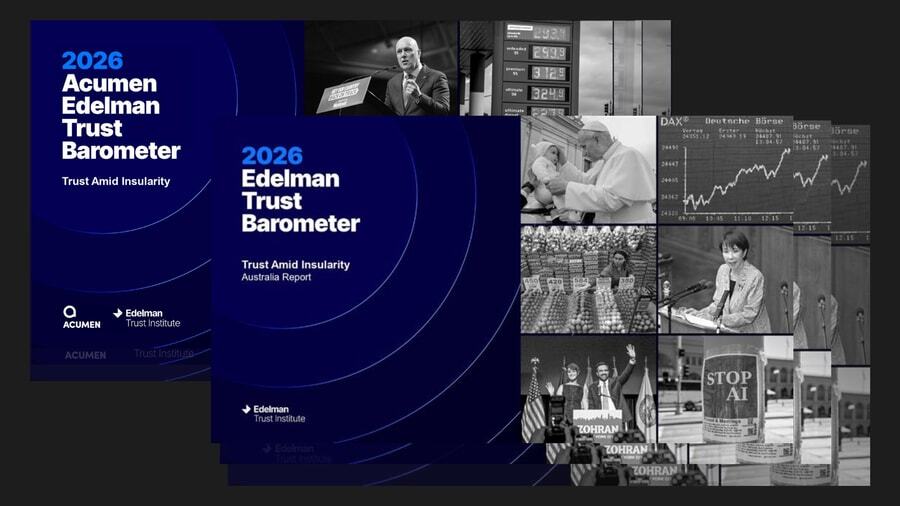
The 2026 Edelman Trust Barometer for Australia and the 2026 Acumen Edelman Trust Barometer (New Zealand) have been released, marking 26 years of the global study. This year's research focused on trust amid growing insularity - defined as a reluctance to trust those perceived as different in values, beliefs, or background.
The research draws on insights from more than 30,000 respondents across 28 markets globally, with the New Zealand edition incorporating additional local data and insights.
A shared finding across the reports is the rise of an inward-looking mindset: around three quarters of respondents (76 per cent in New Zealand and 73 per cent in Australia) reported hesitation or unwillingness to trust people who see the world differently. Increasingly, people are retreating into familiar circles for information, relationships, and reassurance.
Adelle Keely, Chief Executive at Acumen, said New Zealand is experiencing a noticeable cultural shift.
"We've traditionally prided ourselves on being open and tolerant. What we’re seeing now is a clear shift away from 'we' to 'me' - towards caution and selectivity in who and what we trust.”
Economic uncertainty driving caution
The study suggests that the inward turn is linked to rising uncertainty about the future. Economic pressure, technological disruption, and misinformation are contributing to declining optimism across both markets.
When asked if they believe the next generation will be better off, positive respondents from both countries fell below the global average of 32 per cent, with New Zealand at 17 per cent and Australia at 22 per cent.
Australians are also increasingly concerned about economic volatility, with 60 per cent worried about trade and tariff impacts on their work and 54 per cent concerned about job loss due to a looming recession.
Trust rising but unevenly
The report shows that while New Zealand remained in the distrust category overall, trust had increased from 47 per cent in 2025 to 49 per cent in 2026.
In Australia, trust across business, government, media, and NGOs rose from 49 per cent in 2025 to 54 per cent in 2026, moving the country from distrust into neutral territory. However, confidence remained unevenly distributed, with Australia recording its largest trust gap between high and low income earners since 2021, now sitting at 19 per cent.
Tom Robinson, CEO of Edelman Australia, said the data reflected increasingly divided perceptions of institutions.
"In Australia, we're witnessing the emergence of opposing institutional realities. This means that, across demographics, we're seeing levels of competence and efficacy in business, governments, NGOs and media, and the leaders of these sectors differ widely."
While New Zealand is not experiencing the same level of division seen in some other markets, 68 per cent believed distrust between people with different views is a serious problem that needs addressing.
Workplace impacts emerging
The research also highlighted how social division is beginning to influence workplace dynamics and productivity.
Similar trends were seen across both countries, with 32 per cent of employees in New Zealand and 42 per cent in Australia saying they would rather switch departments than report to a manager with different values. 19 per cent in New Zealand and 33 per cent in Australia also said they would put less effort into helping project team leaders succeed if they had different political beliefs.
Adelle warned: "If we lose the ability to work and collaborate across difference, we risk slowing productivity, limiting innovation, and making it harder to get ahead."
Employers seen as key trust builders
Employers remained among the most trusted institutions and were viewed as uniquely positioned to help rebuild trust.
In New Zealand, employers are trusted by 77 per cent of employees, while Australian respondents rated their employers among the strongest performers in meeting expectations to bridge divides, with only a 17 per cent gap between expectation and performance.
Workplaces were seen as one of the few environments where people regularly interact with others who are different from them, creating opportunities to build shared goals, have constructive conversations, and cooperate despite disagreement.
A shared responsibility to rebuild trust
The Trust Barometer findings suggested rebuilding social cohesion will require coordinated action across sectors.
Respondents in both markets believed governments, businesses, NGOs, and the media all hold responsibility for reducing division and strengthening trust. Australians placed the highest obligation on government, though only 36 per cent believe it is currently succeeding.
"Usually when we think about addressing divides, we try to eliminate differences," said Tom.
"However, in trying to navigate a world populated by insular groups, we need to be willing and able to work across these differences. This involves surfacing common interests, translating perspectives, and creating conditions for co-operation without requiring agreement."
Adelle added that rebuilding trust depends on engagement rather than retreat.
"Trust isn't built by surrounding ourselves with people who agree with us. It's built by engaging with difference - listening with respect and finding common ground where we can.”
Other key findings
- Among the sectors polled, 15 of 17 industry sectors are now trusted in Australia, with energy rated neutral at 54 per cent, while social media remained distrusted at 38 per cent.
- Only 33 per cent of Australians said they regularly consume news from politically diverse sources, below the global average of 39 per cent.
- Concern about foreign actors spreading misinformation to drive domestic division had reached 64 per cent among Australians, reflecting the global high of 65 per cent.
- Globally, the fear of being left behind by generative AI was strongest among low-income groups, with 54 per cent expressing concern.
- Following major societal disruptions in recent years, Australians reported declining trust in national political leaders and major news organisations, while trust increased in neighbours, coworkers, family members, and direct employers.
- 74 per cent of Australians believed rising mutual distrust is a moderate or crisis-level issue, while 37 per cent viewed it as a severe societal problem.
- In New Zealand, high-income respondents reported 56 per cent trust compared with 43 per cent among low-income groups.
- Among those in New Zealand holding an insular mindset, neighbours were the most trusted actors (69 per cent), while journalists (42 per cent), other CEOs (37 per cent), and government leaders (37 per cent) remain distrusted.
- 26 per cent of New Zealanders would support reducing the number of foreign companies operating locally, even if it resulted in higher prices.

-Sep-23-2026-02-32-38-6871-AM.png)