
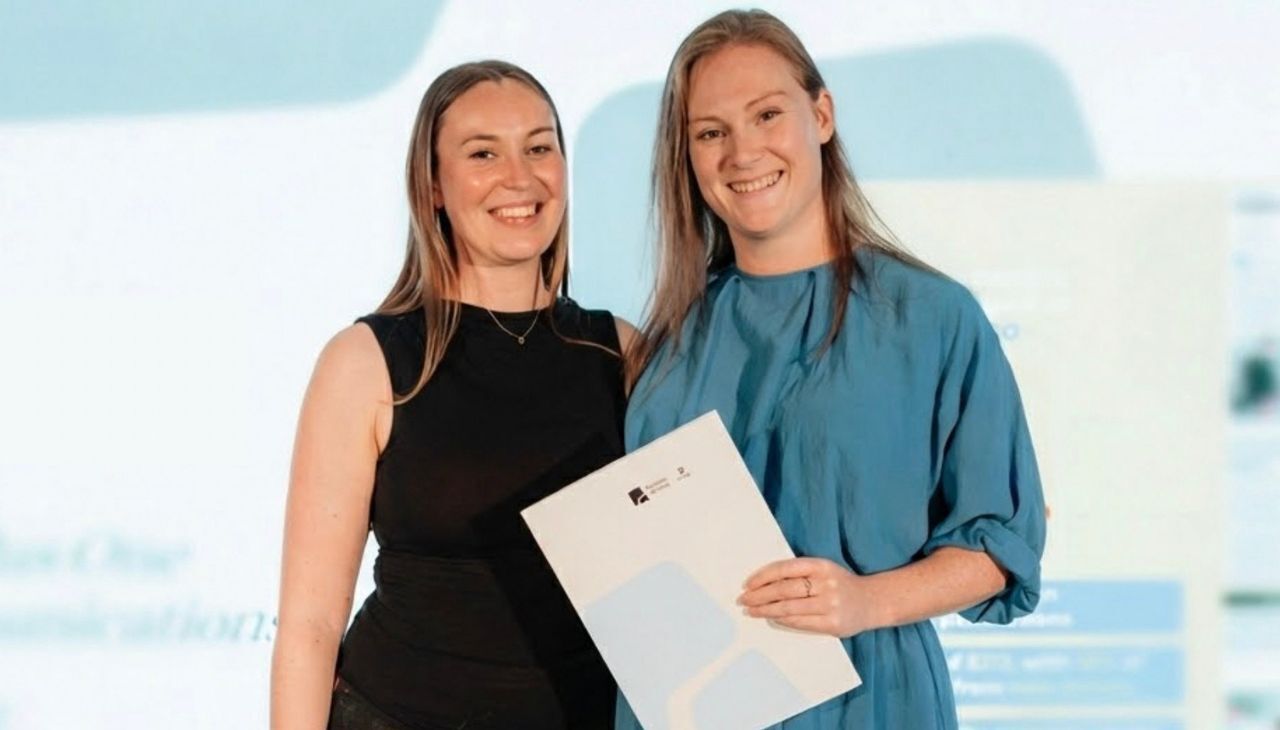
Independent PR agency, One Plus One Communications, has announced the promotions of Hannah Kronast and Rosalie Basham to Account Director and Senior Account Manager, respectively.
The pair have been working closely together on the same team, and have made contributions to campaigns for the likes of 2degrees and RMHC.
One Plus One Managing Director, Kelly Bennett, says it feels appropriate to cap off an exceptional year by recognising some of the people who made it great.
"I've worked with Rosalie now for more than four years. She's been with us since she graduated and continues to challenge herself and get better everyday. I love that aspect of our role; to be able to teach somebody a really valuable trade and see them mature and flourish over years. At this stage in my career, it's genuinely my favourite thing," he said.
"Hannah joined us a bit more recently and continually impresses with her commitment to growth and delivering exceptional results for clients. She recently took it upon herself to complete the PRINZ APR accreditation, where she's certainly distinguished herself."
(Pictured: Hannah Kronast and Rosalie Basham)
One Plus One promotes two
Telum Media creating connections
Get in touch to learn more
Telum Talks To: Haymarket Media
You might also enjoy

We. Communications and USC Annenberg Center for Public Relations have released a new research report, Message vs. The Machine. The study examines how communicators perceive AI’s impact on brand reputation, and the opportunities and challenges that come with it.
Awareness vs. Action
The rise of generative AI has led to the “zero-click search” phenomenon, where users rely on AI summaries instead of clicking through to websites. Communicators recognise the shift: 62 per cent believe that generative engine optimisation (GEO) - the practice of tailoring content for large language models - represents the biggest opportunity in communications since search.
However, skill and understanding lag behind awareness. Only 12 per cent of communicators strongly feel they understand how AI decides what information to present about their brands. Nearly half (49 per cent) say that if they were asked to review content for GEO today, they wouldn’t know where to begin.
According to the report, time and attention are key factors behind this gap. Rapid AI development, and economic or geopolitical pressures all contribute. Despite these challenges, the study notes that communicators still have a relative advantage in GEO compared to other business functions.
Measuring success in generative AI
The study identified another opportunity with the rise of generative AI: measuring AI prominence. The practice refers to establishing new KPIs to track how a brand appears in AI results
One approach is AI share-of-voice (AI SOV), a rough measure of how often a brand is mentioned in questions about its industry or competitors. When asked how their organisation monitors the accuracy of AI-generated brand content, the largest share of respondents (34 per cent) cited reliance on third-party tools or platforms, followed by 33 per cent who said they regularly query AI with brand-related prompts.
Yet measurement still trails recognition. Only 23 per cent of communicators say their organisation currently tracks how often they appear in AI output. Others are planning to do so (31 per cent), believe they should despite having no current plans (30 per cent), or have no plans at all (17 per cent). The study underscores that “you can’t optimise what you don’t measure,” highlighting the urgency of monitoring AI output.
New waves of crises and threats
AI introduces new forms of reputational risk, including misinformation, outdated content, and challenges around authority. A majority of respondents (64 per cent) believe AI-related reputational damage is a serious threat today, and another 64 per cent fear AI could amplify negative narratives.
Additional concerns include AI misrepresenting the brand or its values (58 per cent), AI rewriting or distorting carefully crafted messaging (60 per cent), and stakeholders potentially trusting AI over official communications (57 per cent).
These concerns are not hypothetical. 30 per cent of communicators say their organisation has already faced reputation issues due to AI-generated content, while 36 per cent report instances of AI providing inaccurate information about their products or services. Despite these risks, only 39 per cent feel prepared to correct or prevent AI-driven misinformation.
Key takeaways for communicators:
- Learn what AI prioritises: Understand the sources AI cites for your industry and brand, and identify recurring narratives.
- Track brand health in AI: Audit product and brand messaging in AI outputs regularly to ensure accuracy and consistency.
- Strengthen authority and storytelling: Build strategies to influence authoritative sources and ensure repetition of your key narratives across credible outlets.
- Prepare an AI-based crisis plan: Incorporate AI-driven risks into simulation exercises, and align responses across legal, C-suite, and other stakeholders.
- Leverage this moment to drive communications value: Package GEO-related insights and demonstrate to stakeholders how communications can shape what AI says about the brand.
Katie Aung has stepped up to Director of Marketing and PR at Meranti Green Steel, a green iron and steel company with offices in Thailand, Singapore, and Oman. Based in Bangkok, she leads the company’s global marketing and communications strategy, overseeing PR activities across APAC, the Middle East, and Europe.
With more than 9 years of experience across APAC, Katie has held senior marketing and communications roles spanning the agency, corporate, and technology sectors.
Anthea Desmond has commenced a new role as Media and Communications Manager at the NSW Irrigators’ Council. She has wrapped up more than three years at the Port Authority of New South Wales as Senior Media & Communications Advisor. Prior to this, Anthea worked in communications at a number of local government councils and within the emergency services sector.