As the Middle East undergoes rapid transformation, communication has become a defining factor in how organisations navigate the region's complexity, which spans regulatory changes to rising stakeholder expectations. No longer constrained to being a downstream function, it now actively shapes how businesses position themselves, make decisions, and build trust in an increasingly high-stakes environment.
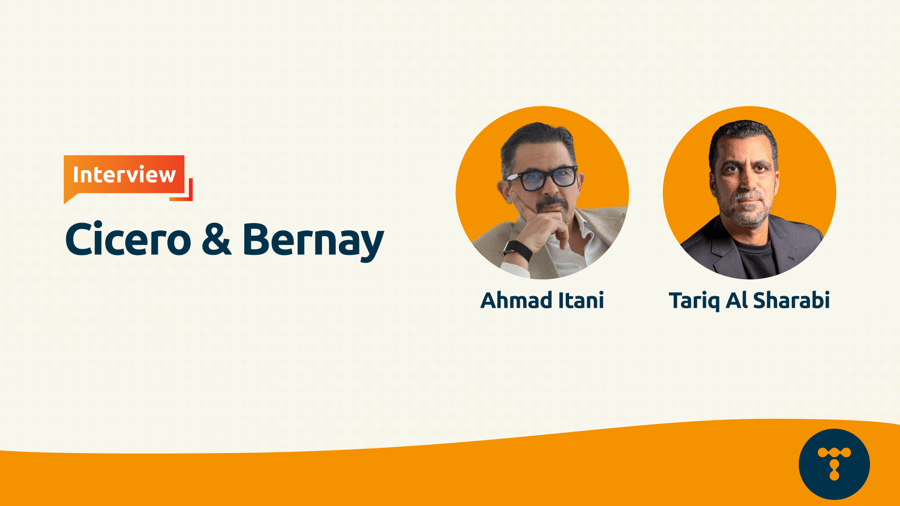
Ahmad Itani, Founder and Chief Advisor, and Tariq Al Sharabi, Executive Advisor at Cicero & Bernay (C&B), share how this shift is redefining the role of communications in the Middle East. Based on their work across the region, they discussed the increasing demand for strategic counsel, where global companies go wrong, and how communication is influencing real business outcomes.
What complex communication decisions have organisations in the Middle East had to navigate in recent years?
Tariq Al Sharabi: The biggest shift I've seen is how communication is now at the centre of how companies make decisions. Five years ago, most of our conversations with clients started with "we need coverage" or "we need a campaign." Now they come to us with "we're not sure how to position this" or "we need to work out what to say before we say anything."
A lot of that comes down to the environment we're all operating in. Our clients are managing pressure from multiple stakeholder groups at the same time, and how they communicate through that has become a strategic priority.
On top of that, regulatory and policy changes across the region are accelerating. Governments are introducing frameworks around AI governance, digital economies, and investment ecosystems. The UAE's National AI Strategy 2031 and Saudi Arabia's Vision 2030 reforms mean organisations have to articulate long-term commitments, which is a very different conversation from promoting a recent launch.
And then there’s credibility. The 2025 Edelman Trust Barometer shows that while many countries are experiencing a crisis of institutional confidence, the UAE stands out as one of the highest-scoring nations surveyed, with 82 per cent of respondents trusting the government and 76 per cent trusting business. But that comes with high expectations. People here expect companies to lead, and for our clients, that means each message carries more weight.
So when we talk about complexity, it’s really about helping businesses think clearly in a landscape where the stakes around what you say, when you say it, and who you say it to are much higher than they used to be.
Global companies often talk about “the Middle East” as one homogeneous market. Where does that assumption break down from a strategic comms perspective? How does this understanding affect business outcomes?
Ahmad Itani: It breaks down almost immediately. Saudi Arabia and the UAE are neighbours, but anyone who has worked across both markets knows that how people consume information, what they respond to, and what earns their trust are shaped by very different cultural and regulatory realities.
Saudi Arabia is in the middle of one of the most ambitious transformation programmes in modern history. The appetite for new ideas and partnerships is enormous. But many international companies still walk in with a one-size-fits-all regional strategy. That's a fundamental misread. The organisations succeeding there have taken time to understand the national vision and communicate in a way that shows they're here for the long term.
The UAE operates at a completely different pace. The media environment is more open, international connectivity is deeper, and expectations around speed and innovation are very high. And then you have markets like Egypt, Jordan, and Kuwait, each with its own set of pressures and opportunities. When you treat the region as a single market, the work ends up feeling generic, and the relationships stay at a surface level.
This has real business consequences. The ones running a single regional playbook tend to burn through their budget without building the credibility they need to grow. We've seen it repeatedly. The comms strategy is often what determines whether a market entry becomes a genuine partnership.
What kinds of business decisions are now reaching communication advisors that traditionally sat elsewhere in the organisation?
Ahmad: The simplest way I can describe it is that the people we're talking to have changed. Ten years ago, our main point of contact was a marketing director or communication manager. Today it's the CEO, the general manager, or the head of strategy. When that happens, the question changes completely. Last month, we were helping a client rethink their market entry. The month before that, it was a leadership transition that needed careful handling. This is strategy work, and the fact that it's reaching us says something important about where the industry is heading.
Tariq: What I would add is that the type of decision has changed as well. A client going through a restructuring isn't just asking how to approach it. They're asking how to talk to their own people, how to frame the investor narrative, or how to make sure three regional teams with very different contexts are telling a coherent story. That kind of job would have gone to a management consultancy or a law firm not long ago.
The area that's grown more than any other is employer communication. Companies are competing for talent in ways they've never had to, and the internal story matters as much as the external one. That's where trust is won or lost. And once it erodes inside, the outside narrative falls apart very quickly.
Ahmad: This is happening everywhere, by the way. Gartner's latest research found that CEOs now expect their communication leaders to think and operate like business leaders, to help solve problems across the enterprise. That matches everything we're experiencing in this part of the world. The clients who demand the most from us strategically are the ones growing the fastest.
How do you see communicators taking on these new remits and integrating them with long-established processes?
Tariq: It's messy, honestly. And I think we should be upfront about that. The demand for communicators to be involved earlier and more deeply is real, but the structures within most organisations haven't kept pace. You still have procurement processes designed for buying media placements, not strategic counsel.
What I've found works is proving value on a specific problem before asking for a permanent seat. You help a client navigate one difficult restructuring well, and the next time something sensitive comes up, you're the first call. That's how the relationship evolves.
As demand for strategic counsel grows in the region, how do you see the comms agency model evolving?
Ahmad: The traditional agency model is already outdated. Most agencies in this region still operate on a retainer-plus-deliverables structure that was designed for a world where the job was media relations and content production. That world is shrinking.
Clients used to pay us to secure coverage for them. Now, the most valuable thing we do is help them decide what to say, or whether to say anything at all. That's a fundamentally different service, and it requires a fundamentally different kind of team. You need people who understand business strategy, regulatory environments, and stakeholder dynamics. A traditional PR background alone won't get you there.
Advisories will thrive in this region over the next decade, ones that price for thinking, build multidisciplinary teams, and are willing to walk away from work that doesn't require strategic depth. That's a difficult transition for an industry that was built on volume. But the opportunity is enormous.
What’s a recent communication challenge that required particularly complex stakeholder navigation? How did this showcase the industry’s shift toward advisory-led firms and changing client relationships in the region?
Tariq and Ahmad: We've had to guide clients through tough economic stretches where the business had to restructure, cut costs, or quietly step back from public commitments. The communication challenge in those moments went beyond explaining what's changed. It's about making sure the people who matter still believe in the company’s direction.
Our job was to resist the pressure to react and instead create space for the client to properly map out their exposure. Who are we actually speaking to? What does each group need to hear? What can we credibly say? Sometimes the answer was a public statement. Other times, it meant staying quiet and making sure the reasoning was solid in case it was ever challenged.
That's a long way from media relations. That's real-time counsel on decisions that shape how an organisation has been perceived for years.
Ahmad: And these are the moments that reveal what kind of relationship you actually have with a client. When someone calls you at midnight asking whether they should respond to something that broke hours ago, they're not looking for a holding statement.
They need someone who already understands their business, their stakeholders, and the sensitivities well enough to give direction without needing a briefing first. That's the difference between an agency on retainer and a genuine advisory relationship, and it's not something you can build overnight.
Interview: Ahmad Itani and Tariq Al Sharabi from Cicero & Bernay
Telum Media creating connections
Get in touch to learn more
Zeinoun Aridi takes on new agency role
You might also enjoy
Katch International has welcomed Zeinoun Aridi as Associate Director. In this role, he will lead on strategic communications, client servicing, and business growth, working across a portfolio of hospitality, lifestyle, and corporate accounts in the region.
Based in Dubai, Zeinoun brings over 12 years of experience in PR and communications across the Middle East. He has previously worked with agencies including Four Agency Worldwide, Paradox Events Qatar, Q Communications, and Action Global Communications in Beirut, building a track record across lifestyle, tourism, and consumer brands.
Dhara Bhatia, Group PR Director at Katch International, said, “We’re delighted to welcome Zeinoun to the team at an exciting time of growth for the agency. His regional experience, strong client understanding, and ability to lead with both strategy and creativity make him a valuable addition to our senior team. As we continue to expand our footprint across hospitality, lifestyle, and corporate sectors, Zeinoun will play a key role in strengthening our client offering and driving impactful, integrated campaigns.”
Commenting on his new role, Zeinoun said, “I’m really excited to be part of Katch and to be working on such a fun and diverse mix of accounts. Over the years, I’ve learned that while PR will always come with its fair share of pressure and fast-paced moments, the environment you’re in makes all the difference. Having a team that keeps things collaborative, supportive, and genuinely enjoyable is what really allows the work to flow, and I’m very happy to have found that here.”
Perspective Strategies has been reappointed as the public relations agency for Mercedes-Benz Malaysia, following a competitive pitch.
The agency first secured the account in 2022 and has been on retainer since 2023. After a formal pitch in October 2025, Mercedes-Benz Malaysia re-elected it in December, securing a renewed two-year mandate from January 2026 to December 2027, as the agency told Telum Media.
"Renewing our partnership with Mercedes-Benz Malaysia is an exciting step for Perspective Strategies, allowing us to move beyond execution and provide more intuitive, strategic counsel," commented Tan May Lee, Partner & Executive Director at Perspective Strategies.
She further mentioned that with this renewal, the agency looks forward to delivering fresh, purposeful ideas - crafting narratives that not only amplify visibility but also build lasting trust and loyalty for the Mercedes-Benz brand. For Tan, the partnership represents both continuity and evolution: strengthening ties with an iconic brand while advancing Perspective Strategies’ growth ambitions within Malaysia’s competitive PR landscape.
(Picture: Perspective Team at the launch of the new Mercedes-Maybach GLS 600 4MATIC)
The 2026 Edelman Trust Barometer for Australia and the 2026 Acumen Edelman Trust Barometer (New Zealand) have been released, marking the 26th editions of both reports. This year's research focused on trust amid growing insularity - defined as a reluctance to trust those perceived as different in values, beliefs, or background.
The New Zealand study drew on insights from more than 30,000 respondents across 29 markets, while the Australian report reflects a similarly sized global sample spanning 28 markets.
A shared finding across the reports is the rise of an inward-looking mindset: around three quarters of respondents (76 per cent in New Zealand and 73 per cent in Australia) reported hesitation or unwillingness to trust people who see the world differently. Increasingly, people are retreating into familiar circles for information, relationships, and reassurance.
Adelle Keely, Chief Executive at Acumen, said New Zealand is experiencing a noticeable cultural shift.
"We've traditionally prided ourselves on being open and tolerant. What we’re seeing now is a clear shift away from 'we' to 'me' - towards caution and selectivity in who and what we trust.”
Economic uncertainty driving caution
The study suggests that the inward turn is linked to rising uncertainty about the future. Economic pressure, technological disruption, and misinformation are contributing to declining optimism across both markets.
When asked if they believe the next generation will be better off, positive respondents from both countries fell below the global average of 32 per cent, with New Zealand at 17 per cent and Australia at 22 per cent.
Australians are also increasingly concerned about economic volatility, with 60 per cent worried about trade and tariff impacts on their work and 54 per cent concerned about job loss due to a looming recession.
Trust rising but unevenly
The report shows that while New Zealand remained in the distrust category overall, trust had increased from 47 per cent in 2025 to 49 per cent in 2026.
In Australia, trust across business, government, media, and NGOs rose from 49 per cent in 2025 to 54 per cent in 2026, moving the country from distrust into neutral territory. However, confidence remained unevenly distributed, with Australia recording its largest trust gap between high and low income earners since 2021, now sitting at 19 per cent.
Tom Robinson, CEO of Edelman Australia, said the data reflected increasingly divided perceptions of institutions.
"In Australia, we're witnessing the emergence of opposing institutional realities. This means that, across demographics, we're seeing levels of competence and efficacy in business, governments, NGOs and media, and the leaders of these sectors differ widely."
While New Zealand is not experiencing the same level of division seen in some other markets, 68 per cent believed distrust between people with different views is a serious problem that needs addressing.
Workplace impacts emerging
The research also highlighted how social division is beginning to influence workplace dynamics and productivity.
Similar trends were seen across both countries, with 32 per cent of employees in New Zealand and 42 per cent in Australia saying they would rather switch departments than report to a manager with different values. 19 per cent in New Zealand and 33 per cent in Australia also said they would put less effort into helping project team leaders succeed if they had different political beliefs.
Adelle warned: "If we lose the ability to work and collaborate across difference, we risk slowing productivity, limiting innovation, and making it harder to get ahead."
Employers seen as key trust builders
Employers remained among the most trusted institutions and were viewed as uniquely positioned to help rebuild trust.
In New Zealand, employers are trusted by 77 per cent of employees, while Australian respondents rated their employers among the strongest performers in meeting expectations to bridge divides, with only a 17 per cent gap between expectation and performance.
Workplaces were seen as one of the few environments where people regularly interact with others who are different from them, creating opportunities to build shared goals, have constructive conversations, and cooperate despite disagreement.
A shared responsibility to rebuild trust
The Trust Barometer findings suggested rebuilding social cohesion will require coordinated action across sectors.
Respondents in both markets believed governments, businesses, NGOs, and the media all hold responsibility for reducing division and strengthening trust. Australians placed the highest obligation on government, though only 36 per cent believe it is currently succeeding.
"Usually when we think about addressing divides, we try to eliminate differences," said Tom.
"However, in trying to navigate a world populated by insular groups, we need to be willing and able to work across these differences. This involves surfacing common interests, translating perspectives, and creating conditions for co-operation without requiring agreement."
Adelle added that rebuilding trust depends on engagement rather than retreat.
"Trust isn't built by surrounding ourselves with people who agree with us. It's built by engaging with difference - listening with respect and finding common ground where we can.”
Other key findings
- Among the sectors polled, 15 of 17 industry sectors are now trusted in Australia, with energy rated neutral at 54 per cent, while social media remained distrusted at 38 per cent.
- Only 33 per cent of Australians said they regularly consume news from politically diverse sources, below the global average of 39 per cent.
- Concern about foreign actors spreading misinformation to drive domestic division had reached 64 per cent among Australians, reflecting the global high of 65 per cent.
- Globally, the fear of being left behind by generative AI was strongest among low-income groups, with 54 per cent expressing concern.
- Following major societal disruptions in recent years, Australians reported declining trust in national political leaders and major news organisations, while trust increased in neighbours, coworkers, family members, and direct employers.
- 74 per cent of Australians believed rising mutual distrust is a moderate or crisis-level issue, while 37 per cent viewed it as a severe societal problem.
- In New Zealand, high-income respondents reported 56 per cent trust compared with 43 per cent among low-income groups.
- Among those in New Zealand holding an insular mindset, neighbours were the most trusted actors (69 per cent), while journalists (42 per cent), other CEOs (37 per cent), and government leaders (37 per cent) remain distrusted.
- 26 per cent of New Zealanders would support reducing the number of foreign companies operating locally, even if it resulted in higher prices.