On the 20
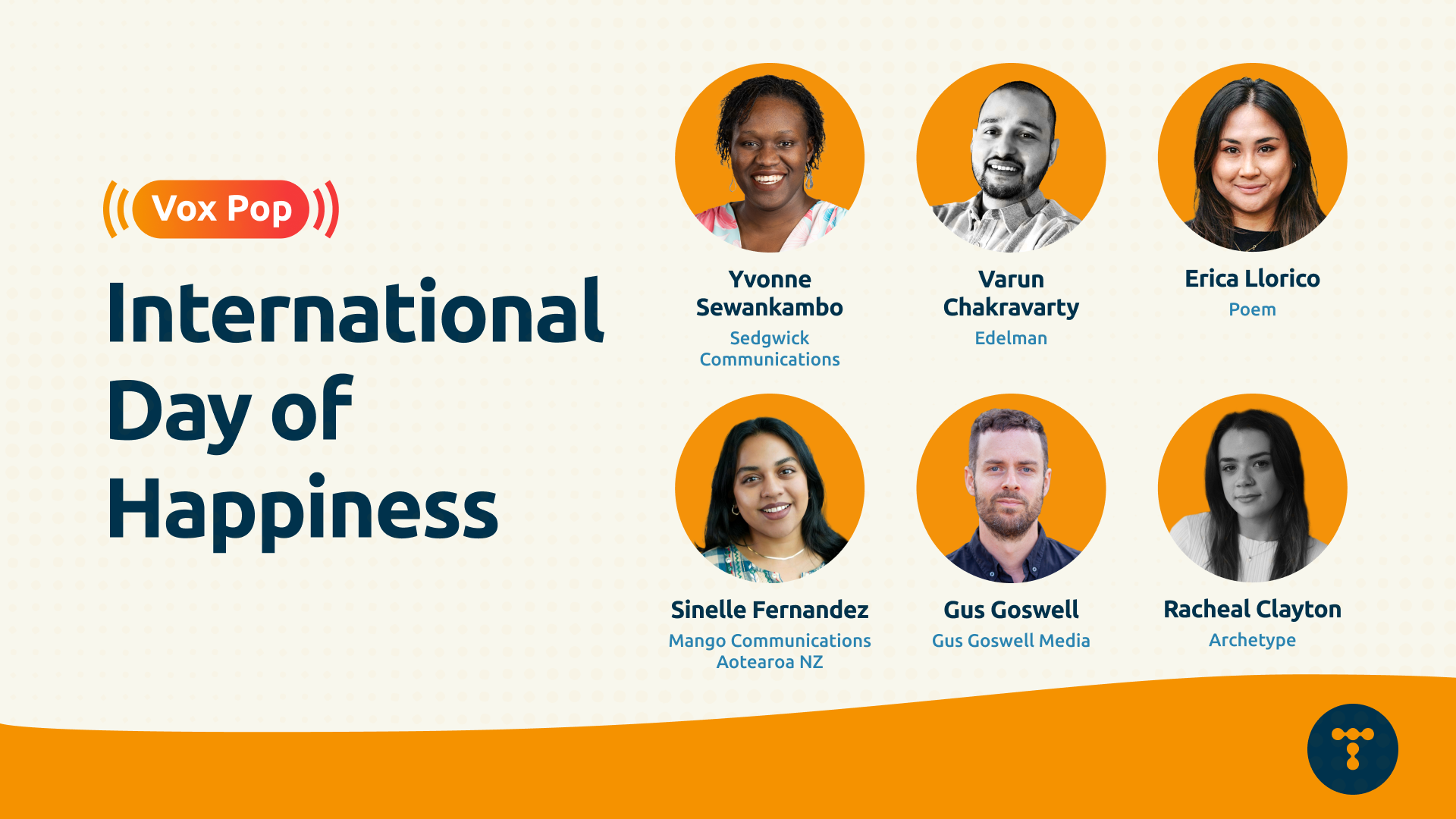
th of March, the world comes together to celebrate International Day of Happiness. In the spirit of this global occasion, Telum Media spoke with six communications professionals to explore what keeps them happy and motivated at work, as well as their "happy places" beyond the office.
Here's what they had to share about finding joy in both their careers and personal lives.
What’s your secret to staying happy and loving what you do at work?
Erica Llorico, Senior Account Director, Poem
I embrace variety, stay curious, and always come in with a growth mindset. I’m also lucky that I work as part of a team where we can honestly say we come to work as our genuine selves, everyone's kind, and we consistently get to work on cool campaigns for our clients. Recipe for a happy gal, really!
Varun Chakravarty, Head of Technology, Edelman
I like to think of work as a game of Tetris - new challenges keep dropping in, sometimes faster than expected, and the trick is to stay calm, find the right fit, and keep things moving. I find energy in making sense of the chaos and turning it into something meaningful.
But what truly keeps me happy is the people. The real strength of any organisation lies in the diversity of its teams - different perspectives, experiences, and ideas always lead to unexpected and out-of-the-box solutions. At the same time, I believe we shouldn’t take things too seriously. A positive and calm mindset, with empathy at the centre, makes all the difference. That’s where good work becomes great, and where my happy place truly is.
Lately, I've also been focusing on upskilling and re-learning, which has been a challenging but rewarding process. Seeing technology complement human thinking, unlocking solutions I hadn’t considered before, has been both humbling and exciting - reinforcing just how powerful continuous learning can be.
Finally, meditation keeps me centred when things get chaotic, and the power of reading speaks for itself - two habits that keep me sharp and energised. And, of course, a sense of humour always helps!
At the end of the day, it's the people, the challenges, and the constant learning that make work something I genuinely love.
Yvonne Sewankambo, Senior Communications Consultant,Sedgwick Communications
Not spending too much time worrying about what I can't control, especially given the unpredictable nature of PR and life. I say "too much" because I’m human - there will, of course, be times when the worry does creep in. The secret is to not dwell on it - because I can then spend those hours, days or even months (yikes!), using my limited time and energy for something far more positive.
I can't control a client doing something I wouldn't, a journalist saying no to a pitch I thought would be right up their alley, or my son needing to be picked up from daycare 30 minutes after I've dropped him off. But I can control the crisis communication plan I set up, the tweaked pitch I send to another media target, and how my husband and I tag team on a workday with a sick toddler. So, that’s what I choose to focus on.
I also believe I still love what I do at work because my career is not my whole identity. I am able to get through the tough days simply because I’ve made a conscious effort to ensure work is not my everything.
Gus Goswell, Nature and Climate Communications Specialist, Gus Goswell Media
Most of my storytelling and communications work is about threats to nature and the climate pollution crisis. At first glance, they don't look like ingredients for a happy work life, but I find great satisfaction and, yes, happiness in this work.
The client communications part of my business is mainly working with organisations that advocate for nature protection and restoration and action on climate change, and incorporating active hope and happiness into this storytelling is essential. Grief and anger can motivate us to act, but I believe it is a shared sense of optimism, joy, determination and community that sustains us.
Healthy nature gives us so much: clean air, clean water, food, medicine and - vitally - a deep sense of wellbeing and happiness. Whether I am writing an article, scripting a podcast episode, or presenting media training, I feel I am constantly learning from nature and I try to be inspired by the natural world in everything I do.
It isn't always easy to hold onto hope and happiness when you're writing and communicating for a better future for nature and our climate, but it is deeply satisfying to know that my work is a reflection of my values and those of millions of other nature lovers. That sense of meaning is something I am grateful for, which often makes me happy.
Sinelle Fernandez, Senior Account Manager, Mango Communications Aotearoa NZ
Being happy at work comes largely from the environment you're in. I've been so lucky to work with the loveliest girls at Mango, where the banter and chit-chats never stop.
The clients we work with have also been truly kind, and that helps make our jobs so much easier, helping us love what we do.
Racheal Clayton, Account Executive, Archetype
There's no universal secret to staying happy at work, but I believe it helps to remember that work comes in peaks and valleys. The key is to focus on the positives that come with both. By taking into account that challenges and stress points are also opportunities to learn and grow, not just in your career but in your personal development as well.
The difference between simply being content and truly loving what you do lies in your attitude and approach to work. Staying curious and embracing continuous learning creates a sense of purpose and keeps me motivated.
Whether it’s progressing in your role, upskilling, taking on more responsibility, or even strengthening your network of contacts, there’s always room to improve. This commitment to always evolving is what makes work fulfilling.
Where’s your happy place outside of work - an adventure, hobby, or a side hustle?
Erica Llorico
I'm a lover of music. I especially love curating playlists for different moods, situations, people etc, which I then share with the office every Friday (guess the love for burnt CDs / mixtapes from childhood never left me!). Definitely a 'happy place' for me.
Varun Chakravarty
Happiness has meant different things to me over the years - right now, it’s about rhythm and flow. Movement keeps me energised - whether it’s football, lifting weights, or making music. Then there are the quieter moments - reading, meditating, or sitting with my guitar, trying to put rhythm to paper.
Lately, I've been practising the art of slowing down - being more present in the process rather than always chasing what's next. That also means stepping away from devices and simply being in the moment - whether it’s re-learning old passions from the ground up or something as simple as enjoying a quiet coffee with my partner, with no distractions, just good conversation. There's something refreshing about stripping things back, finding joy in the small moments and embracing the momentum of learning again.
It all comes down to mind, body and fuel - keeping the body active, the mind engaged, and the spirit recharged. Sometimes, the best way to do that is to get in the car and hit the motorways. There's something about the open road that clears my mind and resets everything.
That balance of adrenaline and reflection, motion and stillness, learning and re-learning - that's what keeps me grounded. That's my happy place.
Yvonne Sewankambo
I have a few happy places, but one of my favourites is whenever I’m writing. I'm a published author of two children's books - "Good Hair" and "First There Was Me, Then There Was You" - with a third on the way later this year. So, any chance to work on my next book brings me joy.
And although I don't get to read for leisure as much as I did a few years ago (due to many life commitments), I always enjoy sitting down with a cup of tea and a good book as time seems to stand still.
Swimming and boxing also bring so much peace! I'm constantly amazed by how quickly my brain shuts everything else out the minute my feet push against a pool wall, or I throw that first punch.
Gus Goswell
Despite how aware I am of the many threats to nature - or perhaps exactly because of that awareness - nature is my happy place. I'm happy if I'm watching my kids explore a rock pool, if I'm surrounded by birds doing their thing in the bush or the backyard, if I am camping near a snow gum, or just nerding out about weird and wonderful wildlife with other nature lovers.
International Happiness Day is a great day to experience the joy and wonder of the nature that's all around us, but so is every day! And every day is a great day for us all to do what we're able to do to celebrate and help care for nature and our climate.
Sinelle Fernandez
Outside of work, I mostly enjoy spending time with my family, going to the gym, dancing, and recently, gardening! My summer garden has been thriving, and it's been incredibly rewarding seeing it grow and bringing in delicious home-grown fruit and veggies in everyday!
Racheal Clayton
The place I feel most at peace is anywhere that brings me closer to nature. Whether it's the beach, a quiet lake or the mountains, switching off from technology and just being in the moment helps me reset. It's a reminder of what really matters and makes me appreciate how lucky I am.
With so much of our week spent staring at screens, I think it’s important to unplug - not just from technology, but mentally too. It's so easy to check your phone for a quick work update and suddenly feel like you're always "on".
That's why being outside is my happy place. It's my personal "do not disturb" mode, where I can truly switch off, recharge and step into a new week feeling refreshed.
Here's what they had to share about finding joy in both their careers and personal lives.
What’s your secret to staying happy and loving what you do at work?
Erica Llorico, Senior Account Director, Poem
I embrace variety, stay curious, and always come in with a growth mindset. I’m also lucky that I work as part of a team where we can honestly say we come to work as our genuine selves, everyone's kind, and we consistently get to work on cool campaigns for our clients. Recipe for a happy gal, really!
Varun Chakravarty, Head of Technology, Edelman
I like to think of work as a game of Tetris - new challenges keep dropping in, sometimes faster than expected, and the trick is to stay calm, find the right fit, and keep things moving. I find energy in making sense of the chaos and turning it into something meaningful.
But what truly keeps me happy is the people. The real strength of any organisation lies in the diversity of its teams - different perspectives, experiences, and ideas always lead to unexpected and out-of-the-box solutions. At the same time, I believe we shouldn’t take things too seriously. A positive and calm mindset, with empathy at the centre, makes all the difference. That’s where good work becomes great, and where my happy place truly is.
Lately, I've also been focusing on upskilling and re-learning, which has been a challenging but rewarding process. Seeing technology complement human thinking, unlocking solutions I hadn’t considered before, has been both humbling and exciting - reinforcing just how powerful continuous learning can be.
Finally, meditation keeps me centred when things get chaotic, and the power of reading speaks for itself - two habits that keep me sharp and energised. And, of course, a sense of humour always helps!
At the end of the day, it's the people, the challenges, and the constant learning that make work something I genuinely love.
Yvonne Sewankambo, Senior Communications Consultant,Sedgwick Communications
Not spending too much time worrying about what I can't control, especially given the unpredictable nature of PR and life. I say "too much" because I’m human - there will, of course, be times when the worry does creep in. The secret is to not dwell on it - because I can then spend those hours, days or even months (yikes!), using my limited time and energy for something far more positive.
I can't control a client doing something I wouldn't, a journalist saying no to a pitch I thought would be right up their alley, or my son needing to be picked up from daycare 30 minutes after I've dropped him off. But I can control the crisis communication plan I set up, the tweaked pitch I send to another media target, and how my husband and I tag team on a workday with a sick toddler. So, that’s what I choose to focus on.
I also believe I still love what I do at work because my career is not my whole identity. I am able to get through the tough days simply because I’ve made a conscious effort to ensure work is not my everything.
Gus Goswell, Nature and Climate Communications Specialist, Gus Goswell Media
Most of my storytelling and communications work is about threats to nature and the climate pollution crisis. At first glance, they don't look like ingredients for a happy work life, but I find great satisfaction and, yes, happiness in this work.
The client communications part of my business is mainly working with organisations that advocate for nature protection and restoration and action on climate change, and incorporating active hope and happiness into this storytelling is essential. Grief and anger can motivate us to act, but I believe it is a shared sense of optimism, joy, determination and community that sustains us.
Healthy nature gives us so much: clean air, clean water, food, medicine and - vitally - a deep sense of wellbeing and happiness. Whether I am writing an article, scripting a podcast episode, or presenting media training, I feel I am constantly learning from nature and I try to be inspired by the natural world in everything I do.
It isn't always easy to hold onto hope and happiness when you're writing and communicating for a better future for nature and our climate, but it is deeply satisfying to know that my work is a reflection of my values and those of millions of other nature lovers. That sense of meaning is something I am grateful for, which often makes me happy.
Sinelle Fernandez, Senior Account Manager, Mango Communications Aotearoa NZ
Being happy at work comes largely from the environment you're in. I've been so lucky to work with the loveliest girls at Mango, where the banter and chit-chats never stop.
The clients we work with have also been truly kind, and that helps make our jobs so much easier, helping us love what we do.
Racheal Clayton, Account Executive, Archetype
There's no universal secret to staying happy at work, but I believe it helps to remember that work comes in peaks and valleys. The key is to focus on the positives that come with both. By taking into account that challenges and stress points are also opportunities to learn and grow, not just in your career but in your personal development as well.
The difference between simply being content and truly loving what you do lies in your attitude and approach to work. Staying curious and embracing continuous learning creates a sense of purpose and keeps me motivated.
Whether it’s progressing in your role, upskilling, taking on more responsibility, or even strengthening your network of contacts, there’s always room to improve. This commitment to always evolving is what makes work fulfilling.
Where’s your happy place outside of work - an adventure, hobby, or a side hustle?
Erica Llorico
I'm a lover of music. I especially love curating playlists for different moods, situations, people etc, which I then share with the office every Friday (guess the love for burnt CDs / mixtapes from childhood never left me!). Definitely a 'happy place' for me.
Varun Chakravarty
Happiness has meant different things to me over the years - right now, it’s about rhythm and flow. Movement keeps me energised - whether it’s football, lifting weights, or making music. Then there are the quieter moments - reading, meditating, or sitting with my guitar, trying to put rhythm to paper.
Lately, I've been practising the art of slowing down - being more present in the process rather than always chasing what's next. That also means stepping away from devices and simply being in the moment - whether it’s re-learning old passions from the ground up or something as simple as enjoying a quiet coffee with my partner, with no distractions, just good conversation. There's something refreshing about stripping things back, finding joy in the small moments and embracing the momentum of learning again.
It all comes down to mind, body and fuel - keeping the body active, the mind engaged, and the spirit recharged. Sometimes, the best way to do that is to get in the car and hit the motorways. There's something about the open road that clears my mind and resets everything.
That balance of adrenaline and reflection, motion and stillness, learning and re-learning - that's what keeps me grounded. That's my happy place.
Yvonne Sewankambo
I have a few happy places, but one of my favourites is whenever I’m writing. I'm a published author of two children's books - "Good Hair" and "First There Was Me, Then There Was You" - with a third on the way later this year. So, any chance to work on my next book brings me joy.
And although I don't get to read for leisure as much as I did a few years ago (due to many life commitments), I always enjoy sitting down with a cup of tea and a good book as time seems to stand still.
Swimming and boxing also bring so much peace! I'm constantly amazed by how quickly my brain shuts everything else out the minute my feet push against a pool wall, or I throw that first punch.
Gus Goswell
Despite how aware I am of the many threats to nature - or perhaps exactly because of that awareness - nature is my happy place. I'm happy if I'm watching my kids explore a rock pool, if I'm surrounded by birds doing their thing in the bush or the backyard, if I am camping near a snow gum, or just nerding out about weird and wonderful wildlife with other nature lovers.
International Happiness Day is a great day to experience the joy and wonder of the nature that's all around us, but so is every day! And every day is a great day for us all to do what we're able to do to celebrate and help care for nature and our climate.
Sinelle Fernandez
Outside of work, I mostly enjoy spending time with my family, going to the gym, dancing, and recently, gardening! My summer garden has been thriving, and it's been incredibly rewarding seeing it grow and bringing in delicious home-grown fruit and veggies in everyday!
Racheal Clayton
The place I feel most at peace is anywhere that brings me closer to nature. Whether it's the beach, a quiet lake or the mountains, switching off from technology and just being in the moment helps me reset. It's a reminder of what really matters and makes me appreciate how lucky I am.
With so much of our week spent staring at screens, I think it’s important to unplug - not just from technology, but mentally too. It's so easy to check your phone for a quick work update and suddenly feel like you're always "on".
That's why being outside is my happy place. It's my personal "do not disturb" mode, where I can truly switch off, recharge and step into a new week feeling refreshed.
.png)