PR News
Kate Midttun

The number we all know is fake, but still put in the report

Somewhere in the GCC region, this month, a communications team is presenting results to a client. Slide after slide of coverage, and then the figure everyone has been waiting for: the AVE, or Advertising Value Equivalent.

A big number with a currency sign in front of it, built by measuring the space a story took up and pricing it as if the brand had bought an ad in exactly that spot. The client nods. The team exhales. And everyone in the room, if they are honest with themselves, knows the number is invented.

Why AVE still gets applause

I write this as someone whose agency has spent years winning AMEC awards, the global benchmark for measurement done properly. So this is not a note from the cheap seats. It is the opposite. I’ve grown tired of watching an industry I love keep score with a metric the rest of the world has already retired.

Here is the uncomfortable timeline. In 2010, AMEC, the global body for communications measurement, published the Barcelona Principles. The very first thing they said was to stop using AVEs. Not soften them. Stop.

That was fifteen years ago. The Principles have been revised three times since, most recently to version 4.0 in June 2025, and every single edition has had to repeat the same line, because we still have not listened.

Principle five, today, reads plainly: invalid measures like AVEs should not be used, measure outcome and impact instead. The fact that it still needs saying is the whole problem.

The habit that flatters everyone

So why does the Gulf, a region that genuinely wants to lead global communications, cling hardest to the one thing global communications agreed to bury?

Part of it is how we buy and sell the work. When agencies compete mostly on price and volume, a fat AVE is the easiest way to look like value for money. So we hand it over.

Part of it is training. A marketing director who has seen an AVE in every report for a decade will ask where it has gone the moment it disappears, and its absence feels like you are hiding something.

And part of it, the part nobody says out loud, is that the number flatters everyone in the room at once.

The agency looks effective. The manager looks justified in the spend. The client looks smart to their board. A metric that makes four people happy is very hard to kill, even when all four privately suspect it is nonsense.

Some teams still multiply the figure by three or five for "PR credibility," inventing value on top of invented value, and we all keep straight faces.


Agencies need to own their role

I want to be fair about where the fault sits, which means being unfair to my own side.

Agencies are complicit. We keep AVEs because they win pitches and pad reports, and then we blame the client for wanting them. We taught the client to want them. If we are serious about measurement in this region, that is where the honesty has to start, at our own end of the table.

Moving away from AVE

None of this is hard to fix. It is just uncomfortable, and comfort is what has kept the number alive.

Here is what it actually takes to move a client off it:

1. Start before the campaign, not after

Agree what the work is for while you can still shape it. Version 4.0 calls these SMARTER objectives, but strip the acronym away and it is four questions:

  • What should change

  • For whom

  • By when

  • How will we know

If nobody in the room can answer those, no metric invented afterwards will save the report. Most AVEs exist precisely because that conversation never happened.

2. Replace, do not just remove

You cannot take away a client's comfort number and hand them a lecture in its place. Give them something better to hold: whether your actual messages pulled through, your share of positive coverage among the audiences you were trying to reach, movement in perception, actions people took.

Outcomes, not centimetres of print.

3. Prove it small

Pick one campaign and measure it properly alongside the old way, just once. Show the client where the AVE said one thing, and the outcomes said another. You will almost always find a piece of coverage that scored huge on AVE and did nothing, and a quiet placement that moved the needle.

Let that gap make your argument for you. It is far more persuasive than anything you can say.

4. Name the trade honestly

Measuring properly costs time, and sometimes money. Say so. A client who understands they are paying for the truth instead of flattery will usually choose the truth, but only if you actually give them the choice. Most have never been offered it.

The region has the ambition, that has never been in doubt. We host some of the biggest campaigns in the world and we want to be judged among the best who do this work. You cannot claim that seat while reporting on a metric the rest of the profession threw out in 2010.

Winning awards taught me something simple and slightly deflating: the agencies that measure honestly are the ones that get braver over time, because they can finally see what works and what only looked like it did. The number that flatters you is the number that keeps you from getting better.

It is long past time we put it down.

Kate Midttun is Founder and Managing Director of Acorn Strategy, an Abu Dhabi-headquartered integrated communications consultancy with offices across the UAE, Australia, and the UK. Founded in 2010, Acorn has grown into a multi-award-winning firm serving sovereign wealth entities, energy giants, tech disruptors, and cultural institutions across the Middle East and beyond.

With over two decades advising multinationals and public sector organisations, Kate specialises in reputation, stakeholder trust, transformation communications, and AI integration. Acorn Strategy was named Independent Agency of the Year at the Australian Marketing Institute Awards in 2024, and Large Agency of the Year at the Middle East PR Association Awards in 2021. Kate serves as Governor of Future Communicators Foundation and Board Member of The Marketing Society.

Read more from our columnists in The Earned View 

Previous story

AMPR strengthens its architecture, design, and placemaking portfolio

Next story

Joseph Khong expands role at multinational pharma company

You might also enjoy

Current
Industry update

Current Global MENAT fetches new pet care business win

Current Global MENAT has been appointed as the PR partner for Paws & Co., a new pet care, health and wellness business preparing to launch in the UAE.

The agency will lead the brand’s launch in the UAE, supporting the business’s ambition to create a connected pet healthcare ecosystem.

Peter Jacob, Managing Director, Current Global MENAT, said, “As a father of two dogs, I know first-hand that there isn’t a shortage of vets. With Paws & Co., this isn’t simply about another entrant into the market. Paws & Co. is founded on the idea of changing how people think about pet healthcare and building a brand and an experience designed around the needs of pets, pet parents and veterinary professionals.”

Matt Butterworth, Co-Founder Paws & Co. said, “For many pets and pet parents, the current process is fragmented, reactive and clinical yet the way people see their pets has changed, and frankly the veterinary experience hasn’t evolved at the same pace. From the beginning, we wanted to rip up the institutionalised playbook and build a pet healthcare experience that feels different. Pets are family, and their care should be personal, consistent and reassuring. In Pete and the Current Global team we have a partner that gets us and understands our intention and wider growth ambitions.”

TEAM
Industry update

TEAM LEWIS introduces integrated AI platform

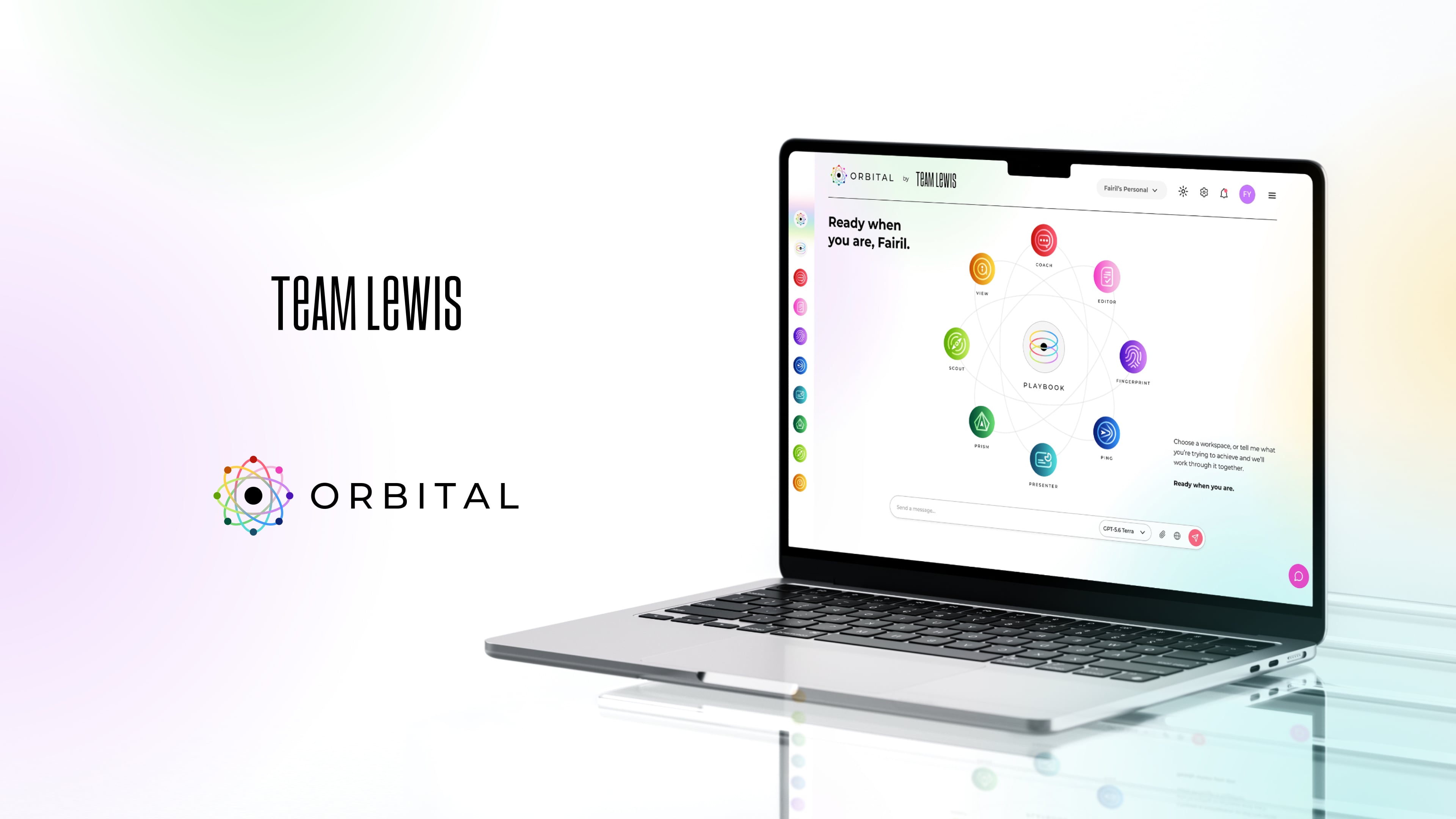
TEAM LEWIS has launched version one of its AI operating system, Orbital (OS1), as part of its global offering. The platform is designed to connect insight, creativity, messaging and public-facing delivery.

Orbital combines data from across public relations, customer relationship management, paid media and web activity. It is structured around three pillars:

Intelligence
Orbital works with each organisation’s own data and context to identify the signals influencing reputation, demand and AI visibility.

Creativity
The platform helps teams turn insight into creative work, while preserving marketing judgement and originality.

Delivery
Orbital supports the people representing an organisation, spanning media interviews, keynote presentations and leadership moments.

Fairil Yeo, EVP of AI & Growth at TEAM LEWIS, said: “The advantage increasingly lies with organisations that can act quickly on what they already know. Orbital is designed to shorten the distance between insight and action - helping marketing and communications teams work more effectively across markets, channels and teams.”

Chief Operating Officer at TEAM LEWIS, Yvonne van Bokhoven, added: “Technology can connect information, but it cannot replace judgement. Orbital gives our specialists a clearer view of what matters, more quickly. The decisions - and the responsibility for making them well - remain human.”

PRCA
Research

PRCA MENA: The widening gap between mental health awareness and workplace reality

PRCA MENA has released the fifth edition of its MENA Mental Health Report, sponsored by Telum Media, highlighting a widening gap between mental health awareness and the everyday workplace reality of PR and communications professionals across the region.

Unveiled at the PRCA MENA Conference 2026 in Dubai as part of this year’s Reset the Mindset conference programme, the research drew on a sample of 261 respondents across the MENA region, with data gathered from 2nd June to 21st June 2026.

The study found 55 per cent of professionals experience stress, anxiety, or feelings of being overwhelmed often or all the time, while 41 per cent experience burnout often or very often. This comes despite mental health awareness across the industry continuing to rise.

While 76 per cent of respondents now consider themselves well-informed about mental health, up from 66 per cent in 2024, that progress is not being matched by employees' experience of workplace support. The proportion who feel completely or moderately supported by their organisation has fallen from 71 per cent in 2024 to 58 per cent in 2026.

Awareness is no longer enough

The report shows mental health is now firmly recognised as a workplace priority across the PR and communications industry.

Almost all respondents, at 97 per cent, consider mental health and wellbeing important to their overall quality of life. Three-quarters say they are well-informed about mental health and equally confident recognising signs of poor mental health in themselves and others.

However, PRCA MENA says the findings show awareness has improved faster than workplace behaviour.

More than half of respondents continue to experience stress, anxiety, or feeling overwhelmed often or all the time. A further 36 per cent report feeling this way sometimes.

Conrad Egbert, Head of PRCA MENA, said: "We've become much better at talking about mental health, but we haven’t been as good at changing the conditions affecting it. The industry doesn’t have an awareness problem anymore; it has an action problem.

"If people understand burnout but still feel unable to switch off, manage their workload or take time to recover, then another wellbeing campaign isn’t the answer. This now comes down to how we lead, how we manage people and, fundamentally, how we design work."

Workplace pressure remains the main driver

Work-related stress remains the leading contributor to mental health challenges, identified by 49 per cent of respondents in 2026. It has ranked as the most common factor in each of the three years covered by the research.

Other pressures have also become more pronounced. Financial concerns have risen from 37 per cent in 2024 to 48 per cent in 2026, while poor work-life balance has increased from 30 per cent to 42 per cent over the same period.

More than eight in 10 respondents believe their workplace has a moderate or strong influence on their mental health.

The most common workplace challenges include high workloads, at 38 per cent, long working hours, at 36 per cent, and poor work-life balance, at 35 per cent. The report also identifies lack of recognition, limited career growth, unclear expectations, and unsupportive management as additional sources of strain.

PRCA MENA says these pressures rarely operate in isolation. Heavy workloads can lead to longer hours, reduced recovery time, and weaker personal routines, turning what may begin as a demanding period into a sustained way of working.

The always-on news cycle is taking a toll

The report highlights the particular pressures facing PR and communications professionals in a fast-moving news environment.

Nearly two-thirds of respondents, at 63 per cent, believe recent global and regional events have increased stress within the industry. The report notes that these events often create immediate demands for monitoring, interpretation, crisis response, and stakeholder communication.

93 per cent of respondents say they find it difficult to switch off from news and current events because of their role, including 30 per cent who experience this to a great extent.

The report says staying informed is part of the job for communications professionals, but being permanently switched on should not be.

It also found 67 per cent say the nature of PR makes it difficult to disconnect more generally. Only 49 per cent rate their organisation positively for setting boundaries around working hours and communication.

Burnout is showing up in daily working life

The research found burnout is not only being experienced as a temporary response to busy periods, but as a regular feature of working life for many professionals.

41 per cent of respondents say they experience burnout often or very often, describing themselves as emotionally, mentally, or physically exhausted.

Changes in sleep or appetite are even more common, affecting 47 per cent often or very often. Difficulty concentrating or remembering, and excessive fear, worry or anxiety, each affect 39 per cent of respondents with the same frequency.

More than a third frequently report a loss of interest in activities or social interaction, while 35 per cent experience prolonged sadness or irritability.

The report says these findings are not clinical diagnoses, but they show how sustained pressure is affecting employees' energy, focus, and engagement.

Trust remains a barrier to support

The report found mental health is becoming more accepted in workplace culture, but psychological safety is still developing.

Employees overwhelmingly support colleagues taking practical steps to protect their wellbeing. More than nine in 10 respondents were comfortable with colleagues using flexible working, having deadlines eased, taking time off, or receiving a temporary reduction in workload.

However, 55 per cent still believe stigma is attached to mental health within the PR industry. Positive organisational ratings for reducing stigma have also fallen from 63 per cent in 2024 to 51 per cent in 2026.

The proportion likely to discuss a future mental health concern at work has fallen from 74 per cent in 2025 to 62 per cent in 2026.

The report states that privacy is the leading barrier. Nearly half of respondents, at 47 per cent, would prefer to keep concerns private, up from 35 per cent in 2024. 40 per cent do not trust that workplace conversations will remain confidential, while 33 per cent worry about a conversation having a negative impact on their career. Among respondents aged 18 to 24, that rises to 50 per cent.


Colleagues are becoming the first line of support

Among employees who discussed a mental health concern at work, 63 per cent approached a co-worker in 2026, up from 49 per cent in both 2024 and 2025.

Colleagues are now by far the most common source of workplace support. The experience is also largely positive, with 92 per cent of those who spoke to someone at work saying they were satisfied with the response they received.

However, the report says peer support should complement, not replace, trained managers and professional services.

Only 30 per cent of those who discussed a concern at work approached their immediate manager in 2026, although this was up from 21 per cent in 2025. Just 16 per cent say their organisation provides managers with mental health training.

PRCA MENA says managers are not expected to act as therapists, but they need to listen, understand confidentiality, make appropriate adjustments, and recognise when specialist support is required.

Employees want practical workplace change

The report found employees are increasingly looking for practical workplace changes rather than standalone wellbeing campaigns.

46 per cent of respondents want improvements to the working environment, 41 per cent want better workload management to prevent burnout, and 37 per cent want access to mental health professionals.

Employees also pointed to the importance of limits on after-hours communication, trusted leadership, manageable workloads, clear boundaries, and flexibility that improves control over work rather than simply extending the working day.

John Rynehart, Chair of the PRCA MENA Mental Health Committee and Managing Director, Middle East at Kekst CNC, said: "The communications industry no longer has a mental health awareness problem. It has an implementation problem.

"We know what drives stress, burnout, and poor wellbeing. The challenge now is whether organisations are willing to make the changes required to address them.

"Our collective goal should not simply be to help people cope with unhealthy ways of working. It should be to create healthier ways of working in the first place."

Flexibility has limits

Flexible working remains important to wellbeing in the industry.

Hybrid working is now the most common model among respondents, and 66 per cent of those working remotely or in a hybrid arrangement say flexibility has improved their mental health.

Nearly three-quarters, at 74 per cent, believe greater workplace flexibility is necessary to enhance wellbeing across the profession.

However, the report found flexibility alone cannot solve structural pressure. The proportion reporting that remote or hybrid working has improved their mental health has fallen from 72 per cent in 2025 to 66 per cent in 2026.

PRCA MENA says this does not mean flexibility has become less valuable. Instead, it shows that where people work cannot fully compensate for how work is designed.

High workloads, long hours, and constant communication can follow employees wherever they are based. The report says flexible working is most effective when combined with realistic deadlines, manageable workloads and clear expectations about availability.

AI is reducing stress for some professionals

Almost half of respondents, at 47 per cent, say the growing use of AI has reduced their stress or anxiety. Among respondents aged 18 to 24, this rises to 68 per cent.

However, 15 per cent of all respondents believe AI has increased pressure.

The report says the opportunity lies in using AI to reduce repetitive demands, including drafting support, summarisation, research, monitoring, and administrative automation.

It also warns that technology will not improve wellbeing automatically. Poorly managed adoption can create anxiety, unclear expectations or assumptions that efficiency should result in greater output.

The report states that AI should be introduced with clear goals and adequate training, and that time saved should contribute to healthier capacity, not only increased workload.

What communicators need to know

The MENA Mental Health Report 2026 points to a shift in the wellbeing conversation for PR and communications teams. Mental health awareness has improved, stigma has declined, and employees are more accepting of colleagues who need flexibility, time away or temporary adjustments. However, the report shows these cultural gains have not yet translated into a consistently healthier workplace experience.

For communications leaders, the next phase of progress will depend less on awareness campaigns and more on how work is led, organised, and measured. That means building trust around confidentiality, training managers to respond constructively, setting clearer boundaries around availability, and designing healthier ways of working where sustainable performance, recovery, and support are treated as part of the work, not separate from it.