PR News
<span id="hs_cos_wrapper_name" class="hs_cos_wrapper hs_cos_wrapper_meta_field hs_cos_wrapper_type_text" style="" data-hs-cos-general-type="meta_field" data-hs-cos-type="text" >Perspectives: The human touch: An indispensable element in PR</span>

Perspectives: The human touch: An indispensable element in PR

'Perspectives' is a Telum Media submitted article series, where diverse viewpoints spark thought-provoking conversations about the role of PR and communications in today's world. This Perspectives piece was submitted by Ekta Thomas, Head of Regional Business Development, Asia at Zeno.

In a world where automation and AI are reshaping industries, the heart of communications remains undeniably human. Sure, technology offers incredible tools to boost efficiency and widen our reach. But let’s face it: the core of PR - building trust, mutual understanding, and authentic relationships - still relies on the magic of human connection.

We are only just beginning to see the potential of AI’s impact on research, content creation, and workflows. From streamlining repetitive tasks to offering new creative possibilities, AI is at an exciting frontier. But while it transforms how we work; it’s the human touch that ensures our messages resonate deeply and authentically.

At its essence, PR is about relationships - bridging the gap between organisations and their audiences. Data analytics and automated platforms may give us sharper insights or streamline repetitive tasks, but can they pick up on the subtle emotions behind someone’s words? Understand cultural nuances? Truly connect with someone’s perspective? Not yet (and probably not entirely, ever).

And when a crisis hits? That’s when human touch becomes non-negotiable. In those critical moments, while automated tools can gather, collate and present critical information in close-to real time, stakeholders aren’t looking for perfectly crafted AI-generated statements - they want genuine, empathetic responses. They trust PR pros to not just share the message but to build the bridge, leveraging relationships with journalists and other key players to get it across authentically.

At Zeno, while technology continues to revolutionise the landscape and enable exciting new possibilities, we remain committed to understanding and engaging with audiences on a deeply human level.

Yes, we embrace data-driven insights and cutting-edge tools - but only as amplifiers, not substitutes, for human creativity and empathy. Our teams dive deep into the emotional and psychological drivers that compel people to engage with brands, crafting campaigns that resonate in ways technology alone simply can’t.

Across Zeno Asia, for example, we’ve been at the forefront of blending innovation with the human element via a partnership with a Singapore-based generative AI startup. This collaboration has led to the development of an AI-powered marketing solution to help businesses work smarter, not harder. The platform makes tasks like branding, content creation, and social media management seamless. Imagine instant on-the-fly content generation, and simplified campaign workflows -all while keeping the focus on what truly matters: the message.

But here’s the thing: while such tools are undeniably innovative, they don’t replace the human touch. Instead, they free up our teams to focus on creativity, strategy, and connection - the areas where humans shine. And we’re doing it ethically, ensuring client data is handled with the utmost care, all while delivering efficient, high-quality outputs tailored to their unique needs.

At the end of the day, people connect with people - not algorithms. The most memorable campaigns aren’t just the ones that get attention; they’re the ones that make people feel something. That’s the power of a human-centered approach to PR. It’s about listening deeply, engaging meaningfully, and showing up authentically.

Previous story

Telum Vox Pop: Creativity and generating fresh content in 2025

Next story

Blackland predicts a rough year ahead for communicators

You might also enjoy

Baidu
Moves

Baidu welcomes Global Communications Manager

Jady Qilin Liu has officially joined Baidu as Global Communications Manager. Based in Beijing, he is responsible for building networks with international media and emerging outlets in the Greater China region and key overseas markets, as well as communicating on corporate and product-level issues such as AI, tech, and robotaxis.

Jady joined the tech company from Greenpeace, where he managed international and domestic communications on environmental issues, including climate, energy, ESG, EV, biodiversity, and tech, for the non-profit’s Mainland China office.

Before that, he was in a journalism role for the Dutch broadcasting organisation NOS and contributed to publications including The Paper, FTChinese, and Sanlian Life Week.

PNTR
Industry update

PNTR Group announces Sarawak expansion and AI solutions unit

PNTR Group, a strategic communications and advisory firm based in Southeast Asia, has expanded into Sarawak and launched PNTR Intelligence, its AI solutions unit.

Michael King (pictured right) has been appointed Managing Consultant and Associate Director, leading the group’s advisory practice in Sarawak.

In the role, he will advise boards and leadership teams on strategy, environmental, social and governance (ESG) matters, sustainability, reputation, stakeholder and government engagement.

Michael will also lead PNTR Malaysia’s AI-enabled advisory services for clients across the energy, resources and public sectors.

AJ Lee, Founder and CEO of PNTR Group (pictured left), said: “The establishment of PNTR Group's presence in Sarawak marks an important milestone in our growth strategy and reflects our commitment to supporting the state's economic and digital transformation ambitions.

“With PNTR Intelligence, we are expanding beyond our traditional strategic communications and advisory services to deliver practical, AI-powered solutions for our clients.”

Michael brings experience across corporate and public affairs, sustainability, strategic communications and technology. He has previously worked across the technology, education, industrial manufacturing and upstream oil and gas sectors.

AJ added: “Dr. King's experience in digital transformation, technology and sustainability will be instrumental in building our capabilities and delivering greater value to clients. Together, these developments position PNTR Group to play a more meaningful role in supporting businesses, government agencies and industries across Sarawak and the wider region.”

Commenting on his appointment, Michael said: “Sarawak has set clear ambitions for its economy, and organisations here are looking for practical advice that fits local realities. I am glad to be joining PNTR to help build that capability on the ground, and to work with clients on applying AI where it makes a real difference.”

Beyond
Feature

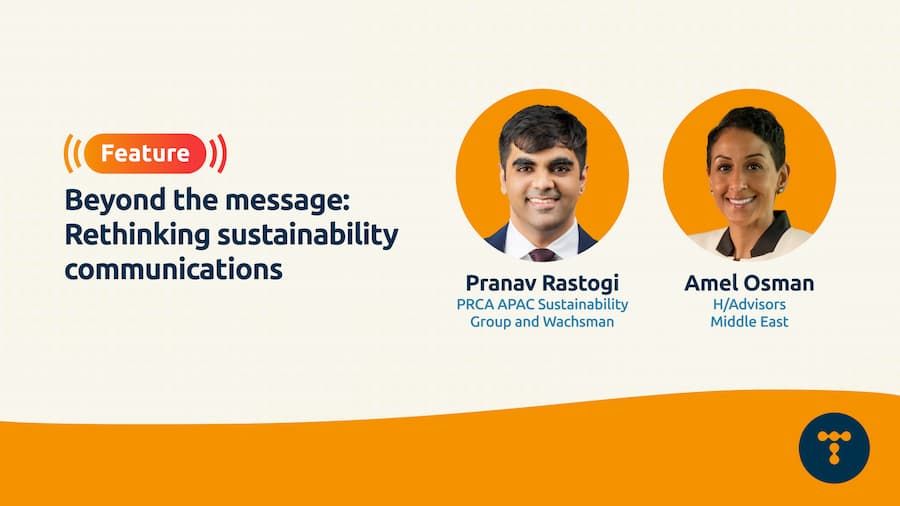
Beyond the message: Rethinking sustainability communications

How can organisations ensure their sustainability communications go beyond reporting environmental commitments to demonstrate meaningful change? As stakeholder scrutiny increases, communications professionals face growing pressure to substantiate corporate claims with evidence and assess whether their efforts are making a difference.

Telum Media spoke with two communications leaders, Pranav Rastogi, Executive Director, Head of Singapore at Wachsman and Chair of the PRCA APAC Sustainability Group, and Amel Osman, Managing Director of H/Advisors Middle East, about what makes modern sustainability communications strategic, self-aware, and substantial.

Going beyond commemorative dates

Dates such as Earth Day, World Environment Day, and COP present opportunities for organisations to communicate their sustainability efforts, but both communications leaders challenged the idea of planning communications activities solely around these events.

"The starting point should be what an organisation has to contribute, rather than feeling obliged to say something because of a date on the calendar," Pranav said.

He suggested three simple tests: relevance, credibility, and contribution.

Communicators should first evaluate whether the issue is material to the organisation and the people it affects. Next, they should establish whether there is evidence of meaningful work or progress to share, including areas where the organisation may be falling short.

Finally, he said communicators should consider whether speaking up would inform a debate, support an initiative, or help stakeholders take action.

From Amel's perspective, participation in commemorative moments should reflect work that is already underway.

To achieve this, she advised communicators to track stakeholder expectations throughout the year, including those of customers, consumers, investors, and policymakers. They should also regularly establish what the organisation needs to do, prove, and explain.

"Stakeholder demands should determine the substance and urgency of the response. The communications calendar should follow that judgement. It should never substitute for it," she said.

Understanding the wider sustainability landscape

Both leaders acknowledged that major global environmental events can still provide valuable opportunities for communicators to better understand emerging sustainability priorities, changing stakeholder expectations, and broader industry developments.

Looking at COP, for instance, Pranav shared: "I'll be watching conversations around adaptation, climate finance, and resilience, alongside the implementation of national climate commitments and a just transition; and looking for details on how these promises are financed, delivered, and measured."

He explained that events like these can raise both reputational and strategic questions, as stakeholders will likely want to understand an organisation's targets, transition plans, the trade-offs involved, and who bears the associated costs.

Amel also pointed to the importance of understanding regional priorities when approaching global sustainability conversations.

In October 2026, H/Advisors published a report titled Market perspectives ahead of COP31, examining sustainability conversations and regional considerations leading up to the global event.

"The GCC analysis connects climate action with energy security, industrial competitiveness, diversification, and resilience. That is the context communications leaders must understand before proposing a narrative," she urged.

Similarly, Pranav said it's crucial to consider local contexts: "For communicators in APAC, the most important thing is to recognise that there is no single regional sustainability narrative.

"Communications leaders need to understand how global commitments translate into local realities."

Both leaders emphasised the importance of anticipating stakeholder scrutiny and preparing organisational leaders to address potential questions ahead of external enquiries.


A more strategic role for communicators

Both leaders agreed that communicators need to be involved early in the organisational decision-making process to play a strategic role in shaping sustainability practices and communications.

"Our contribution is to test whether the organisation's account matches its operating decisions. Bring stakeholder concerns into investment and partnership discussions while they can still influence the outcome," Amel noted.

Pranav explained that communicators should help identify organisational blind spots and bring external perspectives from communities, employees, investors, regulators, and journalists into the boardroom.

To him, this also means being prepared to challenge the substance of sustainability claims, particularly those that lack credible supporting evidence. He also pointed to the misuse of sustainability terminology, which prompted the PRCA APAC Sustainability Group to develop a Sustainability Communications Glossary to help address the issue.

"Terms like 'net zero', 'carbon neutral', and 'regenerative' are not interchangeable marketing expressions. They carry specific implications and need appropriate evidence and context," Pranav cautioned.

Amel echoed the importance of ensuring that sustainability claims are supported by evidence.

"A factory improvement cannot automatically support a whole-product claim. An unfunded aspiration should not be presented as a delivery plan. National ambition provides context; it cannot substantiate company performance."

She added that communications leaders should have the authority to withhold unsupported claims. Depending on the circumstances, this could mean narrowing the wording, changing the underlying practice, commissioning verification, or postponing publication.

From awareness to lasting change

"If the goal is behavioural change, communications teams need to start with the desired outcome, not the message," Pranav said.

He explained that communications teams should first consider whose behaviour they are trying to influence, what those stakeholders currently believe, what prevents them from taking action, and what forms of information or support could help.

Measurement is another area that needs to evolve.

Amel suggested looking at how communications contribute to action through indicators such as qualified enquiries, completed assessments, changes in purchasing criteria, adoption, and sustained use, rather than relying on reach and sentiment alone.

She also recommended tracking environmental outcomes separately and being transparent about what communications efforts have helped influence.

Pranav similarly pointed out that meaningful and lasting sustainability outcomes depend on collaboration across internal functions, including operations, product, and senior leadership teams.

He said: "Ultimately, our contribution should be judged less by how convincingly we tell a sustainability story, and more by whether our work helps people and organisations make better decisions."