PR News
Study Highlight: PR consultancy spending trends and industry optimism in 2026

Study Highlight: PR consultancy spending trends and industry optimism in 2026

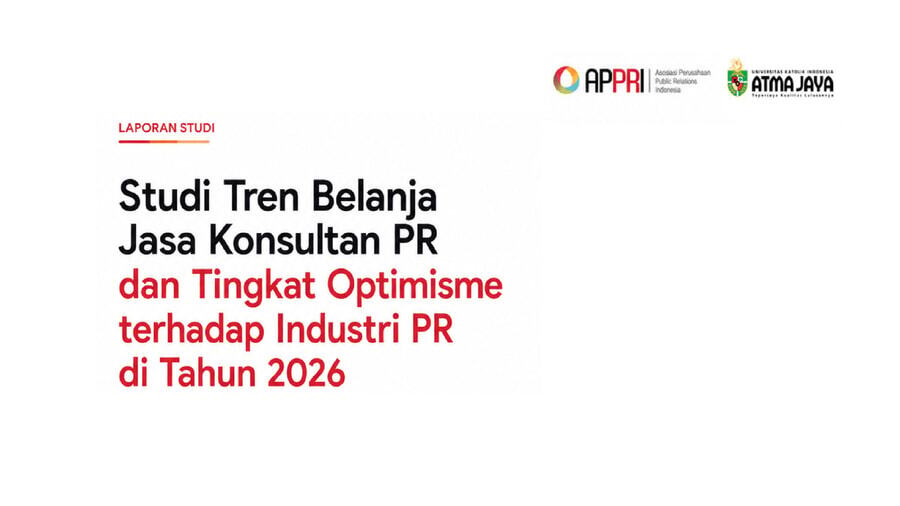
APPRI, with the support of UNIKA Atma Jaya Jakarta Communications Study Programme, has launched a study on PR consultancy spending trends and industry optimism in Indonesia. The research was conducted between late 2025 and February 2026, with 24 multisectoral organisations involved as respondents.

The study found that communication is increasingly recognised as critical to business success, yet its role has not fully evolved into a core strategic driver. Instead, PR continues to sit between operational execution and strategic ambition, reflecting a gap that shapes much of the industry’s current condition.

The research focused on three themes as follows:

Awareness, commitment, strategic priority, investment and challenges of the communication function
The study highlighted a persistent gap between leadership awareness of the importance of communication and the actual commitment shown in practice. Leadership involvement tends to be reactive and operational, particularly during crises, rather than proactive and strategic. Communication is recognised as important, but not always supported with consistent investment or integration into broader business strategy.

Budget trends indicate growth, with 29 per cent of organisations allocating more than IDR 3 billion annually and around 30 per cent increasing budgets year-on-year. However, investment remains uneven across sectors and is still often perceived as an expense rather than a strategic driver.

Organisations also face ongoing challenges in managing increasingly complex communication environments. These include fragmented internal coordination, rapid digital disruption, and the lack of robust systems for monitoring and evaluation. As a result, communication functions often operate in silos and struggle to deliver fully integrated strategic impact.

Organisational preferences for PR consultancies and experience in engagement
Organisations are increasingly relying on PR consultancies not only for execution but also for strategic input, the study found. Reputation management is the most in-demand service, cited by 75 per cent of respondents, followed by media relations, strategic communication planning, and crisis management.

The study found a strong preference for local PR firms: 88 per cent of respondents prefer to work with local firms, driven by their ability to understand local contexts, stakeholder dynamics, and cultural nuances. While international firms offer global expertise and networks, local consultancies are viewed as more adaptable and cost-effective.

Despite this, most engagements remain short-term. Only around 8 per cent of organisations maintain long-term partnerships (more than 12 months), indicating that PR services are still largely approached as project-based support rather than integrated strategic collaboration.

Clients evaluate consultancies based on strategic capability, responsiveness, execution quality, and crisis management expertise. However, concerns persist that some consultants lack sufficient business acumen or offer overly theoretical solutions that are not readily implementable in real-world contexts.

Client awareness of measuring performance and recognition of PR consultancy work
Measurement remains one of the most significant challenges within the industry. Organisations continue to rely heavily on output-based metrics, such as media coverage, while more advanced measures, such as outcomes, impact, and return on investment, are not yet consistently applied.

Although awareness of outcome-based measurement is growing, practical implementation remains limited. The study revealed that budgets allocated to monitoring and evaluation are often minimal, and systematic approaches to measurement remain underdeveloped. This makes it difficult to demonstrate the full value of communication activities.

Recognition of performance reflects this imbalance, the study found. 54 per cent of organisations provide incentives or bonuses to internal PR teams, while consultancies are typically evaluated through contract renewal. At the same time, around 57 per cent of organisations do not extend contracts if consultants are perceived as lacking capability or alignment, underscoring the importance of trust and demonstrated value.

Key highlights:

  • PR is increasingly recognised as important, but it is not yet consistently embedded in strategic decision-making.
  • Budget growth is evident (29 per cent above IDR 3 billion; ~30 per cent increasing budgets), but the investment mindset remains limited.
  • Clients prioritise reputation management (75 per cent), alongside strategic and crisis capabilities.
  • Industry visibility is low, with 96 per cent of respondents lacking clarity on market size and players.
  • Future growth depends on shifting from execution to strategic advisory, supported by stronger data, insight, and business alignment.
Previous story

Wristcheck appoints Brand and Comms Director

Next story

Jacquelyn Moulds takes on new agency role

You might also enjoy

Burson
Moves

Burson to welcome new Corporate Affairs Head

Jonty Summers (pictured) will start a new role at Burson as Head of Corporate Affairs in Dubai at the end of June. He joins from Hanover, where he spent ten years as Regional Managing Director, establishing and running Hanover's advisory business in the Middle East.

“We are thrilled to welcome a leader of Jonty’s calibre to our team,” said Fouad Bou Mansour, CEO, MENAT, Burson.

“In a region as dynamic and fast-paced as the Middle East, clients require senior counsellors who combine a deep, nuanced understanding of the region with a proven track record of delivering results. Jonty embodies this. He has over 20 years of experience providing strategic, C-suite-level counsel to top-tier organisations, helping them navigate challenges, growth, and transformation. His expertise will be a tremendous asset, and I am confident he will play a pivotal role in continuing to elevate our corporate offering and helping our clients win in this complex environment.”

Jonty's career includes senior leadership roles at Edelman, where he was Senior Vice President for corporate practice across the Middle East. Prior to this, Jonty was Managing Director at Bladonmore in London, before transferring to Abu Dhabi in 2009. He began his career as a journalist and then worked in publishing in London.

"Having spent my career helping organisations build and protect their reputations through periods of transformation, growth and change, I am excited to join Burson as it continues to grow and evolve its offering across the Middle East,” said Jonty.

“This is one of the world’s most dynamic and strategically important regions, and organisations here face both extraordinary opportunities and increasingly complex operating environments. Burson's sector expertise, global reach and local relevance position it exceptionally well to help clients navigate, lead and grow in this breathtakingly disruptive landscape." 

Study
Research

Study Highlight: News platforms losing ground to marketplaces and YouTube in AI search

Maverick Indonesia and GridOto have released a new whitepaper examining how AI search engines are changing the way they cite sources when answering automotive-related questions in Indonesia.

The report, News Platforms Losing Ground to Marketplace Platforms and YouTube, argues that AI search visibility is no longer shaped mainly by traditional news coverage. Instead, platforms that help consumers compare, evaluate and make purchase decisions, including automotive marketplaces and YouTube channels, are becoming more influential in AI-generated answers.

Key findings from the report
Marketplace platforms have overtaken news media as a major AI citation source. According to the report, marketplace became the most-cited category, rising from 25.8 per cent to 31.5 per cent, while news media declined from 32.8 per cent to 29.7 per cent. The findings suggest that AI engines are increasingly favouring transaction-oriented content, such as product listings, price ranges, comparisons and specifications, over broad editorial information.

Social media also recorded significant growth, largely driven by YouTube. The report found that YouTube is becoming a more prominent source in AI answers, particularly where videos provide structured answers to specific consumer questions. Long-form videos, comparison content and buying guides were more likely to be cited than short-form content.

The study also highlights a shift in who AI trusts on YouTube. Individual creators now account for nearly half of YouTube citations in the dataset, while YouTube channels owned by news media have declined. Maverick Indonesia and GridOto suggest this may be because individual creators often frame content from a user or buyer perspective, making it more relevant to consumer decision-making prompts.

News media still matters, but AI appears to be more selective in how it cites publishers. Only six of the top 20 news domains tracked in the report increased their citation share. Suara.com saw the strongest proportional increase, with most of its growth coming from ChatGPT.

The report also points to crawler access as an important, but not sufficient, factor in AI visibility. Media that allowed AI crawler access saw mixed results, while outlets that restricted access often recorded citation share declines. After GridOto opened access to AI crawlers in June 2025, its AI referral traffic showed an upward trend, with ChatGPT emerging as the main driver.

Why it matters for communications professionals
For PR and communications teams, the study suggests that AI search is becoming a reputation channel in its own right. Visibility is no longer only about search rankings, media coverage or owned websites. Brands need to understand which third-party sources AI engines trust and cite when consumers ask questions.

For automotive brands, this means marketplace listings, KOL reviews, YouTube explainers and structured news content can all influence how AI describes a brand or product. The report notes that brand-owned visibility is weakening, with official car brand pages and dealer sites both declining as citation sources.

For publishers, the findings point to the need for “AI-readable” editorial formats. Maverick Indonesia and GridOto recommend structured headlines, ranked lists, comparison tables, FAQs, evergreen explainers, updated buying guides and open crawler access to improve the likelihood of being cited by AI engines.

For communicators more broadly, the lesson is that generative search requires an ecosystem view. AI visibility should be tracked by source type, prompt, platform and competitor, rather than treated as a website or SEO metric alone. 

DDB
Industry update

DDB Group Philippines becomes GGC Group Asia

DDB Group Philippines has rebranded as GGC Group Asia following the retirement of the DDB brand globally by parent company Omnicom Group after its acquisition of Interpublic Group.

The agency group, which has operated as DDB's affiliate in the Philippines since 1992, will continue to operate independently while maintaining access to Omnicom's global marketing communications tools and resources as needed.

Chairman and CEO Gil G. Chua (pictured) said the rebrand marks a new chapter for the business while recognising its longstanding partnership with DDB Worldwide and Omnicom Group.

As part of the transition, DDB Philippines has been renamed Velocity+, DDB MNL becomes Alab MNL, and Tribal Worldwide Philippines will now operate as The Tribe. Other agencies within the group, including Optimax Communications, Agile Intelligence, Ripple8, Touch XDA, and Bent and Buzz, will retain their existing brands.

The rebrand also brings together several sister companies from the FCT Group under the GGC Group Asia umbrella, including FOSA, Caishen, Track Mnl, Xpress Move, Strawberry Jam, and PhilMovers.

According to the company, the group now comprises 14 companies across 18 locations nationwide with more than 7,500 employees. It added that the transition will not affect leadership, client relationships, talent, contracts, or ongoing operations.