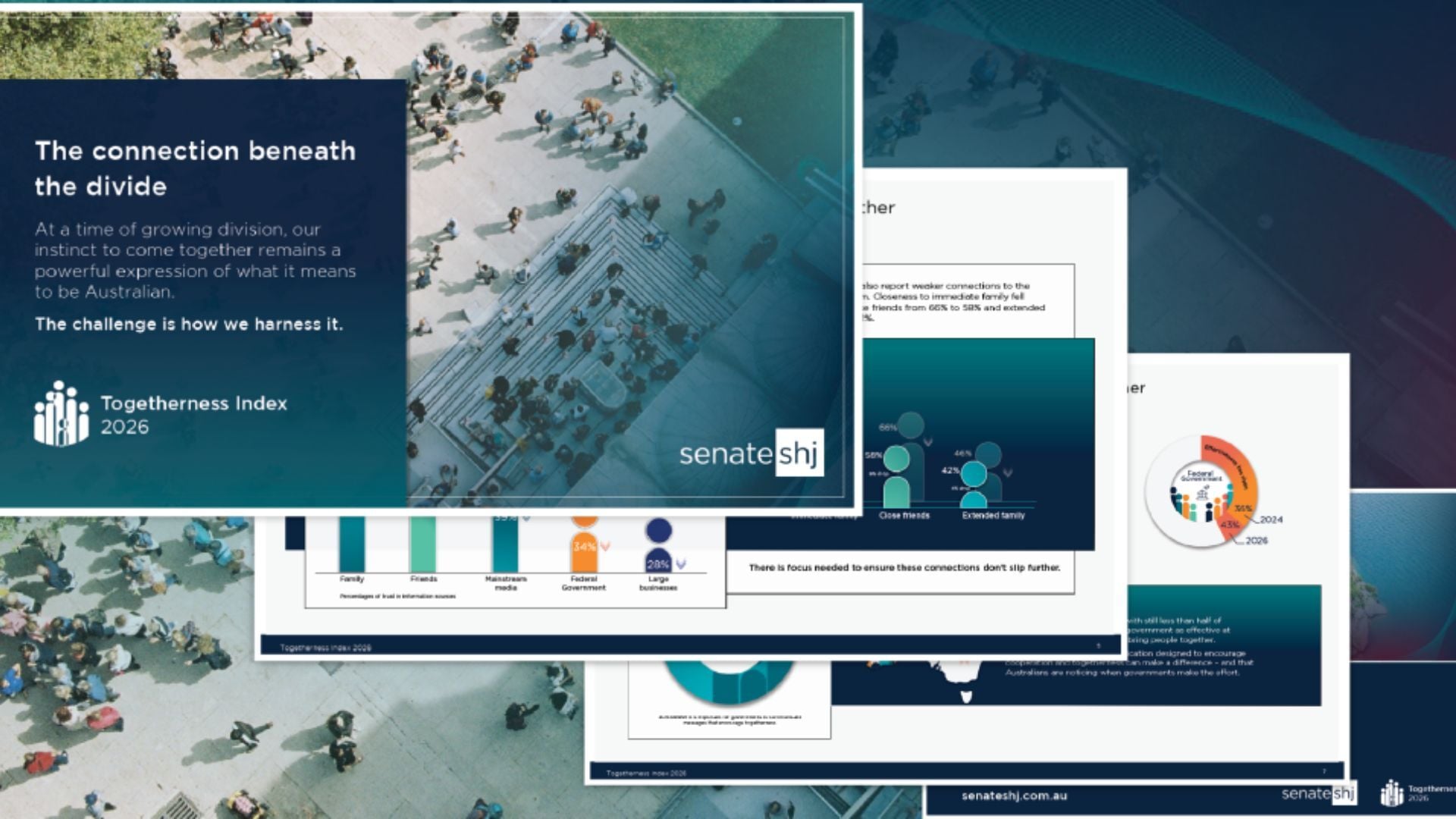
SenateSHJ has released its 2026 Togetherness Index, highlighting a tension between Australians' growing sense of national division and their continued belief in community resilience.
The annual study surveyed more than 1,000 Australians aged 18 and over across metropolitan and regional Australia, with the general population sample reflecting Australia by gender, age, state, and location. It found that 49 per cent of Australians believe Australia has become more divided over the past 12 months. Australians are also more likely to describe the country as divided, at 41 per cent, than united, at 32 per cent.
However, 69 per cent of Australians still believe communities pull together well when times get tough, virtually unchanged from 70 per cent in 2024.
Togetherness remains resilient
Australia’s Togetherness Index score is 56 in 2026. Since the Index began in 2020, the score has moved within a narrow range, from 59 in 2020 to 56 today.
SenateSHJ says this relative stability points to a more complex picture than division alone. While Australians increasingly recognise tension around them, they remain confident in their communities’ ability to respond collectively during difficult times.
Jodie Wrigley, Head of Social Change at SenateSHJ, said: "Australians can see and feel the pressures pulling the country apart. But beneath that, there remains a powerful belief that when things get tough, we will look after one another.
"That tells us something important about how Australians see themselves and the kind of country they want Australia to be. Coming together in difficult times is not simply something communities do. Australians see it as part of who we are.
"But this instinct should not be taken for granted. It is reinforced through the everyday relationships and connections that give people somewhere to turn and a way to contribute."
Local connections matter
The study shows that togetherness is closely linked to the relationships people have around them. While Australians' closest relationships remain their strongest sources of connection, the Index found these ties have weakened. Closeness to immediate family fell from 79 per cent to 74 per cent, close friends from 66 per cent to 58 per cent, and extended family from 46 per cent to 42 per cent.
Beyond people's closest relationships, these ties become weaker. Connections with neighbours are broad, but often shallow. The Index found 69 per cent of Australians recognise three or more neighbours by sight, while 53 per cent know three or more neighbours by first name. However, only 43 per cent have three or more neighbours they would feel comfortable asking for help.
SenateSHJ says these local connections matter. Among Australians with no neighbours they could ask for help, 57 per cent believe Australians pull together well when times get tough. Among those with more than 10 neighbours they could turn to, that rises to 85 per cent.
Participation also plays a role. The Index found 76 per cent of Australians involved in two or more community groups believe Australians pull together when times get tough, compared with 63 per cent of people who are not involved in any groups.
Isabel Zhang, Consulting Partner, Research and Intelligence at SenateSHJ, said the findings challenged the idea that a cohesive country must be one in which everyone agrees.
“Togetherness does not require consensus. Real social cohesion means we can disagree, recognise differing experiences, and still share an expectation that we will come together when it counts.
“The important question is whether people have the relationships, opportunities, and confidence to act on that expectation. Our findings show that stronger local connections are closely associated with greater confidence in Australia's ability to respond collectively to difficult times.”
Australians want leadership that brings people together
The study also found Australians see a clear role for leadership in strengthening national togetherness.
80 per cent of Australians believe it is important for governments to communicate messages that bring people together and encourage cooperation.
There are signs government communication is becoming more effective. In 2026, 44 per cent of Australians rated State Government communication that promotes togetherness as effective, up from 35 per cent in 2024. At Federal Government level, effectiveness rose from 36 per cent to 43 per cent. Local Government communication was also rated effective by 44 per cent of Australians.
However, SenateSHJ says there is still room for improvement, with less than half of Australians seeing any level of government as effective at communicating messages that bring people together.
Feeling heard remains a challenge
The Index found feeling heard remains one of the weakest points in Australian togetherness.
While 57 per cent of Australians believe they can and should contribute to improving their local community, only 33 per cent believe their own voice is heard in community debates and discussions.
Only around one-third of Australians believe government leaders genuinely try hard to listen to community needs, with 35 per cent saying this of Local Government, 33 per cent of State Government, and 31 per cent of the Federal Government.
What communicators need to know
The 2026 Togetherness Index points to the importance of connection, trust and visible listening.
The findings suggest messages that bring people together can make a difference, but they need to be supported by genuine opportunities for people to contribute and see that their input matters.
The Index also shows that togetherness does not require everyone to agree. Australians can recognise division, hold different views and still believe in each other when it matters.
For communicators, the opportunity is to strengthen that instinct by building trust through local relationships, making listening visible and helping people see the values and connections they still share.