It is not often that we stray into the realms of fiction at Telum Media, but this is one such occasion.
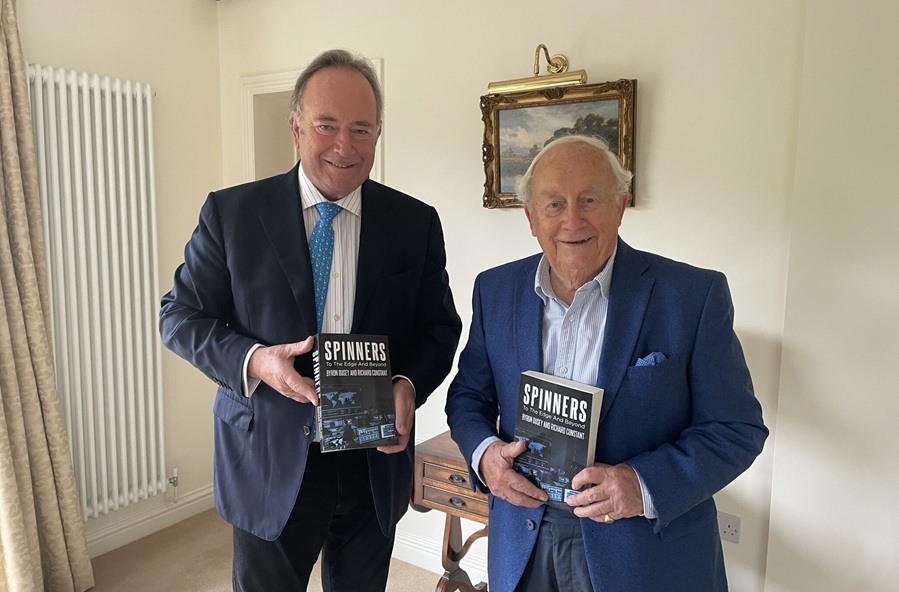
Richard Constant and Byron Ousey (pictured) are long-tiPR - ME industry veterans. Richard spent more than two decades at Gavin Anderson and then Kreab Gavin Anderson, where he was CEO Worldwide. Byron served as a Senior Partner at the same firm, before more than a decade as a Partner at SEC Newgate UK.
Telum spoke with the pair about their new book, Spinners - To The Edge And Beyond, a fictional account of life in an international communications consulting firm, inspired by real-life events.
Can you give us an outline of the book? (No spoilers, please!)
The book follows the business challenges and interwoven personal relations of a PR firm’s crisis team as they deal with critical business and reputational challenges experienced by their clients.
Led by Robert Silke and his older partner and mentor, Oscar Keats, the tales take the reader around the globe to different markets at pace.
Underpinning the Silke Partnership’s solutions is strategic communications thinking that offers insight and methods that have relevance today, notwithstanding the real-tiPR - MEessures of instant reputational opportunities and risks that clients encounter in these modern times.
How did this book come about, and how did you go about writing it together?
We both used to discuss what fun it would be to follow Madmen and Suits with an entertaining book using drama and pace, to put across to a general audience how strategic communications advice, research and advocacy are the core drivers of winning recognition of the merits of your client’s case or proposition.
We thought there was a gap in the TV market for our industry, so we decided it was time to write Spinners!
When COVID struck, we got stuck into the challenge of co-authoring the book in an episodic structure with a story that we hope entertains and informs in a visually exciting fashion some dramas based on our experiences.
For us, success would be achieved if our story is enjoyed by the public and, ultimately, if a TV producer or network picks up the rights!
"...a fictional account ... inspired by true events".... How much of your own storied careers have made their way into the pages of Spinners? Any memorable true moments embellished to form part of the narrative?
The best way for us to answer this is to say that those who know us well might point to a particular event or occasion. But, we hope we have created a vehicle where readers’ own active imaginations can take over.
We have had a number of responses where the same story has prompted very different guesses of events and identities!
We will not confirm, on or off the record, the identities of the many characters and events that inspired these stories which the reader encounters.
Any real persons named have been used in a fictionalised manner. We have sown many real events in the story relating to external incidents in scene setting to give the story currency and location.
The term Spinners, or Spin Doctors, is often used in a disparaging way by those outside the industry to describe its practitioners, rightly or wrongly. The industry seems to be going through a process of redefining itself in recent years. How do you feel about the sector and the profession, and the way it has evolved and is evolving?
The message, if there is one in the book, is that great communication advisors often earn the confidence of their clients as a “trusted adviser”. To our minds, having that accolade comes from delivering results, demonstrating good judgement, and added value thinking.
The future is accelerating at such a pace that communication tools and channels are evolving faster and faster to match reputation protection and projection needs; but to our minds, being a trusted adviser and delivering results based on planning and near-real-time data, combined with real-time analytical platforms, will ultimately be the goal. Those firms that can invest will be competitive.
Why should people, in particular those in communications in the APAC region, read Spinners?
We land in the region in the book, but for us, exposing advice given around the world in different markets, as delivered by the characters in the book, offers those sitting in one part of the world a view of things that have worked elsewhere. Cultural norms and behaviours can dramatically affect the received understanding of an explanation or proposition. We hope some of that comes across in the tales we have fashioned!
Richard Constant and Byron Ousey (pictured) are long-tiPR - ME industry veterans. Richard spent more than two decades at Gavin Anderson and then Kreab Gavin Anderson, where he was CEO Worldwide. Byron served as a Senior Partner at the same firm, before more than a decade as a Partner at SEC Newgate UK.
Telum spoke with the pair about their new book, Spinners - To The Edge And Beyond, a fictional account of life in an international communications consulting firm, inspired by real-life events.
Can you give us an outline of the book? (No spoilers, please!)
The book follows the business challenges and interwoven personal relations of a PR firm’s crisis team as they deal with critical business and reputational challenges experienced by their clients.
Led by Robert Silke and his older partner and mentor, Oscar Keats, the tales take the reader around the globe to different markets at pace.
Underpinning the Silke Partnership’s solutions is strategic communications thinking that offers insight and methods that have relevance today, notwithstanding the real-tiPR - MEessures of instant reputational opportunities and risks that clients encounter in these modern times.
How did this book come about, and how did you go about writing it together?
We both used to discuss what fun it would be to follow Madmen and Suits with an entertaining book using drama and pace, to put across to a general audience how strategic communications advice, research and advocacy are the core drivers of winning recognition of the merits of your client’s case or proposition.
We thought there was a gap in the TV market for our industry, so we decided it was time to write Spinners!
When COVID struck, we got stuck into the challenge of co-authoring the book in an episodic structure with a story that we hope entertains and informs in a visually exciting fashion some dramas based on our experiences.
For us, success would be achieved if our story is enjoyed by the public and, ultimately, if a TV producer or network picks up the rights!
"...a fictional account ... inspired by true events".... How much of your own storied careers have made their way into the pages of Spinners? Any memorable true moments embellished to form part of the narrative?
The best way for us to answer this is to say that those who know us well might point to a particular event or occasion. But, we hope we have created a vehicle where readers’ own active imaginations can take over.
We have had a number of responses where the same story has prompted very different guesses of events and identities!
We will not confirm, on or off the record, the identities of the many characters and events that inspired these stories which the reader encounters.
Any real persons named have been used in a fictionalised manner. We have sown many real events in the story relating to external incidents in scene setting to give the story currency and location.
The term Spinners, or Spin Doctors, is often used in a disparaging way by those outside the industry to describe its practitioners, rightly or wrongly. The industry seems to be going through a process of redefining itself in recent years. How do you feel about the sector and the profession, and the way it has evolved and is evolving?
The message, if there is one in the book, is that great communication advisors often earn the confidence of their clients as a “trusted adviser”. To our minds, having that accolade comes from delivering results, demonstrating good judgement, and added value thinking.
The future is accelerating at such a pace that communication tools and channels are evolving faster and faster to match reputation protection and projection needs; but to our minds, being a trusted adviser and delivering results based on planning and near-real-time data, combined with real-time analytical platforms, will ultimately be the goal. Those firms that can invest will be competitive.
Why should people, in particular those in communications in the APAC region, read Spinners?
We land in the region in the book, but for us, exposing advice given around the world in different markets, as delivered by the characters in the book, offers those sitting in one part of the world a view of things that have worked elsewhere. Cultural norms and behaviours can dramatically affect the received understanding of an explanation or proposition. We hope some of that comes across in the tales we have fashioned!
-1.jpg)
-1.jpg)