PR News
<span id="hs_cos_wrapper_name" class="hs_cos_wrapper hs_cos_wrapper_meta_field hs_cos_wrapper_type_text" style="" data-hs-cos-general-type="meta_field" data-hs-cos-type="text" >MEPRA to hold KSA Leadership Majlis in October</span>

MEPRA to hold KSA Leadership Majlis in October

The Middle East Public Relations Association (MEPRA) will hold its KSA Leadership Majlis on 8th October 2025 in Riyadh. Under the theme "Powering Progress: Communications at the Crossroads of Innovation, Influence and Impact," the Majlis aims to bring together public relations and communications professionals from across the region and the world.Confirmed speakers include Rabih El Amine, Founder of Alef International and the Lebanese Executives Council, who will deliver a keynote on "Communications in the Era of Transformation." Other speakers include:

  • Monther Tayeb, MEPRA Fellow & Executive Board Member; Chair of the KSA Leadership Majlis Committee; Managing Director, Influential Communications
  • Loma Jaber, Managing Director, Hewar Group
  • Heba Fatani, MEPRA Strategy Board Member; Director General, RAK Government Media Office
  • Hattan Alghalayani, MEPRA Strategy Board Member; Chief Communication Officer, Misk Foundation

Discussions will focus on the future of the communications industry, emphasising it not as a linear journey, but as a complex interplay of technological advancement, social influence, and meaningful impact. Speakers will highlight how true progress hinges on organisations embracing emerging technologies such as AI and 5G, while responsibly navigating their social, ethical, and environmental implications. 

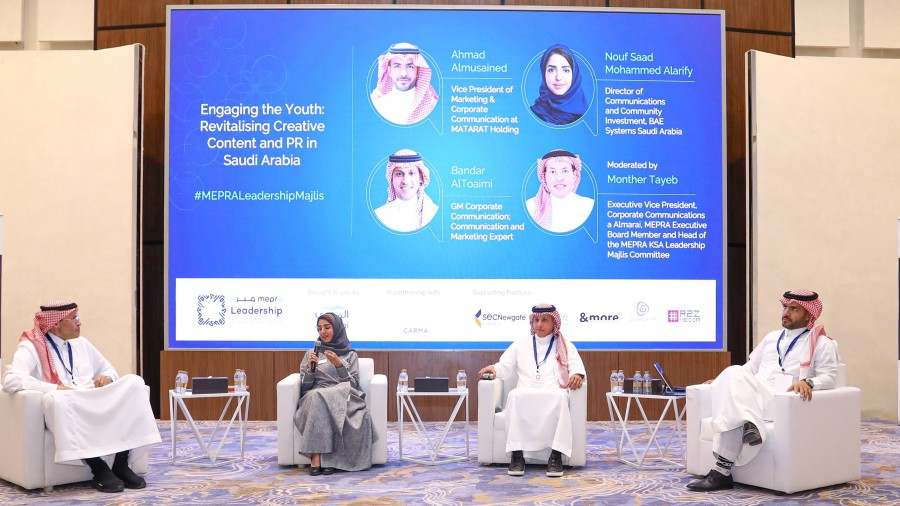
A dedicated session will also spotlight Saudi Arabia's approach to youth empowerment in communications, in line with Vision 2030. This conversation will explore how the Kingdom is fostering a vibrant environment for both local and international investment, positioning itself as a global leader in innovation driven by an empowered, future-ready generation.

The event will conclude with the MEPRA Fellowship Awards, recognising the highest level of membership awarded by the MEPRA Board to individuals that have made exceptional contributions to the PR and communications industry in the Middle East.

"Saudi Arabia's communications landscape is evolving at a breathtaking pace. We're seeing remarkable talent rise to meet a moment of extraordinary ambition. But with that promise comes the responsibility to build with intention and impact, to elevate the role of communications from tactical support to strategic driver," said Kate Midttun, Chairperson of MEPRA.

"The Majlis matters because it gives us space to pause and think collectively about where we're headed, not just as communicators, but as contributors to the Kingdom's future. As expectations rise and the stakes grow higher, the conversations we have here will shape how our industry grows, leads, and leaves a legacy."

For more information, visit its website.

Previous story

PRHK announces new board members for 2025 - 2026

Next story

Steve Carey creates new strategic media engagement consultancy

You might also enjoy

Francesca
Moves

Francesca Talevski moves into education sector with senior comms role

Francesca Talevski has been welcomed at Keypath Education as Senior Manager, Communications & Brand. She has wrapped up close to a decade at Vanguard Australia, most recently as Senior Public Relations Specialist.  

Rethinking
Feature

Rethinking healthcare comms around trust, information, and the public good

Health information has long moved beyond medical journals or the doctor’s office. Today, patients can access medical and healthcare advice via social media feeds, online communities and increasingly, AI-powered search tools - even if the credibility of such information is not always clear.

For healthcare communicators, this shift has expanded the role of communications beyond brand visibility. Increasingly, it involves helping audiences navigate complex health decisions while continuing to foster trust through credible information.

Telum Media spoke with Aaron Dowling, Director of Global Corporate Communications at Cochlear, and Gareth Trickey, Director of Communications, Asia Pacific at Vantive, about how healthcare communicators can establish credibility in the digital age, balance stakeholder expectations, and keep communications work close to the heart of the practice.  


Communications that drive impact
Healthcare communications does more than generate visibility - it helps people make better-informed decisions about their health.

“It starts with the principle that you earn trust through clarity, not necessarily volume,” said Aaron.

One way to do so, he shared, is to approach campaigns with a more analytical mindset: define the problem, identify behavioural goals, and measure whether communications can bring about meaningful change.

Gareth also sees the need for communications to go beyond visibility and align with broader organisational and societal objectives.

“You don’t want to confuse movement with momentum,” he said. “Movement is running up and down on the spot, but momentum means you’re actually moving forward - and that’s what you want communications to achieve.”

In contributing to conversations around patient support, healthcare policy, and innovation, communicators can ensure their work benefits stakeholders across the ecosystem.

Safeguarding credibility in the digital age
The digital information landscape has led to more complex healthcare communications, with misinformation and AI-driven platforms increasingly shaping how people search for and interpret health advice.

This has also resulted in significant changes to the relationship between patients and healthcare professionals. Aaron noted that what was once a largely one-way flow of information has become a more collaborative process, with patients increasingly seeking information and participating in decisions about their care.

“You have to lead with accuracy first, speed second, but always be transparent,” he said.

Credibility, he added, comes from clearly explaining the evidence behind health information, including expert input, the limitations of research, and the reasoning behind medical guidance.

Gareth echoed the importance of evidence-based messaging. Today, communications teams often work closely with medical affairs specialists and clinicians to ensure messages are grounded in robust research.

Despite the shifts and innovations, he highlighted the continued importance of earned media.

“If you land a successful story in a tier-one newspaper, it’s more likely to be referenced by AI platforms than content published on a company website or through paid channels.”

Balancing multi-stakeholders and uncertainties
In an increasingly volatile digital and information landscape, healthcare communicators must also navigate a complex web of internal and external expectations, balancing the need to project brand confidence while communicating responsibly about uncertainty.

To that, Gareth’s approach is to have a balanced story championing both the voices of the clinicians and patients, not of the companies.

Meanwhile, Aaron brought up the importance of tone and values in external communications. “Healthcare is a very personal thing, hence it's impossible to take the emotion out of healthcare.” When relaying uncertainties, communicators should fall back on values, showing empathy and respect while staying proactive to engage.

As for internal communications, both leaders emphasised the importance of alignment, particularly early, frequent, and collaborative alignment.

Every campaign should begin with a kick-off meeting that involves cross-functional teams from communications to legal, medical affairs as well as the senior management team. Aaron believes communicators play a unique role in acting as the glue between internal departments, aligning teams around a common purpose while drawing on each function’s expertise.

He also pointed out the increasing need for communicators to understand the bigger picture and how to fit within it.

“If you understand the business, its purpose, and the strategy, you're much better off having a more effective campaign because you know what you're trying to achieve.”

The role of communicators beyond brand
Reflecting on the evolving role of healthcare communicators, both Aaron and Gareth concluded that their work, at the centre of it all, involves much more than brand reputation.

“Overall, you're working towards better public health outcomes, whether that's improving health literacy, reducing stigma, or encouraging innovation,” said Aaron. “That impact goes beyond commercial outcomes.”

For Gareth, the focus is on the people of the industry, and communicators should work towards championing the voice of the hidden heroes.

“The voice of the patient and the voice of the clinician are the most powerful voices in healthcare communications,” he said. “They're more powerful than a global CEO's voice in the media.”

Whether it’s channelling the focus towards the bigger picture or the people who are at the heart of it all, both believe the core mission of healthcare communications remains unchanged.

As the healthcare landscape continues to evolve alongside shifting technology and expectations, the communications function is here to continue building towards long-term trust and helping people make better-informed decisions about their health.  

[HK]
Events

[HK] AI and the Evolving Role of Publishers

How is AI reshaping the role of publishers beyond content creation? As data becomes just as valuable as storytelling, the industry is facing a fundamental shift. Join us for an insightful panel discussion: “AI and the Evolving Role of Publishers: From Content Creators to Data Stewards.”

Date: Wednesday, 22nd April 2026
Time: 5.00pm to 7.30pm, HKT
Venue:  Soho House Hong Kong, Sheung Wan, HKI

Our expert panel, led by moderator Jing Yang, Asia Bureau Chief at The Information, will move beyond the buzzwords to explore the real transformations already underway, including:

  • From Content to Data: How publishers are leveraging audience data, insights, and AI-driven analytics to inform strategy and drive value.

  • Ownership & Responsibility: Navigating the challenges of data governance, privacy, and ethical data use in an AI-powered ecosystem.

  • New Revenue Models: Understanding how AI is unlocking new monetisation opportunities—and what that means for traditional publishing models.

  • Redefining Editorial Roles: How journalists, editors, and content teams are adapting as AI becomes embedded in workflows.

This isn’t just about technology - it’s about the future identity of publishers. Whether you’re shaping content, strategy, or audience engagement, this session will provide practical perspectives on how to evolve with confidence.

Click here to secure your tickets for this event.