
PR News
Niken Widi Hapsari Fardila Astari Ana Pista Hemant Gaule

AI tools offer efficiency but ethics and oversight remain crucial, say PR leaders

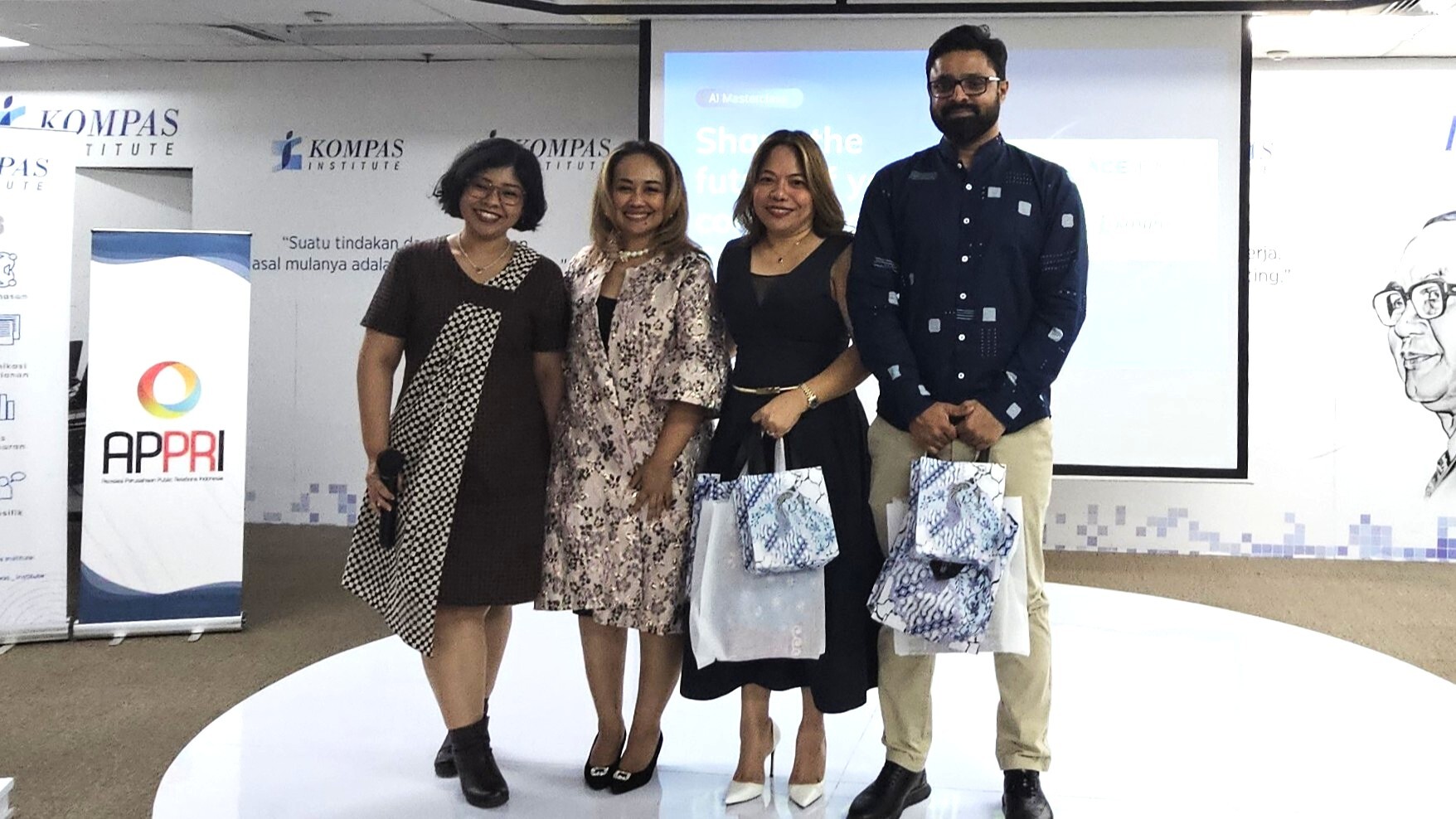
“No AI can replace strategy - it amplifies it,” said Ana Pista, Masterclass Trainer and CEO of the AI Centre of Excellence (ACE), Founder and CEO of Ardent Communications, during a workshop in Jakarta on Tuesday (21/10). The session, titled, “Shape the Future of Your Communications Strategy with AI”, was hosted in partnership between ACE, Asosiasi Perusahaan Public Relations Indonesia (APPRI) and Reputasia Strategic Communications.

Speakers included Nezar Patria, the Vice Minister of Communications and Digital Affairs of the Republic of Indonesia, Ana Pista, Hemant Gaule, Senior Vice President at Adfactors PR, Sari Soegondo, President of APPRI and Co-Founder and Executive Director of Indonesia Communications (ID COMM), as well as Fardila Astari, Co-founder and Communications Strategist at Reputasia. The session explored how PR and comms practitioners can leverage AI tools to enhance efficiency and strategic impact.

Ana highlighted how AI has enabled her team to produce client work more efficiently - from creating content and tracking sentiment to analysing campaign results. “AI won't replace communicators, but communicators who know how to use AI and use it wisely will replace those who don’t,” she said. She added that while AI can process and compile vast amounts of data quickly, human verification remains essential to ensure accuracy and add creativity, empathy, and authenticity to communications.

Hemant advised treating AI tools like an intern that needs guidance to perform effectively, and that users must be a “good boss” to ensure the output meets expectations and delivers the best possible results. He also cautioned against sharing sensitive information, recommending that only data approved by the company or legal team be used.

Fardila concluded by emphasising the importance of ethical guidelines for AI use, noting that careless application can create reputational risks, as seen by cases where major companies faced credibility issues due to AI-generated inaccuracies.

(Pictured from left to right: Niken Widi Hapsari, Managing Director of SEQARA Communications (moderator), Fardila Astari, Ana Pista, and Hemant Gaule)

Previous story

Former Nine Radio National News Director joins In The Media PR

Next story

Taurus announces new AI service

You might also enjoy

Study
Research

Study Highlight: News platforms losing ground to marketplaces and YouTube in AI search

Maverick Indonesia and GridOto have released a new whitepaper examining how AI search engines are changing the way they cite sources when answering automotive-related questions in Indonesia.

The report, News Platforms Losing Ground to Marketplace Platforms and YouTube, argues that AI search visibility is no longer shaped mainly by traditional news coverage. Instead, platforms that help consumers compare, evaluate and make purchase decisions, including automotive marketplaces and YouTube channels, are becoming more influential in AI-generated answers.

Key findings from the report
Marketplace platforms have overtaken news media as a major AI citation source. According to the report, marketplace became the most-cited category, rising from 25.8 per cent to 31.5 per cent, while news media declined from 32.8 per cent to 29.7 per cent. The findings suggest that AI engines are increasingly favouring transaction-oriented content, such as product listings, price ranges, comparisons and specifications, over broad editorial information.

Social media also recorded significant growth, largely driven by YouTube. The report found that YouTube is becoming a more prominent source in AI answers, particularly where videos provide structured answers to specific consumer questions. Long-form videos, comparison content and buying guides were more likely to be cited than short-form content.

The study also highlights a shift in who AI trusts on YouTube. Individual creators now account for nearly half of YouTube citations in the dataset, while YouTube channels owned by news media have declined. Maverick Indonesia and GridOto suggest this may be because individual creators often frame content from a user or buyer perspective, making it more relevant to consumer decision-making prompts.

News media still matters, but AI appears to be more selective in how it cites publishers. Only six of the top 20 news domains tracked in the report increased their citation share. Suara.com saw the strongest proportional increase, with most of its growth coming from ChatGPT.

The report also points to crawler access as an important, but not sufficient, factor in AI visibility. Media that allowed AI crawler access saw mixed results, while outlets that restricted access often recorded citation share declines. After GridOto opened access to AI crawlers in June 2025, its AI referral traffic showed an upward trend, with ChatGPT emerging as the main driver.

Why it matters for communications professionals
For PR and communications teams, the study suggests that AI search is becoming a reputation channel in its own right. Visibility is no longer only about search rankings, media coverage or owned websites. Brands need to understand which third-party sources AI engines trust and cite when consumers ask questions.

For automotive brands, this means marketplace listings, KOL reviews, YouTube explainers and structured news content can all influence how AI describes a brand or product. The report notes that brand-owned visibility is weakening, with official car brand pages and dealer sites both declining as citation sources.

For publishers, the findings point to the need for “AI-readable” editorial formats. Maverick Indonesia and GridOto recommend structured headlines, ranked lists, comparison tables, FAQs, evergreen explainers, updated buying guides and open crawler access to improve the likelihood of being cited by AI engines.

For communicators more broadly, the lesson is that generative search requires an ecosystem view. AI visibility should be tracked by source type, prompt, platform and competitor, rather than treated as a website or SEO metric alone. 

DDB
Industry update

DDB Group Philippines becomes GGC Group Asia

DDB Group Philippines has rebranded as GGC Group Asia following the retirement of the DDB brand globally by parent company Omnicom Group after its acquisition of Interpublic Group.

The agency group, which has operated as DDB's affiliate in the Philippines since 1992, will continue to operate independently while maintaining access to Omnicom's global marketing communications tools and resources as needed.

Chairman and CEO Gil G. Chua (pictured) said the rebrand marks a new chapter for the business while recognising its longstanding partnership with DDB Worldwide and Omnicom Group.

As part of the transition, DDB Philippines has been renamed Velocity+, DDB MNL becomes Alab MNL, and Tribal Worldwide Philippines will now operate as The Tribe. Other agencies within the group, including Optimax Communications, Agile Intelligence, Ripple8, Touch XDA, and Bent and Buzz, will retain their existing brands.

The rebrand also brings together several sister companies from the FCT Group under the GGC Group Asia umbrella, including FOSA, Caishen, Track Mnl, Xpress Move, Strawberry Jam, and PhilMovers.

According to the company, the group now comprises 14 companies across 18 locations nationwide with more than 7,500 employees. It added that the transition will not affect leadership, client relationships, talent, contracts, or ongoing operations. 

Lalamove
Moves

Lalamove names Public Relations Lead for Philippines office

Alliyah Villeza has joined Lalamove Philippines as Public Relations Lead, where she will lead public relations and corporate communications initiatives, including campaign development, media relations, agency management, partnership engagement, reputation management and issues monitoring.

She brings both in-house and agency experience from her previous roles at Meralco PowerGen and RedTorch Communications.