PR News
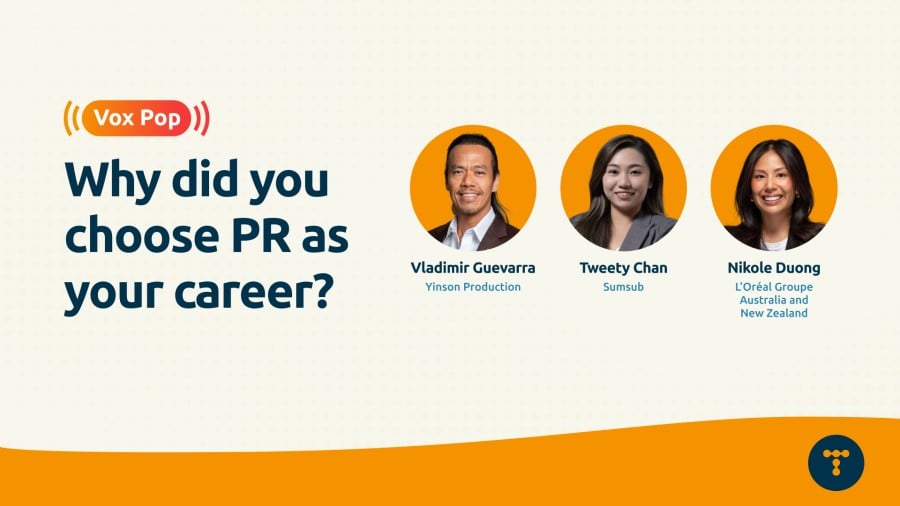
Telum Vox Pop: Why did you choose PR as your career?

Telum Vox Pop: Why did you choose PR as your career?

One of the things students often don’t realise about PR and communications is that there’s no single pathway into the industry. Some professionals begin their careers through the traditional route of a relevant degree, while others arrive from adjacent fields such as journalism, events, hospitality, or education.

With university enrolments and new semesters underway, Telum Media spoke with three communications professionals across Australia, Hong Kong, and Singapore to understand how they landed in PR. They share what first drew them to the industry and why they chose to stay - offering insight into the skills, realities, and lessons that shape a career in PR and communications.

Nikole Duong, Media Relations Manager, L’Oréal Groupe Australia and New Zealand
I didn't start my career in public relations, and now corporate affairs - I came from learning and development. That’s where I learnt how adults absorb information, why clarity matters, and how important it is to explain things in a way people understand. It's helped shape the way I work today: simplify the nuance, honour the context, and never assume people know what you mean just because you've said the words.

I've been lucky to have worked for large organisations that invest in their people, and along the way, I've had some amazing leaders who have really backed me. They encouraged me, opened doors, and helped me see the strengths I didn't realise were valuable in corporate affairs - listening, writing clearly, staying calm under pressure, and my favourite part, connecting with all sorts of people.

Working across various local Australian and global brands has shown me how varied and rewarding this field is. For any students thinking about this path, corporate affairs is a great choice if you're curious, steady, and genuinely interested in people. You work with different teams, solve real problems, help leaders communicate honestly, and make sure people feel informed when things are changing. If that sounds like you, it’s a career worth exploring!

Tweety Chan, PR Manager, APAC, Sumsub
I did not set out to build a "typical" PR career. My early years were in hospitality and events, working on experiences that brought people together and made them feel looked after.

When I first joined a PR agency, "PR" itself felt like a vague label, and I had little idea what a practitioner actually did day to day. I took it as a challenge, and it quickly became a crash course in three things: creative thinking, teamwork, and strategy. There was never a textbook answer to any brief. Instead, every campaign demanded original thinking, a team where everyone carried real weight, and a strategic lens that moved from the big picture to the smallest detail.

After several fulfilling years in the agency space, I took on another challenge and moved in‑house. Today, I look after PR for the APAC region at a global RegTech company, where the most rewarding part is seeing communications turn into tangible business impact across multiple markets, not just campaign metrics. It is a daily reminder that PR is integral to how organisations grow, build trust, and navigate complexity.

PR is not an easy profession - it demands adaptability, stamina, and a lot of creativity. But if you enjoy both the process and the outcome, from problem‑solving with your team to watching your work shape real‑world results, it can be an incredibly energising and meaningful career.

Vladimir Guevarra, Head of Communications, Yinson Production
I didn't actually plan to end up in PR. I started in journalism, writing for The Straits Times, The Wall Street Journal, and Dow Jones Newswires. Back then, I loved the chase for the news, finding the signal inside the complexity, and helping the public understand what was really going on.

People won't believe it, but there's an introvert in me. In fact, many reporters are the same. I had to learn to be more of an extrovert to do my job - to interview, to engage, to express. For instance, when I was a student activist, I realised very quickly that our mission was far more important than our fear, or my fear, of public speaking. So I focused on getting the message out - not the fear, not the noise, not the bells and whistles. And I still live by that principle today.

As I moved and grew into corporate communications, I had the conviction that PR isn't spin, or at least, it shouldn't be - it's translation. It's taking finance, technology, energy, regulation, geopolitics, and making them more human, meaningful, and useful. It's helping leaders speak clearly and responsibly.

Across banking, telco, tech, and offshore energy, these industries I've been serving may be varied, but the meaning of the work remains the same: good communication builds trust, good messaging shapes understanding, and good storytelling creates alignment, not division.

And that's why I choose PR. Because when words are used well - with clarity and courage - they become a force for progress and change.

Previous story

Entries open for the 2026 PRINZ Awards

Next story

Marcus Sia joins education field in communications role

You might also enjoy

Wala
Moves

Wala Amara takes on new challenge in Riyadh

Wala Amara has moved to Riyadh from Dubai and joined 54 as an Account Director. In her new role, she leads strategic communications efforts, focusing on driving narrative and visibility for sports and tourism clients in the Kingdom of Saudi Arabia.

Wala joined 54 from Seven Media, where she managed several sports campaigns. She has also worked with 777Partners and DAZN in the UK.

Interview:
Feature

Interview: Jackie Hanafie from Humankind Advisory

 Storytelling has long been central to NGO communications, but its role is evolving. It's no longer only about raising awareness or driving donations, but translating complex issues into human narratives that audiences can grasp and act on.

Telum Media spoke with Jackie Hanafie, Founder and Principal Consultant of Humankind Advisory, about how NGOs can rethink storytelling to influence policy and behaviour, embed ethics and lived experience into communications, balance impact with nuance and accountability, and adopt a more hopeful, human-centred approach.

Storytelling has traditionally helped NGOs drive awareness and donations. As it becomes a more strategic tool to shape public opinion and policy, how should organisations rethink its role in influencing narratives, behaviours, and systemic change?
In today’s crowded, fast-moving information landscape, storytelling should be treated as a strategic asset - shaping how issues are understood, who is seen as responsible, and what solutions feel possible.

That means rethinking storytelling as narrative infrastructure, not just content. Individual stories are powerful, but when they are connected to structural issues - policy gaps, market failures, social norms - they help audiences understand both the what and why. This shifts the focus from charity to justice, from sympathy to shared responsibility. A well-told story can humanise data, but it can also frame policy conversations and influence how decision-makers define the problem.

Storytelling should also shift away from victimhood. Traditional NGO communications often portray communities as passive recipients of aid, but effective storytelling highlights local leadership, resilience, and partnership. This reframes beneficiaries as changemakers rather than dependants. When audiences see dignity and capability, they are more likely to support long-term solutions rather than short-term fixes.

Storytelling should also be aligned with clear behavioural and policy objectives. Whether the goal is shifting public attitudes, influencing a legislative debate, or changing consumer behaviour, narratives should be designed with measurable outcomes in mind. This requires collaboration across communications, policy, and program teams.

When storytelling is strategic, ethical, and systems-focused, it becomes more than awareness-raising; it acts as a catalyst for lasting change.

NGOs often tell stories about underrepresented communities and issues with less power or visibility. How do you ensure these stories are told ethically and respectfully, and that the people involved have a say in how they are represented?
This is a big responsibility for NGOs and ethics must be embedded in the process rather than as a final sign-off before publication.

It starts with informed, ongoing consent - people understanding their story will be shared, where, how, why, and they can withdraw at any time. In a digital world where content can travel far beyond its original context, transparency is essential.

Participation should go beyond consent to collaboration, with communities having a say in story framing, details, and visual representation. This might mean sharing drafts, inviting feedback, co-creating content, or supporting people to tell their own stories. Ethical storytelling shifts from “about them” to “with them”.

Stories should highlight dignity, agency, and context - acknowledging structural barriers without reducing individuals to them, which can unintentionally strip away complexity, humanity, and agency. Safeguarding is also critical, particularly for people in fragile or politically sensitive environments. This includes assessing risks around visibility, privacy, cultural sensitivity, and potential backlash. Sometimes the most ethical choice is to anonymise or not tell a story at all.

Organisations should also create clear internal guidelines and accountability mechanisms around storytelling ethics. When communities are respected as collaborators of their narratives, storytelling becomes more authentic, credible, and powerful in driving meaningful change.

NGOs face pressure to demonstrate impact, but storytelling can risk oversimplifying complex outcomes. How do you use narrative to communicate impact and accountability, while preserving nuance and long-term context?
Demonstrating impact is essential, but social change is rarely linear or attributable to a single intervention. The challenge is to use storytelling not to simplify reality, but to make complexity understandable.

  • Anchor stories in evidence: Personal narratives are powerful entry points, but they should sit alongside data and context. A story can illustrate change in someone’s life, while reporting explains broader trends, limitations, and lessons learned. This balance helps audiences connect emotionally without losing sight of rigour.
  • Be honest about timeframes: Systemic change often unfolds over years. Rather than presenting impact as a “before and after” transformation, NGOs can tell stories of progress, iteration, and adaptation. Sharing setbacks and course corrections builds trust and signals that accountability includes learning, not just success.
  • Clarify contribution rather than claiming sole causation: Most development outcomes result from partnerships - governments, communities, private sector actors, and other civil society organisations. Storytelling that acknowledges this ecosystem avoids overstating impact and reinforces the collaborative nature of change.
  • Preserve nuance through format: Long-form content, case studies, impact reports, and multimedia storytelling allow space for complexity. Even in shorter formats, careful framing - explaining structural barriers, policy contexts, and ongoing challenges - can prevent oversimplification.

When NGOs use storytelling to illuminate both human experience and systemic context, they strengthen public understanding and trust. Impact communication then becomes not just a showcase of results, but an honest reflection of progress, partnership, and purpose.

How are NGOs incorporating lived experience and community voices into storytelling, and what impact has this had on audience engagement and trust?
NGOs are recognising that credibility comes from creating space for communities to speak for themselves. Incorporating lived experience into storytelling is no longer a token gesture; it's becoming central to how organisations design campaigns, shape policy advocacy, and communicate impact.

Practically, this means moving from extractive storytelling to co-creation. Many NGOs now involve community members in identifying which stories are told, the framing, and the platforms used. Some are investing in training, equipment, and digital access so people can produce their own content, such as video diaries, social media takeovers, blogs, or community-led podcasts. Others are establishing advisory groups made up of people with lived experience to guide messaging and narrative strategy.

This shift also influences whose expertise is recognised. Lived experience is increasingly positioned alongside technical and policy expertise, particularly in advocacy campaigns. When people directly affected by an issue contribute to messaging or speak publicly about solutions, it strengthens authenticity and grounds policy debates in real-world realities.

These days, audiences are more discerning than ever and can sense when stories feel staged or overly curated. Community-led narratives tend to resonate more deeply and often generate higher engagement across digital platforms, fostering stronger emotional connection.

Incorporating lived experience also builds trust internally. When communities see their perspectives accurately reflected - and when they have agency in how they are represented - it reinforces partnership rather than hierarchy.

In a time of misinformation and declining trust in institutions, NGOs that centre lived experience are not just improving their communications; they are strengthening legitimacy. Storytelling grounded in authentic community voices signals transparency, respect, and shared ownership of change - qualities that are essential for sustained engagement and public confidence.

Emotional storytelling has long been used to build public support, but there are signs of audience fatigue and desensitisation to emotive appeals. How is storytelling strategy evolving in the NGO sector in response to this?
One shift is from crisis-driven narratives to solutions-focused storytelling. Instead of focusing solely on need, organisations are highlighting progress, innovation, and collective action. This doesn’t minimise the scale of challenges, but it offers audiences a sense of efficacy - showing that change is possible and that their support contributes to tangible outcomes.

There is also a move towards depth and authenticity, as audiences increasingly value transparency, nuance, and honesty over highly polished emotional appeals. NGOs are sharing more behind-the-scenes insights, lessons learned, and even setbacks, which helps build trust and long-term engagement rather than short-term reactions.

Another evolution is audience segmentation and platform sensitivity, with digital analytics helping organisations understand how communities respond to different tones and formats. Storytelling is becoming more tailored - interactive content, short-form video, long-form journalism, community takeovers - rather than relying on a single emotive formula.

Importantly, the sector is also interrogating power and representation. Stories that centre dignity, agency, and partnership tend to resonate more sustainably than those that rely on portraying people at their most vulnerable. Positive, human-centred narratives can inspire solidarity rather than pity.

Storytelling strategy is shifting from eliciting sympathy to building sustained relationships. Organisations that stand out combine emotional resonance with credibility, agency, and hope - engaging audiences as informed partners in long-term change, not just donors. 

Amnesty
Moves

Amnesty International Australia welcomes back a familiar face

Amnesty International Australia has appointed Andrew Beswick as Strategic Communications Manager. After a long previous stint at Amnesty managing campaigns and communications up until 2016, he has returned to lead media strategy and digital comms for its human rights campaigns.

Following his earlier tenure, Andrew went on to work in senior roles across the not-for-profit and government sectors, including at Oxfam Australia, Wyndham City Council and National Disability Services.