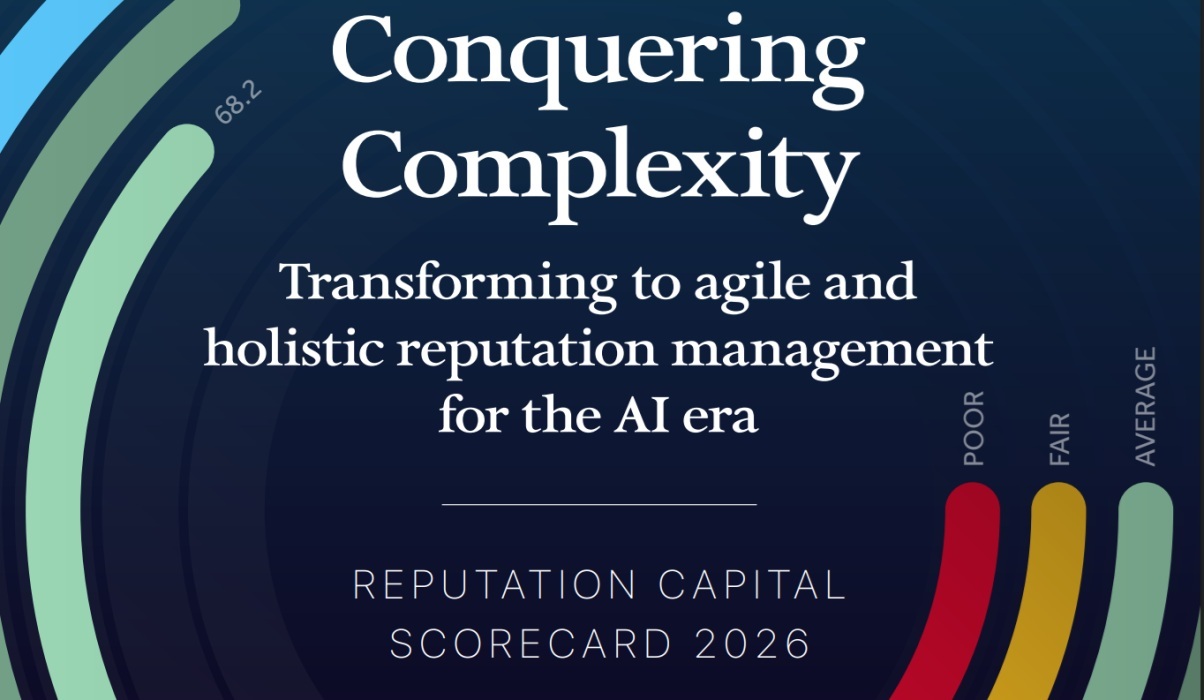
Sandpiper has released its latest study, the Reputation Capital Scorecard 2026, on the sidelines of the World Economic Forum in Davos.
Building on five years of global reputation capital research, the report was spearheaded by Sandpiper Research & Insights and Earned First. It draws on a survey of more than 3,000 C-suite executives across 27 global markets.
The study highlights significant gaps in how reputation is managed at the C-suite level, finding that reputational weaknesses are increasingly impacting company revenues, valuations, crisis resilience, and talent outcomes.
Business impacts from reputation shortfalls rising
The majority of CEOs stated that, in the past 12 months, reputational weakness has impacted trading and revenue (78 per cent), the ability to attract and retain employees (65 per cent), and company valuation (65 per cent). Compared with 2024, the impact on the ability to both trade and sell and to attract and retain talent has risen by four percentage points.
Less than half of the companies were found to be living up to stakeholder expectations, with only 45 per cent saying they are highly aligned with customer expectations. This drops further across other stakeholder groups, with 44 per cent indicating strong alignment with employees, government, and regulators, 42 per cent with investors, and 40 per cent with community members. Media ranked lowest at just 32 per cent.
Overall, 61 per cent of C-suite leaders believe their organisation’s reputation is in a strong position.
Unprepared for reputation management in the AI era
While 72 per cent of CEOs agreed that reputation is critical to their organisation’s commercial success, signs of concern are growing.
Navigating AI was identified as the most significant reputational issue facing organisations, with 68 per cent of C-suite respondents ranking it among their top five reputational concerns - up four percentage points since 2024. Yet, just 40 per cent said they are well prepared to manage it. Across the five biggest reputational concerns, fewer than four in 10 respondents felt prepared to manage cyber and data security risks, ESG and sustainability scrutiny, the rise of mis- and dis-information, and employee activism.
Fewer than half of C-suite leaders described their organisations as agile (45 per cent), adaptable (39 per cent), or effective (49 per cent) in managing reputation in today’s operating environment, defined by AI acceleration alongside societal and geopolitical shifts.
Insights gap and multiplier effect for investment benefits
The Reputation Capital Scorecard evaluated four key indicator groups - Insights, Strategy, Relationships & Connectivity, and Resources - across eight pillars of reputation management, with each organisation assigned a score out of 100.
On average, organisations achieved a global Reputation Capital score of 63. The strongest-performing indicator was within the Resources group, scoring an average of 70, followed by Relationships & Connectivity (65), and Strategy (63). Insights emerged as the weakest area, with an average score of 55.
According to the CCOs interviewed for the study, this insights gap represented more than a performance issue. It was seen as "a strategic vulnerability in an era where reputation can be reshaped within minutes by algorithm-driven narratives," while also highlighting systematic under-investment in data capability and data literacy, despite broader investment in reputation management.
Strength in Insights emerged as the single biggest differentiator of effectiveness. Organisations in the top quartile in this area were 39 percentage points more likely to report highly effective reputation management, and 32 percentage points more likely to describe their reputation as strong.
The data also revealed a multiplier effect, with those scoring in the top quartile on average across all areas of reputation management significantly more likely to perform well and suffer fewer impacts.
Key recommendations
- Embrace complexity to conquer it: Utilise the growing focus on reputation as an opportunity to strengthen the corporate affairs function and secure greater investment and influence.
- Invest in insights to enhance strategic output: A robust data and insights framework is essential for corporate affairs teams to credibly advise the C-suite and demonstrate impact.
- Breakdown data and information blockers and silos: Insights only add value when information flows freely across teams and leadership, enabling honest dialogue about reputational and commercial realities.
- Refine operating models for real-time agility in the AI era: As AI accelerates communications, CCOs must build agile models with the right people, processes, and tools, while recognising AI's limits in judgement and relationship-building.
- Build the case for a holistic reputation management approach to unlock multiple benefits: Investing across all reputation touchpoints delivers compounding business benefits, beyond just high-profile areas like executive or financial communications.
"With the line between machine and human interaction blurring, the way that reputations and stakeholder relationships are managed need to be adjusted," said Kelly Johnston, COO of Sandpiper Group.
"Organisations and leaders all over the world need to rethink reputation success in an era where mis- and dis-information is rife, and where seismic shifts in truth and trust can occur in seconds. The data in this report shows that reputation risk should be a shared responsibility and a centralised part of commercial performance."
The full report can be found here.
-1.jpg)
-1.jpg)