PR News
Study Highlight: News platforms losing ground to marketplaces and YouTube in AI search

AI search visibility no longer driven by traditional media in auto sector

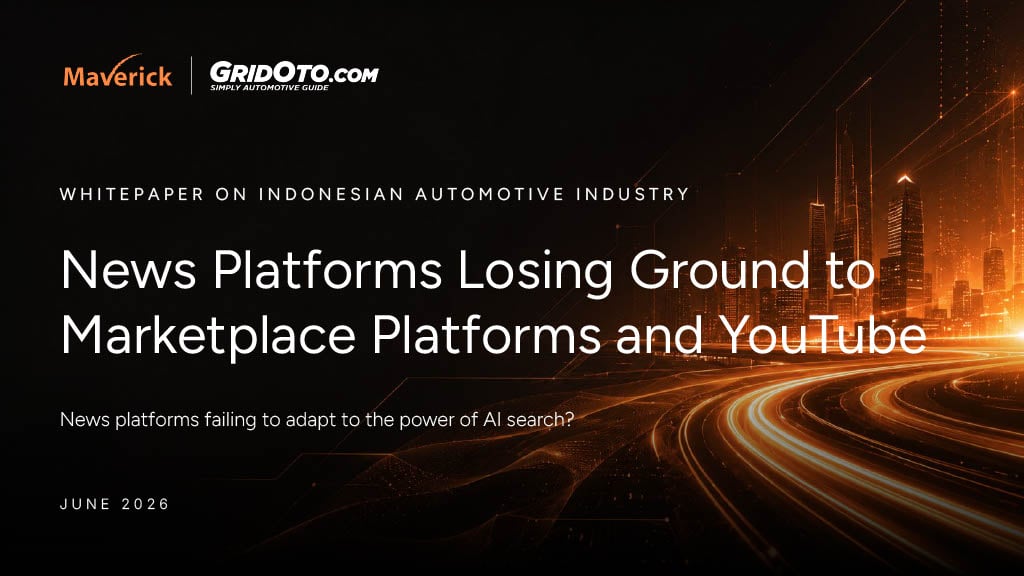
AI search engines are changing the way they cite sources when answering automotive-related questions in Indonesia, according to a whitepaper from Maverick Indonesia and GridOto.

The report, News Platforms Losing Ground to Marketplace Platforms and YouTube, argues that AI search visibility is no longer shaped mainly by traditional news coverage. Instead, platforms that help consumers compare, evaluate and make purchase decisions, including automotive marketplaces and YouTube channels, are becoming more influential in AI-generated answers.

Key findings from the report
Marketplace platforms have overtaken news media as a major AI citation source. According to the report, marketplace became the most-cited category, rising from 26 per cent to 31 per cent, while news media declined from 33 per cent to 30 per cent. The findings suggest that AI engines are increasingly favouring transaction-oriented content, such as product listings, price ranges, comparisons and specifications, over broad editorial information.

Social media also recorded significant growth, largely driven by YouTube. The report found that YouTube is becoming a more prominent source in AI answers, particularly where videos provide structured answers to specific consumer questions. Long-form videos, comparison content and buying guides were more likely to be cited than short-form content.

The study also highlights a shift in who AI trusts on YouTube. Individual creators now account for nearly half of YouTube citations in the dataset, while YouTube channels owned by news media have declined. Maverick Indonesia and GridOto suggest this may be because individual creators often frame content from a user or buyer perspective, making it more relevant to consumer decision-making prompts.

News media still matters, but AI appears to be more selective in how it cites publishers. Only six of the top 20 news domains tracked in the report increased their citation share. Suara.com saw the strongest proportional increase, with most of its growth coming from ChatGPT.

The report also points to crawler access as an important, but not sufficient, factor in AI visibility. Media that allowed AI crawler access saw mixed results, while outlets that restricted access often recorded citation share declines. After GridOto opened access to AI crawlers in June 2025, its AI referral traffic showed an upward trend, with ChatGPT emerging as the main driver.

Why it matters for communications professionals
For PR and communications teams, the study suggests that AI search is becoming a reputation channel in its own right. Visibility is no longer only about search rankings, media coverage or owned websites. Brands need to understand which third-party sources AI engines trust and cite when consumers ask questions.

For automotive brands, this means marketplace listings, KOL reviews, YouTube explainers and structured news content can all influence how AI describes a brand or product. The report notes that brand-owned visibility is weakening, with official car brand pages and dealer sites both declining as citation sources.

For publishers, the findings point to the need for “AI-readable” editorial formats. Maverick Indonesia and GridOto recommend structured headlines, ranked lists, comparison tables, FAQs, evergreen explainers, updated buying guides and open crawler access to improve the likelihood of being cited by AI engines.

For communicators more broadly, the lesson is that generative search requires an ecosystem view. AI visibility should be tracked by source type, prompt, platform and competitor, rather than treated as a website or SEO metric alone. 


Previous story

DDB Group Philippines becomes GGC Group Asia

Next story

Burson to welcome new Corporate Affairs Head

You might also enjoy

When
The Earned View

When the crisis is over, what will people remember?

In my previous Telum column, I wrote about Marshall McLuhan's proposition that the medium is the message and suggested that, in a crisis, the way an organisation communicates can be every bit as important as the words it chooses.

Several readers contacted me afterwards to discuss the article, but the conversations invariably drifted away from McLuhan and towards a broader question.

What do people actually remember when the crisis has passed?

It's an interesting question because, over almost five decades in communication, I've become convinced that we sometimes spend too much time concentrating on the crisis we are living through and not enough time thinking about the one people will remember.

Imagine tomorrow’s conversation

Whenever I become involved in a significant issue, I find it useful to imagine that the immediate turmoil has passed. The media has moved on, the investigations have been completed, the lawyers have packed up their files, and the board is reflecting on what happened. Standing in that future and looking back, what do you hope your customers, your employees, your shareholders, or the broader community are saying about the way your organisation handled itself?

Notice that I'm not asking what they remember you saying. I'm asking what they remember about the way you behaved and how that made them feel.

I've always found that to be a far more revealing conversation, because it shifts the focus away from communication as an exercise in drafting statements and back to communication as an exercise in understanding people.

One of the fascinating things about crises is that the facts rarely remain with us in the way we imagine they will. Ask someone about a major issue they experienced several years ago and they may struggle to remember the chronology, the official statements, or the sequence of events that dominated the headlines at the time.

What they are much more likely to remember is whether they felt they had been treated honestly, fairly, and with respect. They remember whether they believed the organisation understood what they were going through and whether, at a time when trust mattered most, it acted in a way that deserved that trust.

Perhaps that's why I have never been entirely comfortable with the suggestion that crisis communication is primarily about controlling the narrative. Narratives have always had a habit of taking on a life of their own. Journalists contribute to them, commentators contribute to them, social media certainly contributes to them, and now artificial intelligence is adding another layer altogether.

The one thing an organisation can genuinely control is its own behaviour, and communication is one of the most visible expressions of that behaviour.

Before it’s a media issue, it’s a human one

Many years ago, I found myself advising a contractor after an employee claimed he had been accidentally exposed to asbestos. Before long the unions were involved, the regulator was involved, and the media had arrived. As often happens, the discussion quickly became a contest over who could express the greatest level of outrage. Everyone had a position to defend and everyone had an opinion about what should happen next.

What struck me then, and has stayed with me ever since, was that the two people whose lives had been turned upside down had almost disappeared from the discussion. One was the employee, who was understandably worried about his health and his future. The other was the business owner, who knew the incident had happened on his watch and understood that he would face the legal consequences.

I asked everyone else to step back. The lawyers stopped talking, and the two men simply sat down together. They spoke honestly about what had happened, what it meant for each of them and what needed to happen next. The employee received appropriate compensation, the employer accepted the penalties that followed and, perhaps more importantly, they walked away respecting each other, not as victim and irresponsible perpetrator, but as two decent people caught up in an unfortunate situation who cared enough to have an honest conversation.

Looking back, I have little doubt that meeting did more to shape the reputations of everyone involved than anything that was written or said publicly in the weeks that followed. Before it became a legal issue, a regulatory issue, and a media issue, it was a human issue, and once the human dimension was recognised, many of the communication decisions became much clearer.

That experience reinforced something I have always believed about crisis communication: People first. Reputation second. Dollars last.

It has never been a slogan or a neat piece of alliteration. It is simply an acknowledgement that organisations build or diminish their reputations through the way they treat people, particularly when those people are most vulnerable.


See it through their eyes

Take a different, hypothetical example. Imagine a national supermarket discovers that one of its own products may have been contaminated. Within minutes, the executive team is discussing regulators, product recalls, legal obligations, and the inevitable media interest. Every one of those discussions is necessary. But suppose someone asks a different question. If I had just fed this product to my family, what would I want to hear from this organisation over the next hour?

The discussion immediately changes because the communication is no longer being viewed through the eyes of the organisation. It is being viewed through the eyes of the customer. The facts have not changed, but the perspective has, and with it the quality of the communication.

The same principle applies whether the issue involves a cyber-attack, allegations against a senior executive, or a telecommunications outage. People affected by those events are rarely sitting at home analysing legal advice or corporate process. They want to know whether somebody understands why they are worried, whether somebody is taking responsibility, and whether somebody is doing everything reasonably possible to make things right.

Those are fundamentally human questions, and they deserve essentially human answers.

Your reputation is the experience people remember

Communication professionals devote a great deal of time to choosing the right words, and rightly so. Words matter. Accuracy matters. Timing matters. The medium, as I argued in my last column, matters enormously. But all of those things are ultimately in the service of something much bigger.

They help shape the experience people have with an organisation at a time when that experience will influence its reputation long after the crisis itself has faded from memory.

So, before your next crisis meeting begins, try standing in the future and looking back. Ask yourself how your decisions made people feel.

In my experience, the answer to that question will usually tell you far more about the communication strategy you should adopt than the first draft of any media statement ever could.

Douglas Wright is Chief Executive Officer of Wrights, providing strategic counsel to boards and executives navigating complex reputational, stakeholder, governance and public policy challenges.

With more than four decades experience, he has advised leading corporations, industry bodies, government agencies and not-for-profit organisations across Australia and internationally. Prior to establishing Wrights, he founded and led Ogilvy PR Australia.

Douglas is Deputy Chair and a Fellow of Communication and Public Relations Australia (CPRA), a Chartered Public Relations Practitioner (UK), a Fellow of the Australian Institute of Company Directors and a Certified Practising Marketer.

He combines commercial judgement, strategic insight and an ability to shape outcomes in complex environments.

Read more from our columnists in The Earned View 

Owen
Moves

Owen Waters moves to London for new role

Owen Waters has moved from Singapore to London to take up the role of Director at Archetype UK.

In his new role, he will lead client communications strategy across the AI, technology, FinTech, and corporate sectors, drawing on his international experience to help strengthen Archetype's cross-market connectivity for clients.

Owen brings more than 18 years of agency experience. He most recently served as Deputy Managing Consultant at Archetype Singapore. 

Mutant
Industry update

Mutant strengthens sports events portfolio with new wins

Mutant has secured two new sports accounts - the Singapore Tennis Open (STO) 2026 and HSBC SVNS Singapore 2027, a flagship leg of the World Rugby Sevens Series.

The appointments continue the agency’s partnership with The Kallang and build on its work across STO 2024 and HSBC SVNS Singapore 2023.

The wins follow Mutant’s recent expansion into MICE and live events capabilities, as previously reported on Telum Media. The expanded scope includes integrated communications and event collaborations.

Regional Managing Director at Mutant, Lina Marican, said: “Singapore is punching above its weight as a destination for world-class sporting events, and we're proud to be part of what makes them land well. We’re grateful for the continued trust from The Kallang team. It reflects the strength of our team and our ability to deliver impact on the ground.”

Pui Leng Low, Head of Communications at The Kallang, added: “Mutant has consistently delivered with clarity, speed and a strong understanding of what these events require, both on the ground and in-market. We’re pleased to continue the partnership as we scale our event portfolio.”