

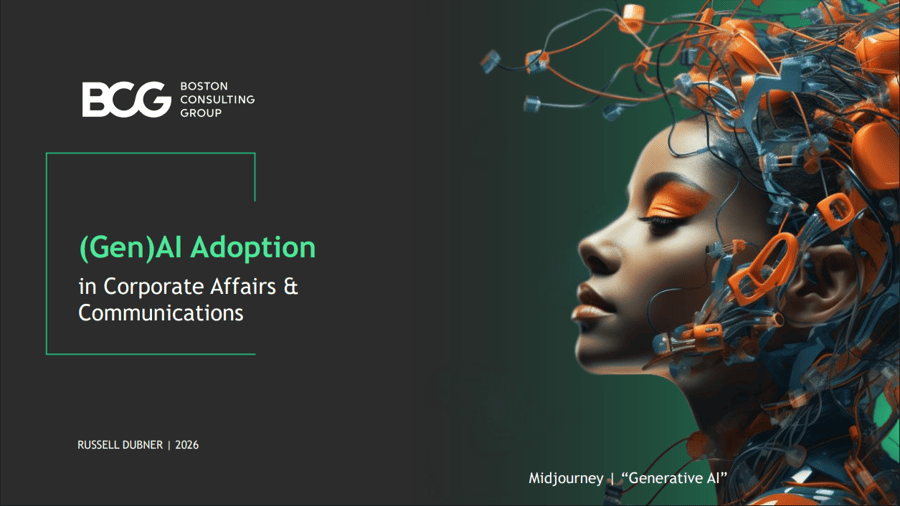
Boston Consulting Group (BCG) has released its latest research, “(Gen)AI Adoption in Corporate Affairs & Communications” by Russell Dubner, Global Chief Communications Officer, Managing Director & Partner. The report explores the disparity between artificial intelligence leaders and laggards within the corporate affairs and communications industry.
The survey features more than 200 corporate affairs and comms leaders across Fortune 1000, Forbes Global 2000, and large private companies. Key findings below.
Preparing leadership
- 88 per cent of respondents said that they are not fully prepared to lead an AI transformation in their function.
- While 74 per cent of respondents believed in the tech and payoff, more than half reported lack of confidence in their ability to measure and communicate (Gen)AI’s value.
- 35 per cent cited a lack of operating model design capability as the top barrier to transformation, followed by lack of (Gen)AI skills (20 per cent), and lack of budget or resources (17 per cent).
- 54 per cent of leaders prioritised near-term capacity gains in GenAI adoption, whereas 22 per cent looked towards its future strategic capabilities.
- In 2025, 82 per cent allocated less than 10 per cent of their budget on AI. The percentage of zero investment is expected to drop from 28 per cent in 2025 to 14 per cent in 2026. Compared to the nine per cent in 2025, 24 per cent of participants planned to allocate 10 to 19 per cent of their budget in 2026 to AI investment.
Laggards vs. pioneers
- 31 per cent of respondents reported meaningful progress in scaling GenAI beyond pilots, while the rest remained in experimentation mode, seeing little to no value.
- 68 per cent self-identified as lagging in AI adoption: three per cent reported minimal or no action, and 65 per cent on early experimentations / pilots. 31 per cent identified as leading in usage: 31 per cent as having (Gen)AI strategies in place, and less than one per cent as having advanced capabilities across workflows.
- According to a past BCG study, the corporate affairs and comms function ranked second among enterprise functions in Gen AI transformation upside, behind customer service and ahead of human resources. However, this survey showed that 67 per cent of industry leaders did not feel ahead of other functions on GenAI progress.
The job is changing
- 23 per cent of corporate affairs and communications leaders shared that they plan to redeploy roles in the next 12 months, 15 per cent expressed plans to freeze hiring, and 12 per cent expect to reduce headcount.
- 37 per cent of respondents considered reducing agency spend by more than 5 per cent in the next 12 months, and 31 per cent considered no changes.
- 12 per cent of leaders planned to redirect agency investment toward strategic advisory work.
- Map workflows to target existing inefficiencies and friction points, and prioritise the identified pain points for AI use cases to address.
- Beyond improving efficiency, define the desired outcomes the function wants to achieve, and identify how its value will be tracked or measured to reimagine full processes within the comms function.
- Remake the operating model to ensure that new tools can scale through establishing clear decision rights, governance, and accountability, as well as ensuring alignment among people, process, and incentives.
- Plan early to redeploy freed capacity toward higher-value work and stakeholder engagement. Identify and mobilise budget pools to finance sustained change to employ AI as a fundamental transformation.
- Proactively upskill talent and invest in enhancing team capabilities to build technical competencies and prepare teams for the shifting roles and responsibilities that AI brings.
- Actively embrace innovation and explore frontier applications to explore the strategic possibilities of AI-integrated work.

-4.png)
-1.jpg)