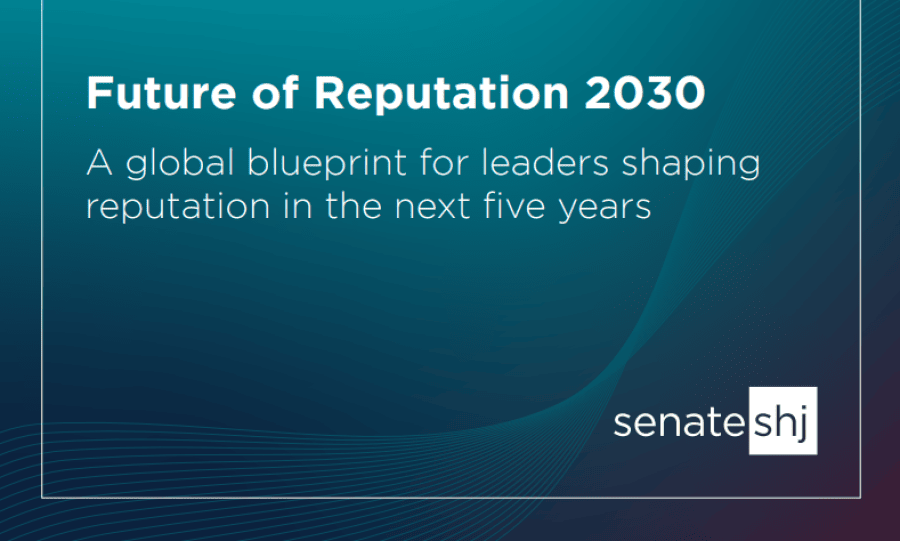
Strategic communication consultancy, SenateSHJ, has just released its Future of Reputation 2030 global report. The report indicated that a surge in reputation risks will force boards and executives to shape new systems of resilience across their organisations.
Based on 44 in-depth interviews with global experts in corporate reputation, communications, public affairs, and risk management, the report reveals how the foundations of reputation are shifting - what builds it, what breaks it and what will define credibility as we approach 2030.
Craig Badings, Partner and Co-lead, Reputation Practice at SenateSHJ, who conducted the interviews, said: "Boards, senior executives and corporate affairs leaders need to prepare for unprecedented levels of scrutiny, complexity and stakeholder expectations, with reputation increasingly determined by how organisations and their leadership behave - not by what they say."
Eight themes emerged from the interviews which are reshaping reputation:
Global reputation risk landscape: Navigating an age of uncertainty
The report found that reputation risk is becoming borderless and harder to control. This is driven by factors such as geopolitics, cultural asymmetry, AI disruption, shareholder pressure, and a surge in mis- and disinformation. What builds trust in one market can damage it in another, and neutrality is increasingly seen as complicity.
Leaders have to balance divergent expectations, act faster than misinformation spreads, and build credibility ahead of crises. In a multi-reality environment, proactive "fact-fighting" and cross-functional coordination are now essential.
Trust and accountability: The currency of credible reputation
There was a consensus that trust and reputation are inseparable. "Trust drives reputation. It’s the micro to reputation’s macro," said Alan Chumley, Senior Vice President at SignalAI. Trust is earned through values lived consistently, transparent decision-making and credible behaviour, not messaging.
In a hyper-scrutinised world, trust is fragile yet recoverable when leaders show competence and accountability. Reputation resilience comes from functional integrity rather than perception management. Elliot Schreiber, Consultant Board of Directors and Leaders and Author of The Yin and Yang of Reputation Management, summed it up: "Trust is not a value - it's a verdict. It's the judgement stakeholders make when they see consistency over time," and experts agreed that trustworthy behaviours are the true currency of reputation.
Leadership, culture and behaviour: The human architecture of trust
Across the respondents' answers, one message stayed consistent: reputation begins within and is determined by how leaders think, decide and act. Trustworthiness is built - or broken - by how leaders behave, reinforce values and shape everyday decisions. Culture emerged as the strongest driver of reputation: employees echo what leaders model, and inconsistency becomes visible fast.
It was also revealed that reputation resilience begins with leadership conduct, cultural alignment and accountability at the top, and that reputation strength depends on whether leaders can connect strategy, behaviour and communication coherently across the organisation.
A point was also raised from a crisis perspective - corporate crises often stem from internal culture and behaviour, not external shocks, with leadership at the centre of risk. Reputation is safeguarded not by process, but by ethically and emotionally prepared people who act with accountability under pressure.
Stakeholder complexity and polarisation: Coherence as the new leadership currency
Global experts who were interviewed agree that the era of one-size-fits-all communication is over. Reputation now sits in a fractured stakeholder ecosystem shaped by divergent expectations, ideological polarisation and competing truths.
Paul Stamsnijder, Founding Partner at Reputatiegroep, described the shift as a complete inversion of the traditional model: "The orientation in building reputation has shifted from inside-out to outside-in. Where organisations once sought to control their message, they now must earn consent through dialogue."
Coherence, empathy and consistency are seen as a core to leaders and matter more than consensus, as silence is increasingly seen as a stance. With misinformation rising and geopolitical pressures intensifying, organisations must read the room, adapt to diverse expectations, and engage stakeholders with credibility.
Technology and AI: Sentinel and saboteur
Technology and AI are accelerating reputational risk, amplifying crises and reshaping how opinions form. Experts warned that while AI offers real-time insight, prediction and scale, it also mirrors organisational bias, spreads misinformation faster than truth, and erodes editorial safeguards. Automation without accountability creates new integrity risks, making ethical governance essential.
The consensus is that AI can inform, but only humans can judge. In an AI-saturated landscape, humanity, authenticity, and moral clarity matter more than ever.
Measurement, data and governance: The metrics of modern reputation management
Reputation measurement is shifting from instinct to evidence, but experts warn that numbers mean little without clarity, governance and context. Reputation lives in stakeholder perception, not dashboards, and single metrics risk oversimplifying complex human judgement.
Effective measurement links drivers to outcomes, guides decisions, and reveals behaviour. As data gains predictive power, governance becomes the architecture of trust, shifting measurement from compliance to conscience.
Crisis, recovery and humility: The hard road back
Across the interviews, experts consistently agreed that crises expose culture more than they damage it. Reputation fails not from the incident itself but from denial, delay and defensive messaging.
When talking about the actions to take in a crisis, Alan Chumley and Scott Sayres used almost the same words: "Own it, respond quickly even if partially, acknowledge, fix it, show empathy and humility." Effective crisis response requires speed, humility, accountability, and alignment of words with actions - regret, responsibility, and remedial action.
Trust is rebuilt through empathy and moral courage, while preparedness, strong governance, and pre-existing trust equity determine the pace and success of recovery.
Purpose and values alignment: Reputation's moral compass
Experts agree that values - rather than campaigns - are the differentiator of reputation.
As Patricia Santa Marina, Founder at MINERBA Corporate Communication, said: "Reputation over everything. Even if you temporarily lose money, reputation is more important."
Purpose only creates trust when it is lived consistently through behaviour, culture and governance. Misalignment between stated values and real decisions is said to be the root of many reputational failures, while predictability and accountability form the "DNA of trust".
With public cynicism rising, interviewees warned against corporate virtue signalling, with multiple respondents claiming that purpose - which was once a differentiator - has now become an overused and unconvincing corporate trope. Organisations must behave their way into credibility, embedding purpose as a governance system rather than a slogan.
The Future of Reputation 2030 report also contains SenateSHJ's 5SL Framework for building reputation resilience, which the agency describes as "...a practical architecture, outlining six disciplines that can turn integrity into a measurable, repeatable and resilient organisational capability."
The full report, which includes predictions and tips for leaders for each theme, can be found here.
Previous story
Seven sets up new global hub
You might also enjoy
.png)