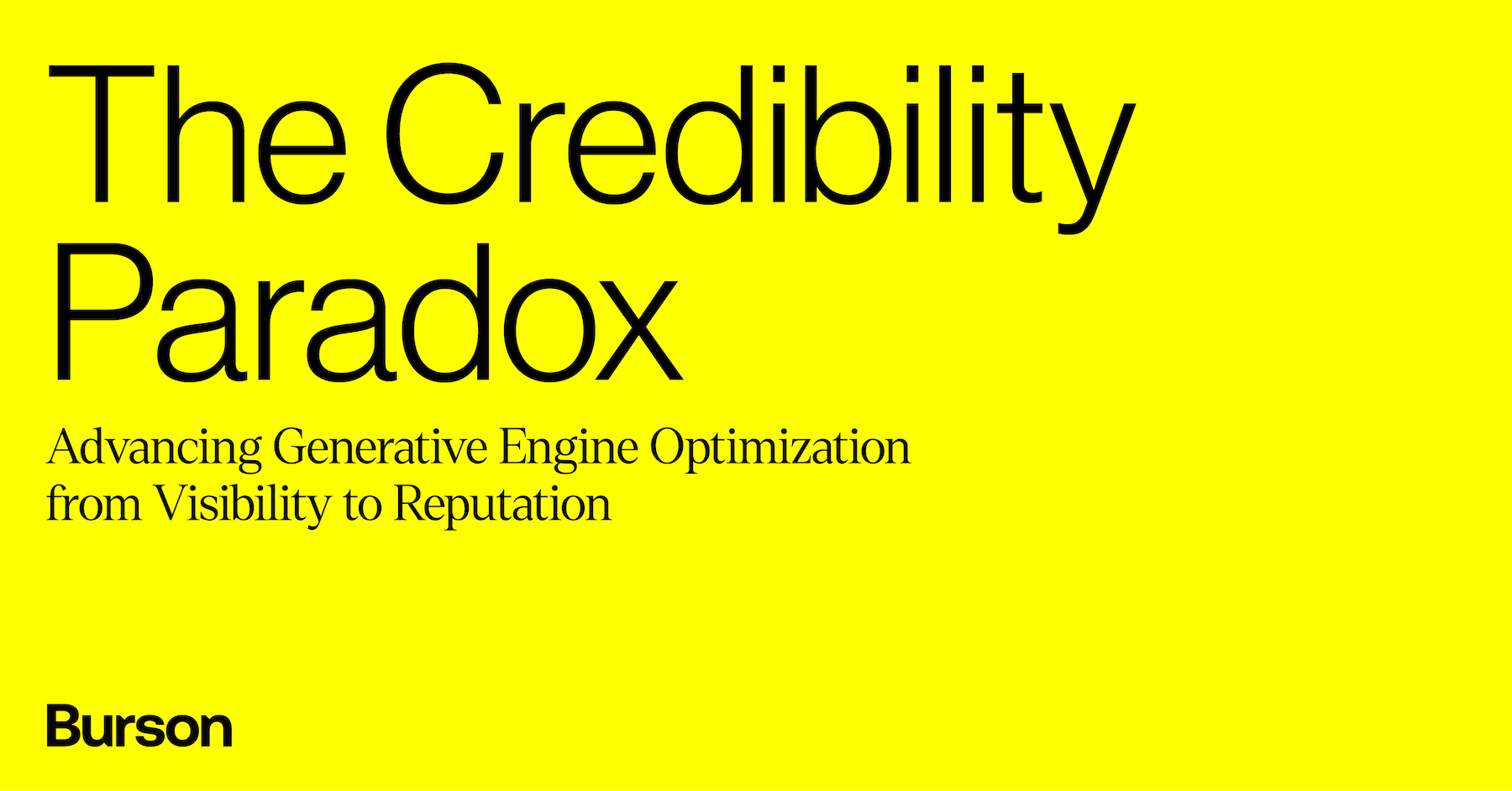
New research from Burson moves discussion around Generative Engine Optimisation (GEO) beyond visibility and cited sources, positioning it as a strategic reputation opportunity focused on believability.
Burson's report, The Credibility Paradox, explores how audiences believe AI-generated answers about brands and companies.
“In today’s zero-click world, LLMs have become the new gatekeepers of reputation - how brands are discovered and evaluated. But visibility is not credibility...”
The agency partnered with AI marketing platform Profound to field thousands of reputation-related answers across seven major AI answer platforms. The study evaluated 85 companies against the eight levers of Burson’s Reputation Capital framework: Innovation, Creativity, Workplace, Products, Financial Performance, Governance, Citizenship, and Leadership.
Responses were assigned a believability score for three audience groups: General Population, Opinion Elites and Business Decision Makers. The agency used its proprietary Decipher tool, developed with cognitive AI company Limbik, to produce more than 55,000 believability forecasts.
Key findings from the research:
-
AI rewards proof, not positioning - the research found that fact-based claims tied to innovation, products, and workplace culture consistently performed better than claims linked to more subjective areas such as leadership, governance, and citizenship. The report said this points to the importance of a strong mix of earned, owned and social content for GEO, as AI places weight on independent corroboration from media coverage, reviews and conversation.
-
Workplace is an underused credibility lever - workplace-related answers were the most believable among the general population. Burson said this finding is consistent with large language models’ reliance on independently verifiable sources such as talent platform reviews, labour reporting and earned media.
-
Leadership is AI’s toughest credibility test - leadership-related prompts ranked among the least believable across every industry studied. The industries that scored higher - Aerospace and Technology - had a common thread. Their proof came from governance structures, business performance and external validation, rather than executive messaging alone.
-
Believability changes by audience - the report found that a narrative that appears credible in an AI-generated answer may not land equally with customers, investors, employees or regulators. Business Decision Makers rated AI-generated answers 10 per cent more believable on average than the general population. Burson said more specialised audiences were more receptive to innovation-led narratives and the business context behind them.
For communicators, rather than treating earned media, owned content, and social engagement as separate workstreams, Burson said the framework takes a holistic approach. The aim is to build an ecosystem of independent, credible voices whose coverage and commentary reinforce a company’s narrative over time.
“In today’s zero-click world, LLMs have become the new gatekeepers of reputation - how brands are discovered and evaluated. But visibility is not credibility,” said Corey duBrowa, CEO, Burson.
“AI synthesises, summarises, and delivers information directly to audiences. Showing up in these LLMs is necessary but not sufficient. Our role is no longer just to make clients visible, but to build an evidence ecosystem so robust that the answers AI constructs are believable to the audiences that matter most. This research is our playbook for turning the credibility paradox into a competitive advantage.”
"As AI becomes an increasingly influential layer between companies and their stakeholders, it is shaping not only how brands are discovered, but also how they are understood and evaluated. The real opportunity for organisations is not simply to secure share of answer, but to ensure those answers are grounded in evidence, backed by credible sources, and believable to the audiences that matter most,” said Red Surtida, APAC Head of Intelligence & Transformation.
"In a region as diverse and complex as EMEA, GEO is fundamentally a reputation challenge, not just a visibility one," says Bryn Tweedale, Senior Director, Digital Marketing, Burson UK. "Visibility in an AI-generated answer is just the beginning, as the true benchmark is if the underlying reputation translates across borders. This study makes clear it has become a test of ensuring a brands' hard-won reputation remains credible and consistent, no matter which market an AI delivers it to."
-1.jpg)
-1.jpg)