


Moves
Madison Davy moves into the entertainment industry
Telum Media creating connections
Get in touch to learn more
Previous story
More noise. More change. More need for great communicators.
You might also enjoy

The Earned View
Recent sensationalist headlines on the Longitudinal Graduate Outcomes Survey would have you believe that communication and PR in Australia is an industry in decline, with falling employment opportunities for graduates.
A more thorough look at the data reveals that the full-time employment rate has risen over the past 10 years, in both the short- and medium-term horizons.
It's too easy to look at a headline about employment prospects, throw in the impact of AI, and come to the conclusion that our industry is doomed.
Paradoxically, this dynamic of soundbites, doomsaying, and selective fact-picking is exactly why communication and PR professionals are more important than ever.
The landscape is changing rapidly
Since the introduction of the internet, newsrooms have changed. 24-hour news cycles, clickbait headlines, niche publications, and decreasing roles for journalists are challenges our industry has adapted to. We are nimble and often recognised within our organisations for being the first to change direction decisively when things change around us.
Over the past six months, three trends have picked up speed.
The first is AI and a column about the PR and Communication industry would not be complete without mentioning it. Although some (uninformed) people believe AI will wipe out our jobs, industry professionals feel much more confident about the future. The rise of AI search means that organisations need earned media and original content to be visible.
The second is the growing influence of people who interpret the news. The line is blurring between news organisations outside the major corporations that use social media to distribute content, and individual commentators who may not be journalists but have built huge followings through personality and engagement.
There is a dangerous trend (which would be another column entirely) around wellness influencers who don't have medical qualifications but peddle health advice. We also see this playing out with influencers curating and commenting on the news without the journalist training or subject matter expertise to be objective and factual.
The third is the importance of cross-platform strategies, and working with media outlets and journalists to tailor news stories to audiences who engage on different platforms. A story might need a detailed explanation for an online article, a compelling visual for social media, and an expert voice for a podcast. Our role is to understand what each format offers and provide the evidence, people, and material that help journalists tell the story well.
Get weekly access to insights from the regions that matter to you.
But we see great work rising to meet the challenges
The recent CPRA Golden Target Awards demonstrate the creativity and strategy that PR and communication professionals bring to our work.
The platinum award National Campaign of the Year is "84 Cents Is All It Takes": All or Nothing for Deaf Babies and Children in NSW by Bumpp and The Shepherd Centre. This campaign created a compelling case for funding and then used earned media and political engagement to build pressure ahead of the NSW Budget. It is a fantastic example of a strategy-led campaign with exceptional creativity in its tactical execution.
We know that results matter. Organisations care more about outcomes than vanity metrics. The platinum award Excellence in Measurement and Evaluation "Call Healthdirect" by Ogilvy Health and NSW Health shows how to use research and insights to inform a campaign, then measure results by impact.
The campaign directly reduced emergency department visits by increasing the use of healthdirect's free, nurse-led helpline. Its strength was linking communication measures to patient behaviour and health system demand.
Behind this work are leaders who excel at strategy, ride the wave of change, and bring the industry along with them.
Our Platinum Award National Leader of the Year, SSI's Dane Moores demonstrates how communication leadership can help change systems. Leading Activate Australia's Skills, he reframed migrant skills recognition as a national productivity opportunity, uniting more than 130 organisations behind reform.
Research, lived experience, media, and government engagement helped build momentum that contributed to an $85.2 million Federal Budget commitment. His leadership also extends to mentoring emerging communicators and giving colleagues opportunities to lead.
And we need to invest in our future leaders
If we want the next generation to deliver work of this calibre, we need to invest in them.
There is a lot of conversation about whether AI will replace entry-level communication professionals. Diane Schwartz, CEO of Ragan, which publishes PR Daily, believes this is a "2026 thesis" that will not come to fruition.
We need a strong pipeline of people entering our industry to become the leaders of tomorrow. Providing pathways into employment is a shared responsibility: universities provide the foundations, and employers offer the opportunities.
The CPRA Board has recently endorsed a Higher Education and Future Workforce Strategy to build sustained collaboration between industry and universities to strengthen courses, student experiences, and employment pathways.
The future of our profession will be shaped by the people we develop and the opportunities we create for them. That is something all of us can influence.
Helen Hutchings is Chair and a Fellow of Communication and Public Relations Australia (CPRA) and Managing Director of Phillips Group. She has more than 25 years’ national and international consulting experience, advising government and business leaders on strategic communication, reputation management, stakeholder engagement and complex public issues.
Helen’s work spans public policy, major infrastructure projects and corporate affairs, supported by qualifications in communication and data science.
Read more from our columnists in The Earned View
16 November 2026 1:00 AM
5 mins read

Moves
Cynthia Dammerer has returned to the aviation sector as Head of PR and Communications at Alliance Airlines. Based in Queensland after two years in Singapore, she was previously Public Relations Manager for Accor Asia Pacific for more than three decades and activated the set-up of the media production company, TellMeWhere2Go. She held the PR & Comms position in Australia for Scoot Airlines from start up until the Covid era, and also works with Plaza Premium Group.
15 November 2026 11:31 PM
1 min read
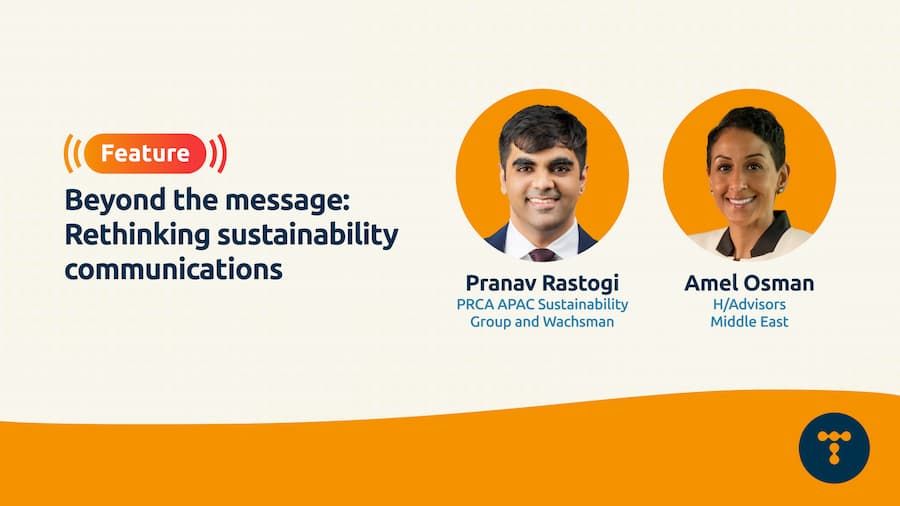
Feature
How can organisations ensure their sustainability communications go beyond reporting environmental commitments to demonstrate meaningful change? As stakeholder scrutiny increases, communications professionals face growing pressure to substantiate corporate claims with evidence and assess whether their efforts are making a difference.
Telum Media spoke with two communications leaders, Pranav Rastogi, Executive Director, Head of Singapore at Wachsman and Chair of the PRCA APAC Sustainability Group, and Amel Osman, Managing Director of H/Advisors Middle East, about what makes modern sustainability communications strategic, self-aware, and substantial.
Going beyond commemorative dates
Dates such as Earth Day, World Environment Day, and COP present opportunities for organisations to communicate their sustainability efforts, but both communications leaders challenged the idea of planning communications activities solely around these events.
"The starting point should be what an organisation has to contribute, rather than feeling obliged to say something because of a date on the calendar," Pranav said.
He suggested three simple tests: relevance, credibility, and contribution.
Communicators should first evaluate whether the issue is material to the organisation and the people it affects. Next, they should establish whether there is evidence of meaningful work or progress to share, including areas where the organisation may be falling short.
Finally, he said communicators should consider whether speaking up would inform a debate, support an initiative, or help stakeholders take action.
From Amel's perspective, participation in commemorative moments should reflect work that is already underway.
To achieve this, she advised communicators to track stakeholder expectations throughout the year, including those of customers, consumers, investors, and policymakers. They should also regularly establish what the organisation needs to do, prove, and explain.
"Stakeholder demands should determine the substance and urgency of the response. The communications calendar should follow that judgement. It should never substitute for it," she said.
Understanding the wider sustainability landscape
Both leaders acknowledged that major global environmental events can still provide valuable opportunities for communicators to better understand emerging sustainability priorities, changing stakeholder expectations, and broader industry developments.
Looking at COP, for instance, Pranav shared: "I'll be watching conversations around adaptation, climate finance, and resilience, alongside the implementation of national climate commitments and a just transition; and looking for details on how these promises are financed, delivered, and measured."
He explained that events like these can raise both reputational and strategic questions, as stakeholders will likely want to understand an organisation's targets, transition plans, the trade-offs involved, and who bears the associated costs.
Amel also pointed to the importance of understanding regional priorities when approaching global sustainability conversations.
In October 2026, H/Advisors published a report titled Market perspectives ahead of COP31, examining sustainability conversations and regional considerations leading up to the global event.
"The GCC analysis connects climate action with energy security, industrial competitiveness, diversification, and resilience. That is the context communications leaders must understand before proposing a narrative," she urged.
Similarly, Pranav said it's crucial to consider local contexts: "For communicators in APAC, the most important thing is to recognise that there is no single regional sustainability narrative.
"Communications leaders need to understand how global commitments translate into local realities."
Both leaders emphasised the importance of anticipating stakeholder scrutiny and preparing organisational leaders to address potential questions ahead of external enquiries.
Get weekly access to insights from the regions that matter to you.
A more strategic role for communicators
Both leaders agreed that communicators need to be involved early in the organisational decision-making process to play a strategic role in shaping sustainability practices and communications.
"Our contribution is to test whether the organisation's account matches its operating decisions. Bring stakeholder concerns into investment and partnership discussions while they can still influence the outcome," Amel noted.
Pranav explained that communicators should help identify organisational blind spots and bring external perspectives from communities, employees, investors, regulators, and journalists into the boardroom.
To him, this also means being prepared to challenge the substance of sustainability claims, particularly those that lack credible supporting evidence. He also pointed to the misuse of sustainability terminology, which prompted the PRCA APAC Sustainability Group to develop a Sustainability Communications Glossary to help address the issue.
"Terms like 'net zero', 'carbon neutral', and 'regenerative' are not interchangeable marketing expressions. They carry specific implications and need appropriate evidence and context," Pranav cautioned.
Amel echoed the importance of ensuring that sustainability claims are supported by evidence.
"A factory improvement cannot automatically support a whole-product claim. An unfunded aspiration should not be presented as a delivery plan. National ambition provides context; it cannot substantiate company performance."
She added that communications leaders should have the authority to withhold unsupported claims. Depending on the circumstances, this could mean narrowing the wording, changing the underlying practice, commissioning verification, or postponing publication.
From awareness to lasting change
"If the goal is behavioural change, communications teams need to start with the desired outcome, not the message," Pranav said.
He explained that communications teams should first consider whose behaviour they are trying to influence, what those stakeholders currently believe, what prevents them from taking action, and what forms of information or support could help.
Measurement is another area that needs to evolve.
Amel suggested looking at how communications contribute to action through indicators such as qualified enquiries, completed assessments, changes in purchasing criteria, adoption, and sustained use, rather than relying on reach and sentiment alone.
She also recommended tracking environmental outcomes separately and being transparent about what communications efforts have helped influence.
Pranav similarly pointed out that meaningful and lasting sustainability outcomes depend on collaboration across internal functions, including operations, product, and senior leadership teams.
He said: "Ultimately, our contribution should be judged less by how convincingly we tell a sustainability story, and more by whether our work helps people and organisations make better decisions."
13 November 2026 12:59 AM
5 mins read