Media pitching is one of the most familiar parts of public relations. It is also one of the most frequently misunderstood.
Much of the advice given to PR practitioners focuses on the visible parts of the process: subject lines, send times, follow-up cadence and email length. These details matter, but they come late in the work. The most important decisions usually happen before a pitch is written.
-
Is there actually a story?
-
Why would anyone outside the organisation care?
-
Who is the right person to approach?
-
Can the PR team provide enough evidence, access and material to make the story usable?
-
Does the idea suit the way that particular journalist, producer or creator actually works?
Telum Media’s Journalist Interest Survey, which has gathered practical dos and don’ts feedback from more than 10,000 journalists, points to a clear conclusion: journalists are not asking PR teams for cleverer email copy. They are asking for better editorial judgement.
A pitch needs to be much more than just a compressed version of what an organisation wants to announce. A successful pitch is a useful, timely and credible story proposition, designed around a particular audience and media format.
The pitching environment has changed
The foundations of good pitching have not changed dramatically. Relevance, newsworthiness, trust and timing have always mattered.
What has changed is the margin for error.
Journalists are working across more subjects, formats and channels. Inboxes are crowded, as AI tools make it easier to generate high volumes of superficially personalised outreach.
At the same time, the media environment has expanded beyond traditional newsrooms. A good story might now be covered by a newsroom journalist, independent newsletter writer, specialist podcaster, LinkedIn commentator, or a creator who blends reporting, education and opinion.
That creates more opportunity for PR teams, but also more noise. Pitching is no longer just about finding a publication that covers a topic. It is about understanding the person, the audience, the format and the value exchange.
Start with the audience, not the announcement
Many weak pitches begin inside the organisation.
A company launches a product, appoints an executive, publishes research, reaches a milestone or announces a partnership. The communications task then becomes: how do we persuade the media to cover this?
But organisational importance does not automatically equal editorial importance.
The stronger question is: what has happened that affects, interests, surprises or informs the audience?
That question creates the bridge between an announcement and a story. A new product is not automatically interesting because it is new. But it becomes interesting if it changes what a defined group of people can do or signals a broader shift.
The same applies to research. A survey is not interesting because it has just been released, or it contains percentages. But if the findings reveal a hidden problem, show a meaningful change in behaviour, challenge accepted wisdom, or prove that something has not changed when everyone expected it would, then it becomes a story.
Find the “so what?”
“I like stories that have an interesting ‘so what?’ factor, by which I mean there’s a meaningful ramification…”
One Australian journalist in Telum Media’s Journalist Interest Survey described wanting stories with a meaningful “so what?” factor. That phrase captures the discipline behind strong media pitching. It focuses your thinking.
I once had a CEO who would occasionally ask “So what?” after I had submitted a report or a particularly productive campaign. It wasn’t that he was in any way dismissive of my efforts or what we had achieved; he just wanted to know what that meant for him – why it mattered to him. He wanted me to link it back to business strategy and how this campaign helped us implement or advance that.
The “so what?” test asks what changes because of the announcement. A product launch may matter commercially, but the editorial story is more likely to sit in the problem it solves, the behaviour it reflects, the pressure it creates for competitors or the broader change it represents.
The PR practitioner’s job is not simply to distribute the announcement. It is to identify the editorial appeal and frame it clearly.
Before writing the pitch, PR teams should ask:
-
What changes because of this?
-
Who experiences that change?
-
Is the consequence surprising, significant or timely?
-
Can we demonstrate it?
When the only answer is “because it is big news for the organisation”, the story may not be ready to pitch.
Build a citizen connection
An Executive Editor in the UAE recommended pitching stories with a “citizen-connect”. It’s a useful reminder that every outlet serves a community.
That community might be residents of a city, investors, parents, travellers, comms professionals, or cultural groups. Strong pitches connect the organisation’s development to the lives, decisions or concerns of that audience.
This is especially important across APAC and the Middle East, where regional context, local relevance and audience nuance can change the strength of a pitch. A story that works for a business publication in Singapore may not work in the same way for a trade publication in the UAE or a creator-led newsletter serving a specialist professional community.
Match the recipient’s content DNA
“I really appreciate PRs who know the nature of each magazine and pitch stories that would fit into my publication’s content DNA. It makes my job a lot easier. I’m aware it takes a lot more effort than just a wide email blast, and I appreciate it.”
Relevance is not only about whether a journalist covers the broad topic.
One Singapore-based senior writer told Telum Media they valued PR practitioners who understood a publication’s “content DNA”. The phrase points to a deeper level of targeting.
Three publications may cover the same industry, but approach it differently. One may prioritise breaking news and investigations. Another may focus on executive interviews. A third may prefer personal narratives, explainers or visual storytelling.
The same pitch will not work equally well for all of them.
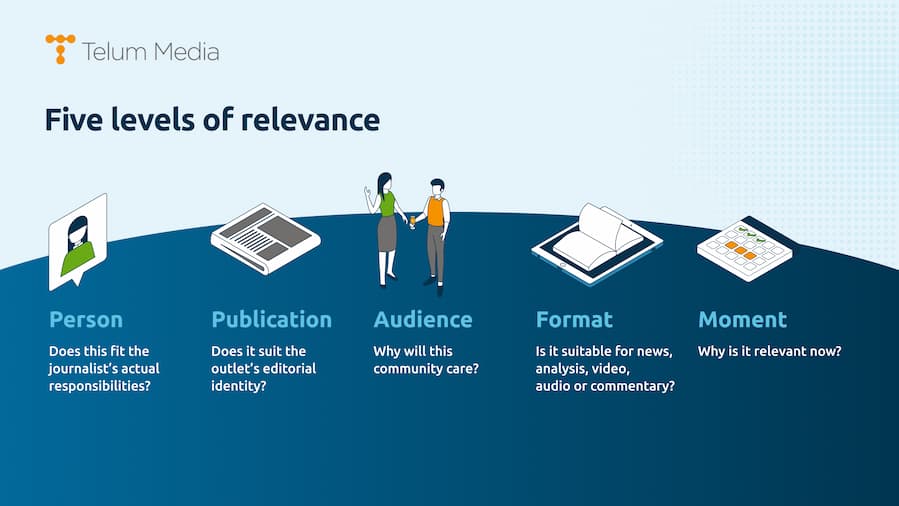
Before pitching, PR teams should test relevance across five levels:
-
Person: Does this fit the journalist’s actual responsibilities?
-
Publication: Does it suit the outlet’s editorial identity and depth?
-
Audience: Why would this community care?
-
Format: Is it suitable for news, analysis, video, audio or commentary?
-
Moment: Why is it relevant now?
A pitch should align with all five, not just the first.
Build the story kit before pressing send
Many pitches fail because the idea is sent before the story is built.
A PR team identifies a promising angle, sends the pitch, gets interest from a journalist and only then begins asking whether the data can be shared, whether a case study is available or whether an independent voice can be offered.
That creates friction. It can also damage trust.
A pitch should allow the journalist to assess both the idea and the feasibility of producing the story.
Before outreach, PR teams should have the story kit ready.
-
Angle - a clear, audience-relevant proposition
-
Evidence - data, examples, documents or observable change
-
People - expertise, experience and human consequences
-
Assets - images, video, charts, audio or locations
-
Logistics - availability, deadlines, geography, embargoes and contact details
Evidence builds credibility. A broad claim such as “consumers are increasingly concerned” is rarely enough. A credible statistic, clear methodology and real example are stronger. But data should do more than decorate a claim. PR teams need to know whether it is genuinely new, whether the sample is credible, and whether the journalist can access the underlying figures.
People matter too. A prepared quote is not automatically an asset. A spokesperson is valuable when they can explain why something is happening or interpret evidence. If they can challenge conventional thinking, answer difficult questions or provide examples that are not already in the release, then they are an asset to the journalist considering the story.
Assets should also be curated, not dumped - a folder of 70 vaguely labelled images is not useful. A small selection of strong assets, with captions, credit information, visible previews and simple downloads, reduces friction and helps the story move.
Pitch for the format
Different formats need different inputs.
A digital news story may need two to five strong high-resolution images and accurate captions. Broadcast may need movement, locations, demonstrations and interview access. A data-led story may require underlying tables, not just a branded infographic. A podcast needs a guest who can sustain an interesting conversation. A creator may need a demonstrable concept, useful lesson, exclusive dataset or visual story.
This matters because media is now bigger than the newsroom, and pitching a podcast is not the same as pitching a news item.
For non-traditional media, PR teams need to pitch the format, not just the person. That may mean proposing a conversation, explainer, demonstration, investigation, debate, visual story or community-relevant experience.
Timing is editorial empathy
There is no universal best time to pitch.
The better question is whether the story arrives in time to fit the journalist’s workflow. A daily news reporter may need something that morning. A monthly magazine may need six to eight weeks. A broadcast producer may need notice to organise a crew, location and interview.
Timing also depends on context. A relevant pitch can fail because a larger story dominates the news cycle. In those moments, the right decision may be to hold the pitch, adapt the angle or acknowledge that the story no longer fits the moment.
Embargoes should be treated the same way. An embargo should help the journalist prepare, not simply serve the PR team’s launch timetable. It is useful when it gives media time to understand complex information, arrange interviews, analyse data, prepare visuals or coordinate coverage of significant news.
Write for the inbox
“Everyone receives hundreds of emails a day, so don’t expect people to save a file into a folder and then automatically read it. Get to the point and make all content relevant.”
Only after the story is built should the pitch be written.
A strong pitch is short at the top and complete underneath. In the first few lines, the recipient should understand what has happened, why it matters, why it suits them, what proves it and what access is available.
A useful pitch structure is:
-
Subject line - The strongest plausible editorial angle
-
Topline - What has happened and why it matters
-
Evidence - The facts, data or examples that support it
-
Offer - Who or what the journalist can access
-
Logistics - Timing, location, embargo and contact details
The goal is not to write the article for the journalist, it is to make the editorial opportunity easy to understand and assess.
Use AI in the prep, not as the editor
Journalists can recognise generic AI pitches. Their concern is not necessarily that AI has been used, it’s that AI has replaced judgement.
AI can be useful backstage:
-
Help research background material
-
Summarise recent coverage
-
Test possible angles
-
Simplify long copy
-
Generate subject-line options
-
Organise data
-
Anticipate likely journalist questions
But human judgement still needs to decide whether there is a story, whether the claim is true, whether the angle is relevant, whether this is the right person, whether the personalisation reflects real understanding, and why the pitch matters now
The pitching framework
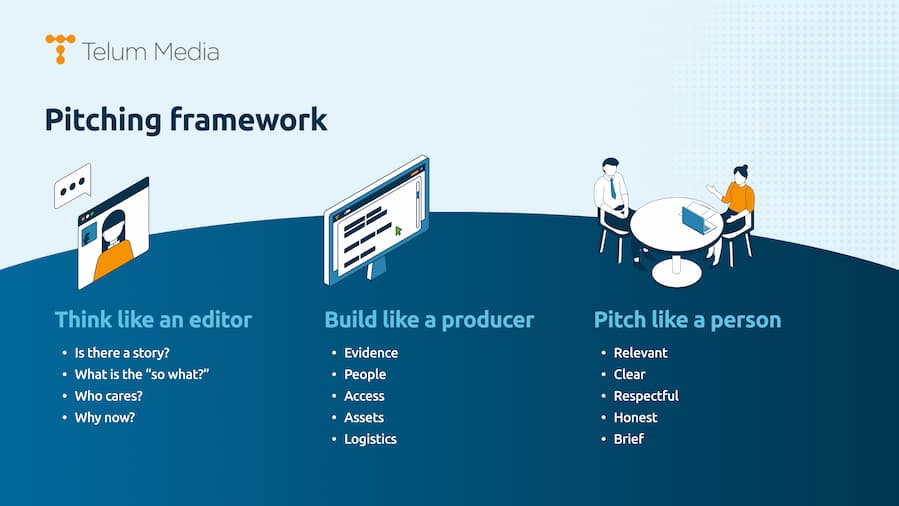
Strong media pitching can be summarised in three instructions.
-
Think like an editor. Identify the story, the consequence, the audience and the timing.
-
Build like a producer. Confirm the evidence, people, access, assets and logistics before outreach.
-
Pitch like a person. Be relevant, clear, respectful, honest and brief.
A good pitch should feel like a considered professional recommendation, not an automated request for attention.
The most important takeaway is that pitching quality is largely determined before the pitch is written. Sometimes the strongest media-relations decision is to tell an internal stakeholder or client that an announcement is not yet an editorial story, then help them build something better.
FAQs
What makes a media pitch effective?
An effective media pitch presents a useful, timely and credible story proposition for a specific journalist, outlet, audience and format. It explains what has happened, why it matters, what evidence supports it and what access is available.
Why do journalists reject PR pitches?
Journalists often reject pitches because they are not relevant, lack a clear audience connection, rely on weak claims, arrive at the wrong time or create extra work. Many weak pitches start with what the organisation wants to say, rather than what the audience needs to understand.
How should PR teams use AI in media pitching?
AI can help with preparation, such as research, summarising coverage, organising data and testing possible subject lines. Human judgement should decide whether the story is true, relevant, credible and suited to the recipient.
What should be included in a story kit?
A story kit should include the angle, evidence, people, assets and logistics. This may include data, methodology, examples, spokespeople, case studies, images, video, charts, interview availability, embargo details and contact information.
With more than 30 years’ experience spanning journalism, corporate communications and media intelligence, Reuben Aitchison is Telum Media’s Head of Insights and Communications.
Explore Telum Media tools that help PR teams pitch with precision.


.png)
.jpg)