PR News
Culture before commerce: What it takes to build in the Gulf

Culture before commerce: What it takes to build in the Gulf

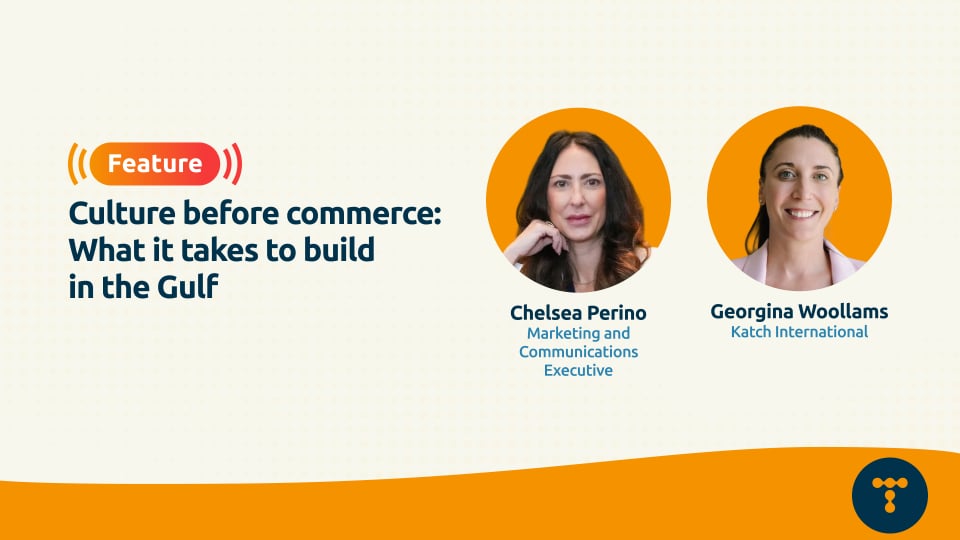
When The Executive Centre (TEC) entered Dubai in 2018, flexible workspaces were still relatively niche in the Middle East market. For Chelsea Perino (then a Marketing and Communications Executive based in Hong Kong) and her team, the challenge was twofold: establishing brand awareness while learning how business is done in the region.

That changed after Covid-19. While many global markets stalled, the region rebounded swiftly. With the rise of hybrid working, the flexible workspace solutions provider fundamentally flipped its business on its head.

The pace of change in the Gulf region is something industry leaders have noticed. Georgina Woollams, Founder and Managing Director of Katch International and whom expanded her agency from London to Dubai more than a decade ago, explained how approaches to brand building and communications have changed over the years as the market transformed:

“The UAE is probably one of the fastest-evolving countries in the world, so we have to adapt to stay on pace continually. With the growth of the country and a recent influx of people from across the globe, we are always finding ways to reintroduce clients to a new audience while simultaneously storytelling to those in the UAE who already know the brand.”

Relationship building in the Middle East and pitfalls to avoid
Chelsea quickly observed that business culture in the Middle East is highly relationship-driven.

Unlike in many Western markets, meetings often begin with personal conversations about family, daily life, or current events before shifting to commercial discussions.


“Making small talk before discussing business details shows that you care about the bigger story behind an initiative. Not doing so can come across as pushy or insincere,” she notes.


Going hand in hand with relationship building is the grasp of cultural nuances and the exhibition of cultural sensitivity. Yet, an often-overlooked aspect for foreign communicators is the sheer diversity of the region, both in terms of language and personas.

Chelsea highlighted the common misconception of treating the Middle East as a homogeneous market. "Each territory has its distinct characteristics and media landscape: Dubai and Abu Dhabi, despite being part of the same country, maintain different business personalities; Saudi Arabia, Qatar, Azerbaijan, and Oman on the other hand each possess unique cultural, economic, and media environments, with varying dialects of Arabic."

She added that success in regional communications requires understanding of both English and Arabic media ecosystems.


Georgina pointed out that a 'pay to play' dynamic is prevalent in certain territories, which might be hard to get around, especially if you are in the real estate or trade industries.

“A lot of international people forget that the majority of the wealth in that region is sitting within the Arabic family holding - it would be naive not to take that side of the demographics seriously,” Chelsea observed.

Tailoring communication to different demographics
Beyond building relationships in person, understanding audiences’ preferred communication platforms across Middle Eastern countries is crucial for successful engagement. Each market has distinct preferences shaping both B2B and B2C communications that brands must adapt to.

While longer-form storytelling and business outlooks would be interesting to audiences of traditional media, social media communication in the region is undeniably on the rise. “X (formerly Twitter) usage in the region is high - it’s actually one of the preferred communications platforms - which is why it is important to consider opening branded channels to drive more tailored engagement when an organisation is expanding into the region,” Chelsea exemplifies.

Georgina echoes Chelsea’s sentiment on the importance of localising communication channels and their content to different audiences.

On numerous occasions, Georgina has seen international brands enter the market and think one rule fits all, but that is simply not the case. “For our clients, this is a journey of education, understanding what competitors are doing and how they are doing it right. We then adapt one of their campaigns culturally to show them the great results we can achieve, so they let us continue with this strategy.”


On the other hand, young people aged under 30 constitute more than half of the population across the Middle East and North Africa region, with recent estimates from the OECD placing this figure at around 55%. In this context, Georgina also advises PRs to “be ready to adapt; Generation Alpha are tech-led, so find ways to communicate with them in a manner they will respond to. Generation Z want to know you care, so you need to speak with authenticity.”

Advice for first-timers
When asked what guidance she would offer to international communicators entering this market for the first time, Georgina honed in on localisation and authentic engagement.

“It is essential to localise the content, build genuine relationships with specific communities, not just by sponsoring something, but by truly finding a way to engage with the audience you are targeting.”

Chelsea encourages brands to inform their marketing and communications campaigns through a competitive audit. A test-and-learn approach is also highly beneficial, she has found. Rather than crafting an extensive year-long strategy immediately, she recommends focusing on shorter cycles:

“For Q1, focus on specific initiatives and channels, assess what works, and use those insights to inform your strategy for Q2. If you find success with certain activities, amplify them; if something doesn’t resonate, pivot and explore new options.”

She also urged brands to think carefully about where they launch within the UAE, rather than defaulting to Dubai.

“Each Emirate has its own identity,” Chelsea explained. “Some are known for luxury and glamour, some for financial strength and investment, and others are emerging as entertainment hubs.

“Don’t automatically assume Dubai is the best starting point for your initiatives just because it’s the most familiar to an international audience.” 

Previous story

iD Collective grows client portfolio

Next story

SOCIETY reports global growth spanning Australia and the US

You might also enjoy

PixVerse
Moves

PixVerse appoints Head of Global PR

Robyn Tan has been named Head of Global PR at PixVerse, an AI video generation platform. Based in Singapore, she leads PR and media relations across international markets, and serves as Chief Representative of Singapore, overseeing on-ground presence and community relations in the region. 

Sefiani
Research

Sefiani unveils new research on AI visibility ownership

Strategic communications consultancy, Sefiani, part of Clarity Global, has released a new study indicating that 84 per cent of Australian marketing and comms leaders disagree on who "owns" AI visibility, while the remaining 16 per cent take an integrated approach.

Conducted by OnePoll on behalf of Sefiani, the research surveyed 150 marketing and communications leaders at Director level and above from organisations with more than 50 employees, exploring how strategies have been adapted in response to AI search.

According to the report, 91 per cent of cross-departmental leaders are revising their strategies to influence AI-driven discovery, although an internal "turf war" is emerging over who controls brands' AI search visibility. The research found that ownership currently sits across five functions: data / analytics (23 per cent), comms / corporate affairs (20 per cent), brand (19 per cent), digital (17 per cent), and performance (16 per cent), which the agency said reflects a structurally fragmented approach within many organisations.

The "silo" challenge
To complement its findings, Sefiani collected qualitative insights from leaders through a series of executive GEO-focused sessions and a recent panel moderated by Mandy Galmes, Managing Partner at Sefiani. Speakers included Johanna Lowe, Chief Marketing and Communications Officer at the University of Sydney; Brad Pogson, Head of Communications at Lendi Group; and Tom Telford, Chief Digital Officer at Clarity Global.

Based on these discussions, several themes emerged around managing reputation in AI-driven environments:

  • Internal silos as a key barrier: Participants noted that while some leaders are encouraging cross-functional experimentation, others remain 'nihilistic' about breaking down traditional departmental walls, leading to stalled effort and wasted budgets. The panel identified the rise of AI as a 'shadow task' layered on top of existing senior role requirements without removing previous duties, which further delays progress.
  • The forever life of reputational issues: According to panellists, LLMs draw on long-term patterns across coverage, reviews, forums, and owned content, meaning historic issues may continue resurfacing in AI-generated responses. This suggests that organisations might need to take a more data-led, cross-channel approach to finding, correcting, and rebalancing inaccurate information.
  • Quality content remains critical: Insights from the discussion indicated that AI models do not discriminate by content format, but they do reward depth. The findings suggest that high-quality, thought leadership content performs better within LLM training sets, so it should be considered as central to strategies across channels moving forward.

The cost of siloed GEO: Misinformation and reputational risk
The agency stated that a lack of clear ownership over GEO is already having tangible consequences. Based on the research, AI search was cited by leaders as the most structurally siloed channel, with 77 per cent reporting problems in the last 12 months. This included a slower response to issues, conflicting messages across channels, and AI tools amplifying yesterday's problems instead of today's narratives.

The study also found that the risk is compounded by the speed at which AI-generated misinformation can spread, with 25 per cent of leaders reporting that incorrect, inconsistent, or outdated brand information has already appeared in AI answers.

"Reputation used to be managed channel by channel, but AI search has changed the rules. Because these systems read across everything - earned coverage, on-site content, social signals, and search authority - siloed marketing and communications are quietly muting your AI visibility," said Tom Telford.

"When your channels don't tell the same story, or teams are chasing independent KPIs with separate budget pots, these silos also become a major reputational liability. It is only when functions are truly connected that the models become trained on a consistent brand message and compound visibility across AI services over time. This is the crux of GEO, Generative Engine Optimisation, and done well it becomes the multiplier on everything you already invest in brand, PR and digital."

The "citations race": PR and earned media take centre stage
The report also suggested that a shift toward AI-first discovery is changing budget priorities.

According to the findings, 49 per cent of leaders have already allocated five to 10 per cent of their marketing and communications budgets to AI visibility, with 90 per cent of that spend being reallocated from traditional channels like paid digital and brand. A further 30 per cent reported allocating up to 20 per cent of their budgets.

Citing external analysis from Gartner, the agency noted that the majority of sources referenced by AI systems are non-paid, which the report argues increases the strategic importance of PR and earned media in AI-driven discovery.

Mandy Galmes said: "When LLMs answer a question in your category, they’re drawing overwhelmingly on non-paid, third party sources. If your spokespeople, experts, case studies and proof points aren’t in those sources, you’re invisible at a key moment in the buyer journey." 

Royal
Moves

Royal Plaza on Scotts names marcomms director

Irwin Lim has been appointed Director of Marketing Communications at Royal Plaza on Scotts. In this role, he oversees brand, communications, content, campaigns, media relations, and marketing initiatives across the hotel’s key business areas.

Most recently, Irwin was Director of Marketing at Pan Pacific Orchard, Singapore.