

Burson has released its latest research study, "The Global Reputation Economy: A New Asset Class for a New Era," which quantifies the financial value of reputation, marking it as a hard asset.
Conducted between October 2024 and October 2025, the study analysed stakeholder sentiment, traditional and social media representation, and stock performance of 66 publicly traded companies headquartered in the U.S. and globally.
A $7 trillion global reputation economy
The study found that companies with strong reputations show as much as 4.78 per cent in additional unexpected annual shareholder returns. These returns are "unexpected" in that they cannot be explained by standard financial performance metrics alone, such as revenue, profit margins, or other financial data. The returns are "additional" in that they can be directly attributed to the company’s reputation.
The companies examined showed a variance in "reputation return" of between US$2 million to US$202 billion, which when applied to all the world’s publicly traded companies, puts the global "reputation economy" at an estimated US$7.07 trillion.
"For decades, leaders have known intuitively that reputation matters, but they've never been able to quantify it as a financial asset; now, we can," said Corey duBrowa, Global CEO, Burson.
"Our research shows that reputation is an interconnected system that, when rigorously managed, can yield billions in measurable returns, build resilience against shocks, and give leaders the confidence to make bold moves. A strong reputation that can deliver financial impact goes well beyond the simple binary of trust."
AI and the workplace
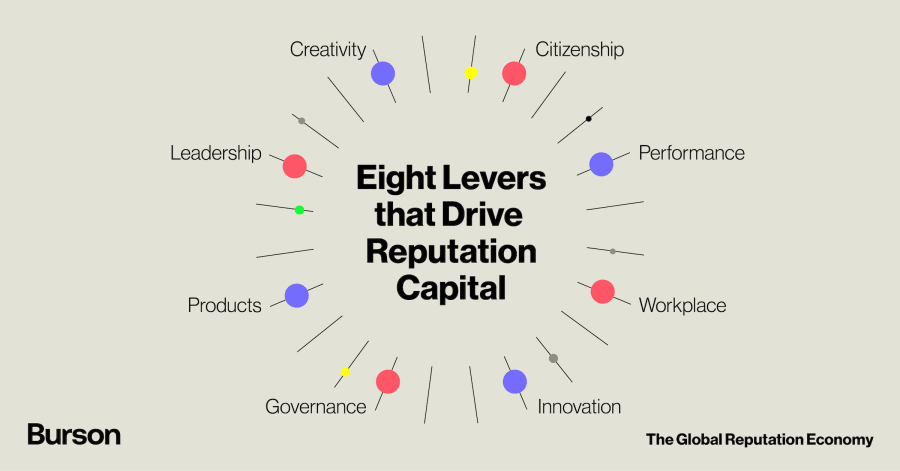
Among the eight drivers of reputation capital, the study identified the workplace - a company’s reputation as an employer - as the highest-ROI reputation investment, despite ranking lowest in perceived importance (11 per cent).
The study warns that this gap may become a crisis for companies that mishandle the integration of artificial intelligence.
"Businesses must go beyond having an 'AI strategy' and create an 'AI people strategy,' because how they manage this transition will be a powerful statement about how they value their employees," said Matt Reid, Global Corporate and Public Affairs Lead, Burson, and U.S. CEO, Burson Buchanan.
"Organisations that invest in reskilling their workforce and co-create the future with their people will earn a reputation dividend. Conversely, those that view AI merely as a tool for headcount reduction will pay a reputation tax, with any efficiency gains offset by reputational losses."
Further key findings
- Top-performing companies dominate across all eight drivers of reputation, scoring an average of 11 to 15 points higher on each lever. The biggest gaps were seen in innovation (15.5 points), product (15.2 points), and governance (14.4 points).
- In the aerospace and energy sectors, reputation is being rebuilt from the inside-out. Two aerospace companies showed the greatest reputation gains, not through showcasing their products, but through a focus on the governance and workplace drivers. Similarly, the energy sector’s reputational gains come from a focus on the workplace and citizenship, not just sustainability narratives.
- In the financial sector, the study found a consistent decline in scoring across leadership, governance, and citizenship. Within the financial firms analysed, this amounts to a US$4.3 billion reputational value risk, which is 38 per cent of their total reputational value of US$11.4 billion.
"Our research demonstrates that reputation is no longer an abstract idea, but a measurable asset with a direct impact on enterprise value," said HS Chung, Asia-Pacific CEO of Burson.
“For Asian companies, including those in Korea, disciplined reputation management is now critical to competing and winning on the global stage. Through our proprietary Reputation Capital model, we're offering clients with near real-time insight into the state of their reputation and how external events are shaping it. This is not only enabling more agile planning and execution but also keeping us sharply focused on the areas that drive tangible business outcomes, helping clients make informed decisions at scale and with speed."
The full report can be found here.
.jpg)
.jpg)
-Oct-12-2026-11-23-43-4230-PM.png)