

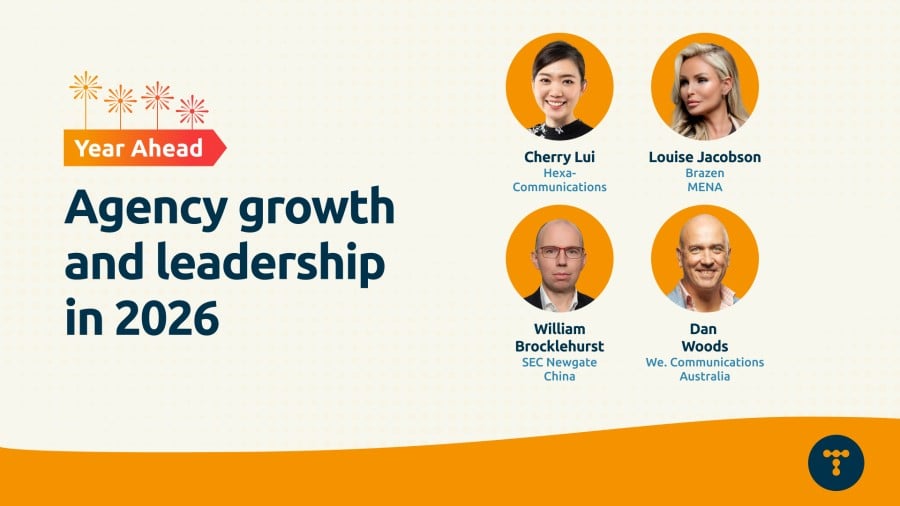
Traditionally, the start of a new year signals fresh beginnings - a time to reset priorities and plan strategically for growth. But as economic pressures continue to reshape the business landscape, agency leaders are being forced to rethink what sustainable growth really looks like, and how it can be achieved in an environment filled with uncertainty.
With leadership and culture increasingly recognised as critical drivers of long-term performance, Telum Media spoke with agency leaders from across multiple regions to understand how growth is being approached from the top down, and where they see the most meaningful opportunities for the PR and communications industry in 2026.
As economic pressures reshape the business landscape, how does your agency approach growth, and what role does leadership and culture play in driving it?
Dan Woods, Managing Director, We. Communications Australia
A couple of things come to mind. The first, to borrow from Socrates, is to “know thyself”. It wasn't that long ago that a swag of agencies decided that they could offer more and grow more as a result. For a small number, this turned out to be true, but for many, it spelt trouble. This led to a dilution of their strengths and confusion about their offer, not to mention significant strain on their operating environment and finances.
For me, the key in this current environment is being very clear about what we do at We., and by definition, being equally clear about what we don't do. That means internal alignment that translates to external clarity.
The things that we do must be done extremely well. We need to aspire to be the best in show - being consistently at the standard expected by our clients, in ways that will ensure we win repeat business and grow existing remits. This also enables us to earn the attention of potential clients looking for support.
Word of mouth is still very real and reputation matters.
Cherry Lui, Managing Partner, Hexa-Communications
In a tougher economic climate, growth has to be intentional.
At H-C, we focus on high-value work rather than high-volume activity. We prioritise sectors where communications can genuinely shift behaviour, and where our expertise creates measurable impact. That discipline keeps us competitive even when the market is volatile.
Leadership plays a central role here. My responsibility is to give the team clarity, direction, and the environment to perform at their best. You cannot build growth on uncertainty - you build it on a clear purpose, consistent standards, and a culture that rewards performance, learning, and accountability.
Culture is not a slogan - it is the operating framework that determines the pace, quality, and ambition of the agency. When culture is strong, the organisation can move faster and adapt faster.
William Brocklehurst, Managing Partner, SEC Newgate China
Fundamentally, at SEC Newgate, we remain focused on providing high quality corporate and public affairs advice to our clients. While the landscape may shift, as it will always do, we have a clear understanding of our strengths here in Hong Kong, in Asia, and around the world.
Culture plays a huge role in how we work and what we do at SEC Newgate. We operate on a model where each of our offices have local autonomy, while always remaining connected through shared global resources and governance.
That means we have fast, locally informed decisions that are supported by our global network and standards. That culture helps to promote both collaboration and accountability, helping us provide clients with what they need in each market, rather than a global solution designed elsewhere.
This combination of local agility and global connectivity supports consistent client delivery and our ongoing growth.
Louise Jacobson, Managing Partner, Brazen MENA
Our approach to growth is very clear: build where we deliver the most value.
This year showed us exactly which verticals are accelerating for us: hospitality, luxury, fashion, travel, and real estate. So, 2026 is about strengthening those even further and expanding our regional footprint in a way that deepens our partnerships across the market.
Culture and leadership are the reason that direction works. When people feel trusted, empowered, and part of the commercial conversation, they perform differently. At Brazen, culture isn't just "how we work" - it's how we grow. The team knows where we're heading, why it matters, and how their role contributes to the bigger picture, and this is all backed by team action plans. That kind of clarity fuels better decisions and more innovative work.
My own leadership is rooted in trust and real connection. I lead with heart and action, being present, listening properly, and giving people the space and support to grow. This region runs on relationships, and my aim is always to be a partner my team and clients can rely on. When trust sits at the centre, everything else has a stronger foundation.
Where do you see the biggest opportunities for meaningful growth in the PR and communications industry in 2026, and what mindsets or capabilities will define the agencies that thrive?
Dan Woods
When you gather clients together in a room - singularly or as a group (as we recently did a roundtable breakfast) - it is clear that they are under enormous pressure. They are working in a world that is splintered, volatile, and as uncertain as it has ever been. The demands on them are high: the budgets they have are lower and / or must be stretched further, while the expected returns are proportionately higher than at any other time.
Comms products and services will remain essentially the same as they always have been (irrespective of the ubiquitous "re-packaging" trend we are currently seeing in the market) whilst evolving in line with the impact of technology and AI. And yes, AI will and should make delivery of some of those services more efficient and effective. But what AI can't do is directly foster relationships and trust, nor substitute informed strategic counsel and guidance. That is the domain of the professional communicator and the responsibility of an agency partner.
Niche products will evolve and iterate, but for me, the cultivation of relationships and trust lies at the heart of success.
Cherry Lui
In 2026, the most important opportunities will sit where communication meets public good.
Health, climate, technology, and social protection, these are not just sectors - they are human stories. Agencies that can bridge government, the private sector, and citizens, and explain complex issues in a way that feels fair, accessible, and respectful, will be the ones that move societies forward.
AI will also accelerate a lot of what we do, but the real differentiator will be human values and judgement. The agencies that thrive will pair strong analytical and technological skills with empathy, cultural sensitivity, and deep listening. They will be humble enough to keep learning, and bold enough to speak up for what is responsible and truthful.
For me, meaningful growth is not only about winning assignments; it's about helping shape a more informed, kinder, and more resilient country - one campaign at a time.
William Brocklehurst
An ability to manage through ambiguity and agility to make decisions quickly will be key to helping clients successfully navigate this environment. Of course, AI tools will help, but we also see a lot of algorithmic noise and hallucinogenic inaccuracies from these tools. For us, they remain more of a support tool than the final deliverable.
In terms of capabilities, our focus is on:
- Converting data and research into insights for decision-making.
- Understanding the intersection of geopolitics and domestic policy to manage risk.
- Offering informed perspectives on the drivers of trust and reputation to a client.
Overall, agencies that are insight-led, globally connected, and locally credible will be best placed to deliver results for clients in today's world.
Louise Jacobson
The biggest opportunity in 2026 lies in truly understanding where we create value for clients, and that won't always sit in classic PR deliverables. Brands are looking for partners who can connect communications to business outcomes, reputation, and long-term growth. Agencies that step into that advisory space will stand out.
Innovation will continue to accelerate, especially with AI, but the advantage won't come from tools alone. It will come from teams who know how to apply them with judgement, using automation to create space for sharper thinking, better storytelling, and stronger decision-making.
There's also meaningful growth in agencies that build depth in the verticals that matter most to their market. It's about understanding what drives value in each sector and shaping work around that reality, not around legacy definitions of PR.
Above all, the MENA region will continue to reward trust. Partnerships built on understanding, consistency, and genuine connection will outperform any trend. Agencies that stay adaptive, stay commercially aware, and stay close to their clients' world will be the ones that move fastest.

-Sep-23-2026-02-32-38-6871-AM.png)