PR News
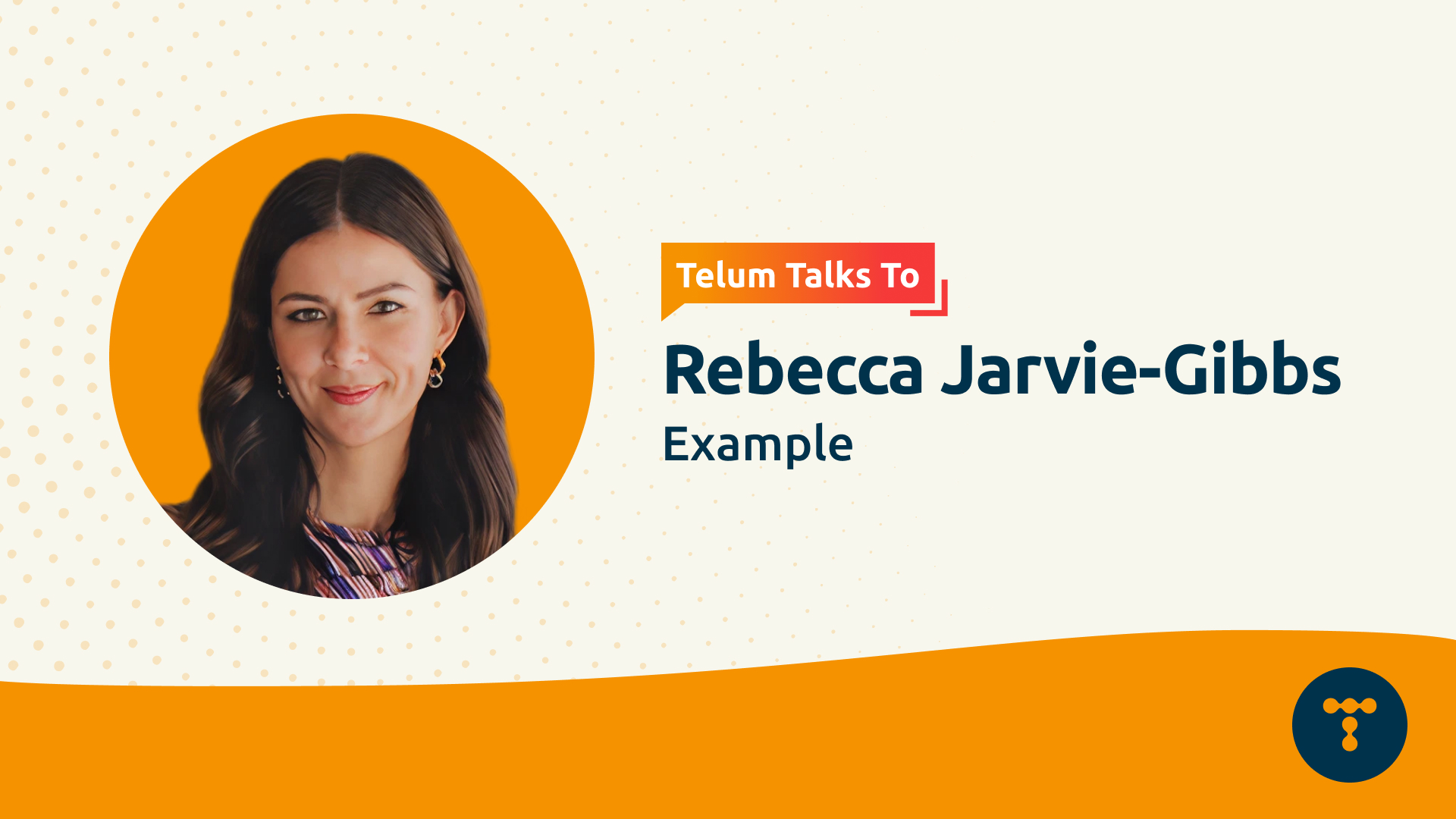
Rebecca Jarvie-Gibbs

Telum Talks To: Rebecca Jarvie-Gibbs from Example

In an industry built on agility, speed, and client demands, the line between ambition and exhaustion can be razor-thin. For PR and communications professionals, being constantly "on" has long been framed as a marker of success. But a growing discourse is pushing back, advocating for a shift from toxic hustle to an intentional and sustainable "healthy" hustle, with the focus on clarity, energy, and systems that enable professionals to thrive without burning out.

Telum Media spoke with Rebecca Jarvie-Gibbs, Co-Founder and COO of Example, on what it means to reject performative busyness and embrace balance as a badge of honour. Rebecca recently launched her own podcast, Fine Form, which explores the realities of hustle culture and shares candid insights from her journey through burnout and recovery.

From redefining productivity and reducing friction to modelling sustainable leadership, her reflections provide a roadmap for PR and comms professionals eager to reclaim personal time, protect their energy, and pursue success on their own terms.

What did your own experience with overwork teach you, and when did you first start rethinking what success should look like?
I believe work often reflects what we haven't yet resolved in ourselves. When you're unclear about who you are, the job quickly steps in to define it - offering validation, identity, a sense of worth. That's when ambition shifts.

Instead of being yours to guide you forward, it becomes tethered to external markers - titles, client counts, or how busy you look. On the surface, it may appear impressive, but inside it feels very different.

My turning point came when full-blown burnout collided with the birth of my son - I felt utterly trapped in a cage of my own making. From a dark and uncertain place, I began to rebuild by doing two things. First, I got really clear on how I wanted my work to feel, not just how it looked. And second, I confronted the toxic behaviours I'd adopted around work and made big changes in how I showed up for myself each day.

You've spoken about rejecting toxic hustle. How would you define a "healthy hustle," and what might that balance look like for someone working in PR?
For me, it all comes down to energy - something either gives it to you or takes it away. I still believe in hard work; building a career or life you want takes discipline and focus. But there's a difference between feeling tired yet satisfied, and feeling constantly tired and empty. One feels like effort with momentum, the other feels like effort slammed up against a wall.

My idea of balance may not be the same as someone else's, but the key is clarity. As you move through a period of work, ask yourself: is this exciting me, expanding me, or just exhausting me? A simple way to check is by keeping a "drain vs gain" tracker for a week. If something consistently drains you, it's probably a good time to stop chasing it.

I also think of work in terms of spikes and stretches. There are spikes of intensity - a big pitch, launch, or campaign - that can be energising and exhilarating. But they have to be balanced with stretches of recovery, reflection and recalibration. When the spikes start to feel like the rule instead of the exception, that's when burnout creeps in.

Ultimately, I believe that a healthy hustle is rooted in what I like to call 'professional resonance' - when your ambition is grounded in clear values and sustained by simple, energising habits.

When you look at the PR and communications industry today, do you see a shift in working styles - particularly with younger professionals prioritising wellness, balance, and flexibility - or are we still a long way from breaking free of hustle culture?
I think a lot of people talk about wellness and balance, but don't really know what that actually looks like in practice. And so without realising it, they build habits that actively prevent those things from happening and allow huge amounts of friction into their day - unclear priorities, reactive communication, SO many meetings - and wonder why they feel overwhelmed.

I then see it play out in two main ways. On one side, people disconnect completely. They play it safe, avoid pushing themselves, and end up struggling with a lack of purpose. On the other, they fall into martyrdom, become addicted to the stress and exhaustion and justify doing a lot as if it's the only way to succeed. I've been there, and it's a dangerous place to stay.

For me, the real shift comes when you take ownership of the friction. Burnout doesn’t just "happen" to us - it's the accumulation of habits and systems that we tolerate. Without clarity on how you're working and what you're working toward, it's easy to get swept into a cycle where busyness replaces progress, and wellness remains a buzz word rather than a lived practice.

PR often rewards being busy - but busyness doesn’t always equal progress. How do you personally tell the difference, and what habits or approaches have helped you shift towards real productivity?
I think PR actually rewards agility and creativity, but too often people conflate that with being busy and stretched. One of the great things about our industry is the speed at which you can influence news and culture, and the energy that comes from delivering impactful work and building strong relationships. But you can't be agile when your diary is crammed with back-to-back meetings, and you can't be creative when you're stuck in a perpetual loop of clearing your inbox.

For me, the two biggest habit shifts came down to reducing friction and changing how I communicate. Reducing friction means designing your day so fewer things feel unnecessarily hard - cutting out recurring stress points like clunky processes, mismatched meeting rhythms and unrealistic schedules.

Changing communication meant breaking the cycle of urgency and reactivity. For years, I thought being constantly available and instantly responsive was proof of competence. In reality, it kept me in a constant state of distraction. Now, I don't reply to emails on my phone and I avoid responding in the heat of the moment - because rushed replies made in a heightened state are almost always the ones I regret.

As an agency leader yourself, how do you put these ideas into practice within your own team? And what lessons could other senior leaders take from your approach to building a productive but sustainable culture?
First and foremost, I live it. There's no point talking about balance if you’re still leading from a place of urgency. Panic breeds panic. If you show up constantly spinning plates and stretched thin, the team will think that's what leadership looks like.

It is absolutely crazy to me now that I once thought being a busy leader with a crammed diary and no time to think was inspiring. In reality, it only modelled unsustainable behaviour.

I also used to take on my team's stress, going into overdrive to solve their problems or take work off them. Of course, some things are mine to manage - the resourcing we have, the clients we work with, the timelines we commit to. But how someone chooses to work is ultimately on them. Being clear on what sits in their control and what doesn't has been an important shift.

Ultimately as a leader, you set the tone, so if you remove constant friction, protect energy and model alignment, you give your team permission to do the same.

Previous story

Virginie Cosentino takes up promotion as Business Director

Next story

The Natural Resources Defense Council bolsters comms with new hire

You might also enjoy

Leadership
Moves

Leadership appointment at FleishmanHillard Singapore

Aaron Tan has joined FleishmanHillard as Auto Practice Lead and Account Director, bringing experience across branding, communications, marketing and digital strategy.


Based in Singapore, he has accumulated more than 15 years of experience, having previously held senior roles at agencies including The Ate Group and W Communications.

Study
Research

Study Highlight: AI trust higher among Chinese public than in the West, Edelman poll finds

In 2025, artificial intelligence sits at the centre of growing global divides. Across economies and generations, engagement with AI is revealing widening gaps in trust, understanding, and opportunity.

Chinese AI trust landscape
The 2025 Edelman Trust Barometer Flash Poll: Trust and Artificial Intelligence at a Crossroads reveals that respondents in Mainland China demonstrates high trust in AI compared to developed markets, including the US, UK, Brazil and Germany.

87 per cent of Chinese respondents say they trust AI, a figure that increased by 9 per cent   between November 2023 and October 2025. This compares with trust levels of 32 per cent in the US, 36 per cent in the UK, and 39 per cent in Germany.

Strong embrace of AI adoption
High trust in AI among Chinese respondents also translates into their everyday use. 60 per cent of Chinese employees use AI weekly or more, while 49 per cent say they embrace its growing use, compared with just 18 per cent who reject it.

Acceptance is particularly strong in sectors shaping future growth. 43 per cent of financial services workers and 55 per cent of technology sector employees report embracing AI in their work, highlighting how quickly the technology is becoming embedded in professional life.

Optimism over fear of disruption 
Unlike Western markets, where AI is often framed as a threat, Chinese respondents remain broadly optimistic. At least 67 per cent believe generative AI will help rather than harm society, including in areas such as climate change, work life, mental health, social cohesion, and economic equity.

Fear of economic displacement is notably low. Only 26 per cent worry that people like them will be left behind by AI, the lowest level among all surveyed markets. Even among lower-income respondents, concern rises to just 36 per cent.

A broad ecosystem of trust
Mainland China’s confidence in AI extends across all categories of AI communicators. 87 per cent trust 'people like themselves' to speak truthfully about AI, 88 per cent trust friends and family, and 85 per cent trust coworkers.

Trust in institutions and authority figures is similarly high, including 87 per cent for scientists and AI researchers, 83 per cent for CEOs, and 84 per cent for journalists and technology influencers.

More than 70 per cent of respondents are comfortable with their employer's use of AI - the highest rate amongst countries surveyed, while 60 per cent are comfortable with the media's AI usage.

Trust issues outweigh other barriers
Despite high overall trust, some barriers to AI adoption exist in Mainland China. Among infrequent users, 43 per cent cite trust concerns such as data protection, 28 per cent worry about how data will be protected, and 19 per cent are concerned about how their data will be used. Issues of motivation and access affect 40 per cent, while discomfort with technology is cited by just 15 per cent.

However these barriers are significantly lower than in Western markets, where 55 to 70 per cent of infrequent users identify trust as the main obstacle to AI adoption.

Ultimately, the Edelman Flash Poll highlights a simple point: trust shapes adoption. Mainland China’s high public confidence supports faster and broader use of AI, while lower trust in Western markets aligns with a more cautious pace. These differences underline how public attitudes influence the trajectory of technological change across regions.

Study
Research

Study Highlight: Beyond ESG: Global perspectives on communicating impact

PROI has released their latest report, "Beyond ESG: Global perspectives on communicating impact". With insights from 11 global communications agencies, the report highlights key trends shaping how ESG and purpose will be communicated in 2026.

Ted Deutsch, Executive Managing Director of RF|Binder and Chair of PROI's ESG Working Group, said: "While certain markets are shying away from acronyms and terms that are seen as overly political, this PROI report confirms that companies are still focused on driving change through sustainability, corporate culture and good governance. The challenge now lies in communicating this with authenticity."

ESG across the regions
ESG maturity differs widely by region. Markets such as Australia, Switzerland, and the Middle East operate in relatively advanced regulatory environments. In Australia especially, Paula Cowan, Managing Director at ImpactInstitute, described ESG as no longer a "nice to have," but rather a licence to operate.

Meanwhile, countries such as Poland and the Czech Republic are experiencing signs of ESG fatigue. As Dirk Aarts, CEO of 24/7 Communication, observed in Poland: "...enthusiasm has cooled. Many businesses now treat ESG chiefly as a regulatory requirement rather than a reputational advantage."

In Thailand, ESG is viewed as central to long-term competitiveness, economic resilience, and access to global markets. Whereas in Ukraine, ESG is shaped by wartime realities and EU integration, with social impact and resilience taking precedence.

Despite their differences, one thing stays consistent: stakeholder expectations are converging. The report highlights how companies are increasingly expected to demonstrate real progress and credible outcomes rather than just showing intent.

Global pressures driving change
It was reported that every region, in one way or another, was being impacted by global forces reshaping their ESG communications. Regulatory alignment stood out as a major driver, particularly around mandates by the International Sustainability Standards Board (ISSB), the Corporate Sustainability Reporting Directive (CSRD), and other international disclosure frameworks.

Trade-related mechanisms, such as the EU's Carbon Border Adjustment Mechanism, have resulted in a push for ESG adoption in export-oriented economies like Thailand. Chelsea King, Head of PR Operations and Editorial Director Midas PR, explained: "This creates direct financial pressure and has spurred Thailand’s domestic carbon tax and mandatory reporting efforts."

Political dynamics also play a significant role, with the U.S. becoming the focal point of ESG politicisation, influencing corporate behaviour across multiple markets. This has contributed to more cautious language globally. For example, in Canada, "...U.S. discourse has influenced Canadian corporate leaders to reconsider how explicitly they use the 'ESG' label," said Kimberly Cohen, CEO of Brown & Cohen.

At the same time, global enforcement action against greenwashing is increasing in Canada, as well as other markets such as Australia, Switzerland, and the UK, reinforcing a shift toward proof-based communication.

Language and framing
The report outlined a clear global trend: the declining use of the acronyms "ESG" and "DEI" in public-facing communications. While these terms remain common in investor, regulatory, and technical contexts, organisations are shifting toward simpler and less politicised language, such as "sustainability," "responsible business," "resilience," and "impact."

Kimberly noted that in Canada, these acronyms are increasingly being broken down into their component parts, whereas in Poland, Dirk explained that the narrative now focuses on health, quality of life, and local community impact - moving away from war language, such as "fighting climate change," toward tangible well-being. This shift doesn't reflect a divergence from ESG principles, but rather as an effort to improve clarity, reduce political risk, and connect more directly with local audiences.

Across several regions, including Canada, the UK, the U.S., Thailand, and the Middle East, an increase in social initiatives continues, but under different labels, such as workforce development, inclusion and belonging, human capital management, and community impact.

Communications challenges
Across all regions, communications leaders are reported to have been facing similar challenges, particularly in balancing ambition with credibility. Stakeholders expect companies to act, but are increasingly rejecting vague or exaggerated claims. Greenwashing, social-washing, and "greenhushing" - deliberately under-communicating progress, which is reported to be rising in Australia - are recurring risks.

Another challenge is internal alignment. ESG data and narratives often sit across multiple functions at an organisation, and when teams are not aligned, messaging can become inconsistent or fragmented, resulting in a lack of trust. In sensitive contexts, such as in Ukraine or politically polarised markets like the U.S. and UK, audiences are sceptical and quick to point out inauthenticity.

Looking ahead
Contributors generally predict that over the next two to three years, ESG communications are expected to become more integrated with financial reporting and core business strategy. Many regions anticipate stricter disclosure requirements, greater use of assurance, and increased focus on governance as the foundation for environmental and social credibility.

Media scrutiny is also intensifying. Investigative reporting on ESG claims is growing, while routine sustainability announcements receive less attention unless backed by data or clear outcomes. At the same time, there is continued demand for accessible explanations, case studies, and stories that demonstrate how ESG efforts deliver tangible benefits to communities, employees, and economies.

Practical guidance for communications professionals
Based on insights across all 11 markets, some common practical guidance include:

  • Lead with evidence: Anchor claims in data, defined methodologies, and disclosures, with assurance.
  • Adapt language and be precise: Localise messaging and ensure clear messaging that resonates with target audiences, while avoiding unnecessary jargon.
  • Show progress over time: Share interim milestones and regular updates to demonstrate momentum and avoid greenwashing or greenhushing.
  • Integrate ESG into the business narrative: Position environmental, social, and governance efforts as part of core strategy and operations, rather than a standalone initiative globally.

Find the full report, including in-depth insights for each region, here.