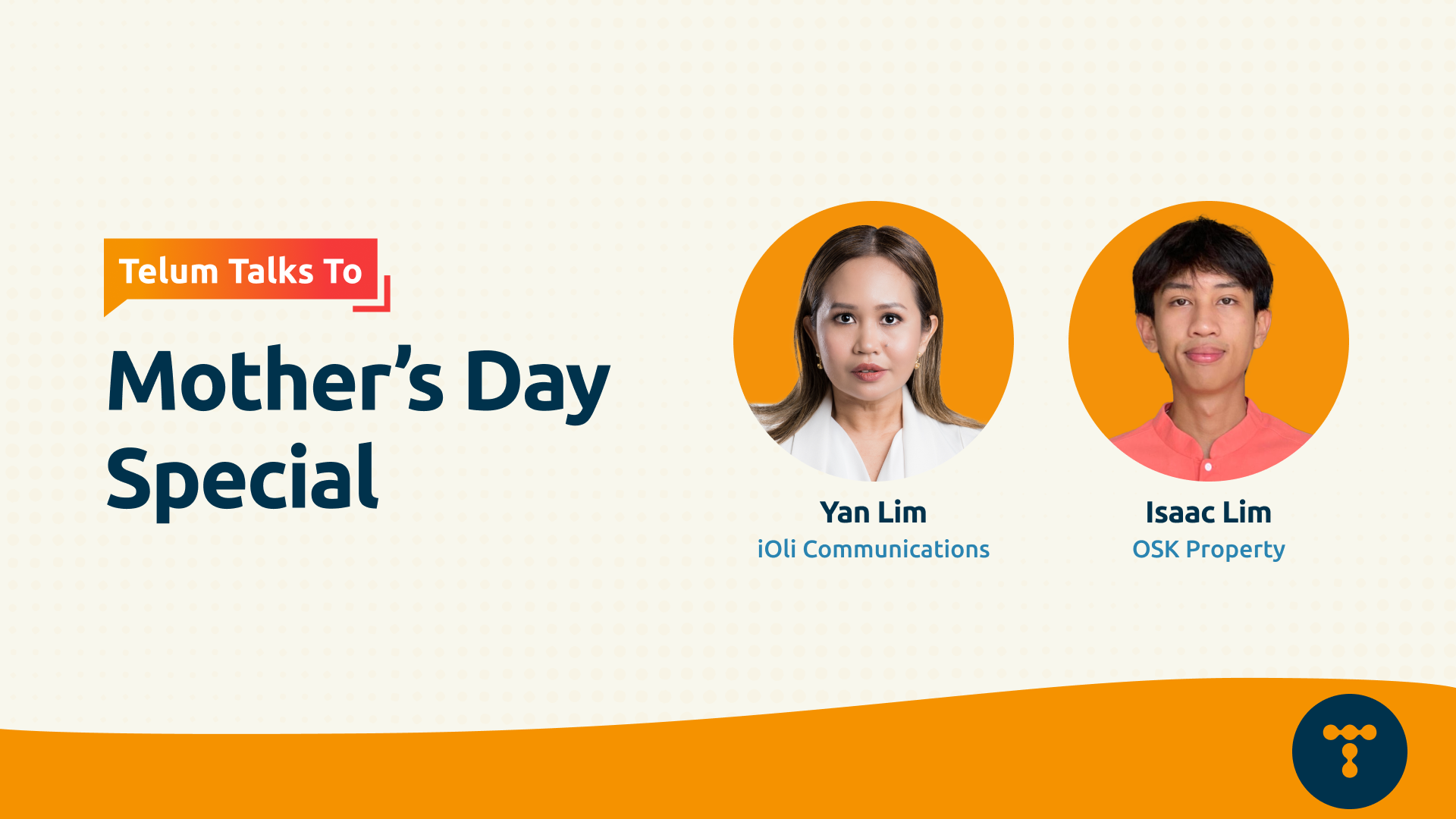
In the spirit of the upcoming Mother’s Day, Telum Media sat down with mother-and-son duo, Yan Lim, CEO and Founder of iOli Communications, and Isaac Lim, Brand, PR & Digital Executive at OSK Property, to explore their shared passion for PR and communications. From childhood memories to professional milestones, they reflect on how they’ve inspired each other over the years and what the world of communications truly means to them.
What brought you to the communications industry? Could you take us back to where it all began?
Isaac: From a young age, I’ve always followed my mum to the office, even before she set up her own agency. So, naturally, I grew up being very familiar with the office environment, learning about the working world and the communications industry.
When I first stepped into iOli Communications, it felt particularly special. Our whole family helped set up the space and I watched my mother building the agency from the ground up. Seeing her transition from working in other people’s offices to creating a space of her own where her team could express their creativity and bring ideas to life has instilled a sense of pride in me.
I began to realise PR and communications might be something I’d want to pursue as well. That sense of purpose that she had, of being the go-to person for others, is something I deeply admire and hope to replicate in my own career.
What soft skills did you unknowingly pick up from your mum that now help you in your day-to-day PR work?
Isaac: One soft skill I picked up from my mum is her strong work ethics and professionalism. I’ve always admired the amount of effort she puts into everything she does, whether it’s her job, being a mother, a friend, or any other role she takes on, and I try to model that same level of dedication.
Another skill I’ve learned is her mannerisms. She always makes a point to say things like “please” and “thank you”. I’ve noticed that people my age sometimes overlook these small courtesies, but when I started applying them myself, I realised how much of a difference they make. Not only do they help me come across as more approachable, but in the world of communications, these gestures are essential for building rapport and trust.
When you first founded iOli Communications a decade ago, did you anticipate Isaac following your footsteps into the communications field? What is it like sharing a career path with him?
Yan: It’s a bit of both - yes and no. Fundamentally, iOli Communications is a family business. In that sense, there was always a quiet hope that one of the children might one day take over the business. And for that to happen, they’d need to be a communications professional.
But to be honest, I never imagined Isaac would be the one to follow me into the world of communications. Throughout his childhood and teenage years, he was deeply passionate about the culinary arts. At one point, we were even making plans to send him to Le Cordon Bleu at Sunway, and eventually to France.
Towards the end of his secondary education, Isaac told me he was interested in pursuing communications. I was surprised, but not entirely. He’s always been great with people and has a natural ability to express himself clearly and thoughtfully.
But Isaac had something different. He was articulate, confident, observant and showed emotional intelligence; all of which are valuable traits for a communications practitioner. I enrolled him at Taylor’s College, which also kicked off my involvement as guest lecturer there. Today, I serve as the External Industry Assessor of the college and it’s been fulfilling to witness his communications journey unfold.
As a mother and a PR professional, once Isaac decided on this path, I set up my mind to support and guide him but never interfere.
While we don’t work together directly now, I’ve had the chance to collaborate with him and see his professionalism and work ethic first-hand during his internship at iOli Communications previously. I’ve always been proud of Isaac, but seeing him do well in a field that means so much to me has made me even prouder.
Do you ever find yourself learning new things from Isaac, even after all these years in PR?
Yan: There’s a lot I’ve learnt from him. First and foremost, I’ve had to set aside my pride and ego as someone with a more traditional communications background.
One thing I admire about the younger generation is their confidence in speaking up and voicing their opinions, which is something my generation wasn’t really taught to do. When Isaac was in college, he would often come home and share what he’d learnt from his assignments. Now, he brings home insights and experiences from his job that we might not be able to replicate at iOli Communications due to the smaller scale or budget of our clients.
One of the key areas I’ve learnt from Isaac over the years is digital marketing and social media activation. At iOli Communications, we’re more experienced in strategic communications and traditional PR, but when it comes to creative social media strategies and KOL engagement, this generation really excels. They’re incredibly savvy and innovative in that space.
Even though we don’t specialise in digital marketing and social media activations, we do occasionally offer those services to our existing clients. So for example, whenever Isaac shares something new, a trend on TikTok, it refreshes my knowledge and I make a point to keep a lookout for it. Digital knowledge is definitely something I’ve been learning from him and his generation.
What advice do you find yourself giving Isaac the most - whether as a mother or a PR leader?
I give Isaac all kinds of advice, but one piece that really stands out is the importance of communicating effectively.
Being in an industry built around communications, it’s essential to have strong communication skills. It doesn’t mean just talking - it’s about truly listening, understanding and expressing your thoughts clearly and in context. And this applies to everything - from how you text someone on WhatsApp, to how you speak with your parents or siblings at home, how you interact with friends at school and eventually, how you communicate at work.
The other key piece of advice I give him is about attitude. I truly believe that attitude shapes everything. Skills can be taught, but attitude can’t. For example, things like being respectful, humble, eager to learn and curious. In my position as CEO and hiring manager, I often tell Isaac and my team that while it’s great to hire someone who is on the Dean’s List or has obtained straight As, it’s your attitude that will carry you far, no matter what field you’re in.
I also remind him to build a good reputation - for himself, not for me. As a parent, of course I sometimes worry that my children might feel pressured to live in my shadow, but I always remind them that they can do whatever they want and it’s for their own reputation.
What does PR or communications mean to you personally? And where do you see yourselves or the industry in the next five years?
Isaac: To me, PR means being a jack of all trades. You need to understand your clients and vendors deeply, while also managing the more technical aspects. I see PR as a space where I can constantly learn, absorb and apply new knowledge and keep growing. Looking ahead to the next five years, I don’t like setting goals that are too big, materialistic, or overly specific. I’ve learnt that doing so can sometimes create unnecessary pressure. One thing I do consciously, though, is to remind myself not to compare my journey with others; the only person that I should be competing with, is myself.
So while I may not know exactly where I’ll be or what I’ll be doing in five years, what I do know is this: I want to make a positive impact wherever I am, keep learning as much as I can, and continue becoming a better version of myself each day.
Yan: I truly love my job and the PR industry as a whole and everything that we do. As PR professionals, we take pride in immersing ourselves in our clients' worlds; from technology to healthcare, or any other sector. We study their industries thoroughly so we can be well-equipped to support them effectively. Personally, I’ve also devoted a lot of time to mentoring and nurturing the next generation of practitioners, whether through lectures and workshops at public and private universities, or through daily knowledge-sharing within my team.
PR is so much more than just managing public perception. People often assume PR is about spinning stories or chasing publicity, but to me, it's the marriage of art and science. It’s how we think strategically, respond to issues, craft narratives and influence behaviours. There's something noble about helping clients tell their stories, protect their reputations, and build lasting value and credibility - it takes vision, empathy, and a lot of hard work.
Looking ahead over the next five years, one thing remains the most important to me - maintaining a human touch in our work by blending the best of traditional PR with new and innovative strategies. That means keeping personal connections alive, like building strong relationships with journalists through media drops or simply catching up with them over coffee or tea (and donuts!). While platforms like Telum Media make our jobs more efficient and convenient, we must not forget the true essence of PR and comms: authentic, human connection.
On a personal note, as a mother, I hope Isaac grows into a leader in his own right, no matter where life takes him. I always remind him that leadership isn’t defined by titles like CEO, Account Manager, or Senior Consultant. It’s about inspiring others, taking initiative, and contributing to shared goals. I want him to lead with integrity, curiosity, and, most importantly, with heart. Specifically for Isaac, I hope he finds his unique voice within the PR and communications field and uses it to positively influence those around him.
What brought you to the communications industry? Could you take us back to where it all began?
Isaac: From a young age, I’ve always followed my mum to the office, even before she set up her own agency. So, naturally, I grew up being very familiar with the office environment, learning about the working world and the communications industry.
When I first stepped into iOli Communications, it felt particularly special. Our whole family helped set up the space and I watched my mother building the agency from the ground up. Seeing her transition from working in other people’s offices to creating a space of her own where her team could express their creativity and bring ideas to life has instilled a sense of pride in me.
I began to realise PR and communications might be something I’d want to pursue as well. That sense of purpose that she had, of being the go-to person for others, is something I deeply admire and hope to replicate in my own career.
What soft skills did you unknowingly pick up from your mum that now help you in your day-to-day PR work?
Isaac: One soft skill I picked up from my mum is her strong work ethics and professionalism. I’ve always admired the amount of effort she puts into everything she does, whether it’s her job, being a mother, a friend, or any other role she takes on, and I try to model that same level of dedication.
Another skill I’ve learned is her mannerisms. She always makes a point to say things like “please” and “thank you”. I’ve noticed that people my age sometimes overlook these small courtesies, but when I started applying them myself, I realised how much of a difference they make. Not only do they help me come across as more approachable, but in the world of communications, these gestures are essential for building rapport and trust.
When you first founded iOli Communications a decade ago, did you anticipate Isaac following your footsteps into the communications field? What is it like sharing a career path with him?
Yan: It’s a bit of both - yes and no. Fundamentally, iOli Communications is a family business. In that sense, there was always a quiet hope that one of the children might one day take over the business. And for that to happen, they’d need to be a communications professional.
But to be honest, I never imagined Isaac would be the one to follow me into the world of communications. Throughout his childhood and teenage years, he was deeply passionate about the culinary arts. At one point, we were even making plans to send him to Le Cordon Bleu at Sunway, and eventually to France.
Towards the end of his secondary education, Isaac told me he was interested in pursuing communications. I was surprised, but not entirely. He’s always been great with people and has a natural ability to express himself clearly and thoughtfully.
But Isaac had something different. He was articulate, confident, observant and showed emotional intelligence; all of which are valuable traits for a communications practitioner. I enrolled him at Taylor’s College, which also kicked off my involvement as guest lecturer there. Today, I serve as the External Industry Assessor of the college and it’s been fulfilling to witness his communications journey unfold.
As a mother and a PR professional, once Isaac decided on this path, I set up my mind to support and guide him but never interfere.
While we don’t work together directly now, I’ve had the chance to collaborate with him and see his professionalism and work ethic first-hand during his internship at iOli Communications previously. I’ve always been proud of Isaac, but seeing him do well in a field that means so much to me has made me even prouder.
Do you ever find yourself learning new things from Isaac, even after all these years in PR?
Yan: There’s a lot I’ve learnt from him. First and foremost, I’ve had to set aside my pride and ego as someone with a more traditional communications background.
One thing I admire about the younger generation is their confidence in speaking up and voicing their opinions, which is something my generation wasn’t really taught to do. When Isaac was in college, he would often come home and share what he’d learnt from his assignments. Now, he brings home insights and experiences from his job that we might not be able to replicate at iOli Communications due to the smaller scale or budget of our clients.
One of the key areas I’ve learnt from Isaac over the years is digital marketing and social media activation. At iOli Communications, we’re more experienced in strategic communications and traditional PR, but when it comes to creative social media strategies and KOL engagement, this generation really excels. They’re incredibly savvy and innovative in that space.
Even though we don’t specialise in digital marketing and social media activations, we do occasionally offer those services to our existing clients. So for example, whenever Isaac shares something new, a trend on TikTok, it refreshes my knowledge and I make a point to keep a lookout for it. Digital knowledge is definitely something I’ve been learning from him and his generation.
What advice do you find yourself giving Isaac the most - whether as a mother or a PR leader?
I give Isaac all kinds of advice, but one piece that really stands out is the importance of communicating effectively.
Being in an industry built around communications, it’s essential to have strong communication skills. It doesn’t mean just talking - it’s about truly listening, understanding and expressing your thoughts clearly and in context. And this applies to everything - from how you text someone on WhatsApp, to how you speak with your parents or siblings at home, how you interact with friends at school and eventually, how you communicate at work.
The other key piece of advice I give him is about attitude. I truly believe that attitude shapes everything. Skills can be taught, but attitude can’t. For example, things like being respectful, humble, eager to learn and curious. In my position as CEO and hiring manager, I often tell Isaac and my team that while it’s great to hire someone who is on the Dean’s List or has obtained straight As, it’s your attitude that will carry you far, no matter what field you’re in.
I also remind him to build a good reputation - for himself, not for me. As a parent, of course I sometimes worry that my children might feel pressured to live in my shadow, but I always remind them that they can do whatever they want and it’s for their own reputation.
What does PR or communications mean to you personally? And where do you see yourselves or the industry in the next five years?
Isaac: To me, PR means being a jack of all trades. You need to understand your clients and vendors deeply, while also managing the more technical aspects. I see PR as a space where I can constantly learn, absorb and apply new knowledge and keep growing. Looking ahead to the next five years, I don’t like setting goals that are too big, materialistic, or overly specific. I’ve learnt that doing so can sometimes create unnecessary pressure. One thing I do consciously, though, is to remind myself not to compare my journey with others; the only person that I should be competing with, is myself.
So while I may not know exactly where I’ll be or what I’ll be doing in five years, what I do know is this: I want to make a positive impact wherever I am, keep learning as much as I can, and continue becoming a better version of myself each day.
Yan: I truly love my job and the PR industry as a whole and everything that we do. As PR professionals, we take pride in immersing ourselves in our clients' worlds; from technology to healthcare, or any other sector. We study their industries thoroughly so we can be well-equipped to support them effectively. Personally, I’ve also devoted a lot of time to mentoring and nurturing the next generation of practitioners, whether through lectures and workshops at public and private universities, or through daily knowledge-sharing within my team.
PR is so much more than just managing public perception. People often assume PR is about spinning stories or chasing publicity, but to me, it's the marriage of art and science. It’s how we think strategically, respond to issues, craft narratives and influence behaviours. There's something noble about helping clients tell their stories, protect their reputations, and build lasting value and credibility - it takes vision, empathy, and a lot of hard work.
Looking ahead over the next five years, one thing remains the most important to me - maintaining a human touch in our work by blending the best of traditional PR with new and innovative strategies. That means keeping personal connections alive, like building strong relationships with journalists through media drops or simply catching up with them over coffee or tea (and donuts!). While platforms like Telum Media make our jobs more efficient and convenient, we must not forget the true essence of PR and comms: authentic, human connection.
On a personal note, as a mother, I hope Isaac grows into a leader in his own right, no matter where life takes him. I always remind him that leadership isn’t defined by titles like CEO, Account Manager, or Senior Consultant. It’s about inspiring others, taking initiative, and contributing to shared goals. I want him to lead with integrity, curiosity, and, most importantly, with heart. Specifically for Isaac, I hope he finds his unique voice within the PR and communications field and uses it to positively influence those around him.
-1.jpg)
-1.jpg)