
PR News
Maverick Indonesia: AI visibility in beauty depends on more than brand-owned content

Maverick Indonesia: AI visibility in beauty depends on more than brand-owned content

A new Maverick Indonesia whitepaper has found that AI-generated answers about beauty and personal care in Indonesia draw on a much wider information ecosystem than brands’ own websites and channels.

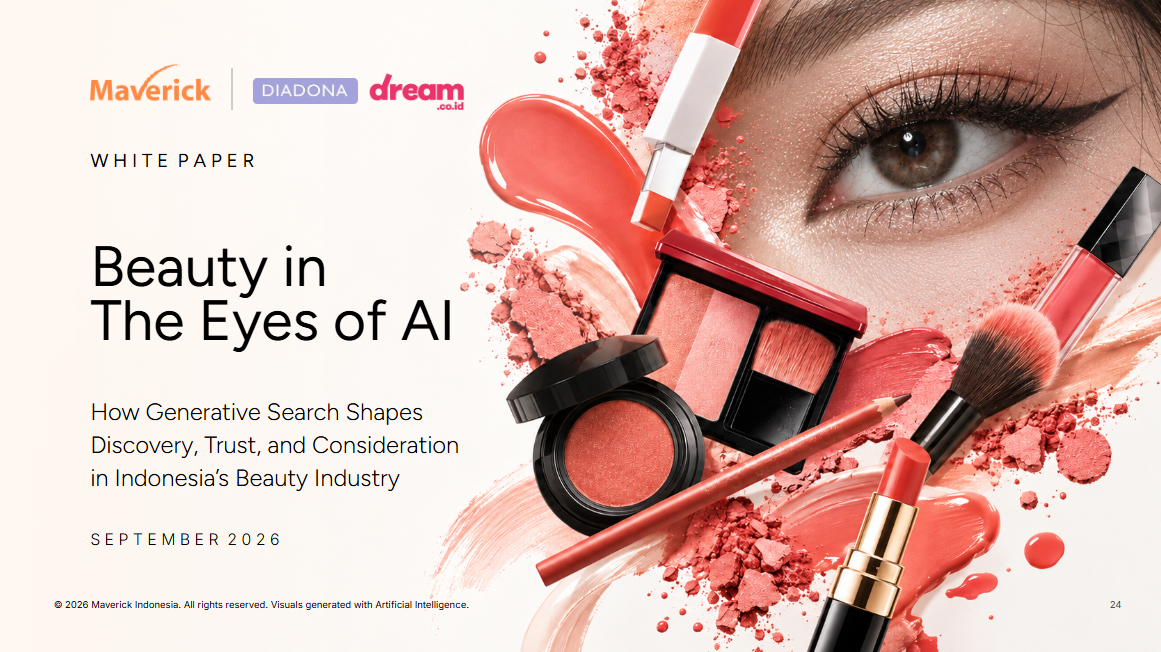
Beauty in The Eyes of AI, produced in collaboration with Dream.co.id and Diadona, examined 8,000 AI-generated responses and 63,286 citations across ChatGPT, Google AI Overview, Perplexity, Copilot, and Gemini in August 2026.

"Beauty and personal care marketing needs to combine creativity with data. In this study, AI drew on sources well beyond beauty media, with different patterns depending on what consumers asked. These findings can sharpen how brands understand audiences and media credibility, which is the basis for choosing channels and developing messages," said Cahyanto Arie Wibowo, Director of Business Growth & Innovation at Maverick Indonesia.

The study tested 100 prompts across five generative AI platforms, including 80 general prompts and 20 prompts that mentioned a brand by name. Each prompt was run daily for 16 days, generating 8,000 responses in total.


All prompts were written in Indonesian and informed by search-volume patterns. The seven topics analysed were based on around 6.4 million Indonesian Google queries related to beauty and personal care, cross-checked against consumer purchase behaviour research.

The topics covered effectiveness and suitability, ingredients and formulation, reputation and reviews, availability and sales channels, price and value, safety and compliance, and beliefs and cultural fit.

AI draws heavily on third-party sources

For general beauty questions, AI drew more heavily on third-party sources than on brand-owned websites.

News Media and Health and Medical Information accounted for a combined 46.6 per cent of citations from general prompts, compared with 11.6 per cent from Brand Owned sources.

The report says news outlets and beauty publications provide broad, independent coverage of brands, products, and beauty topics, while health and medical platforms contribute information around ingredients, safety, and suitability.

Retail and marketplace sites were also significant sources, providing details such as pricing, product information, and availability.

Brand-owned websites remained part of the information mix, but the study found that they were only one part of the broader ecosystem used by AI to answer general beauty questions.

Brand mentions change where AI looks for information

The source mix shifted when a specific brand was named in a prompt.

For branded questions, Retail and Marketplace and Brand Owned sources became more prominent, while News Media and Health and Medical Information no longer held the leading positions.

Social, Blog, and Community content also became more important. According to the report, this category rose from 9.2 per cent of citations in general prompts to 19.5 per cent when a brand was named.

The report says this reflects AI drawing more directly on product listings, brand websites, creator content, and community reviews when the question already points towards a specific brand or product.

News visibility extends beyond specialist beauty media

The study found that AI does not limit its beauty-related sources to specialist beauty publications.

Suara.com, a general news publisher, received more News Media citations than Beautynesia, Female Daily, and Popbela combined.

The report says this shows that being a specialist beauty publisher does not necessarily determine whether a source will have the strongest presence in AI-generated answers.

For brands, the report recommends looking beyond traditional beauty media when building AI visibility, as the publishers shaping AI answers can come from a much broader media landscape.

Health and medical sources play a major role

Health and Medical Information was one of the strongest source categories in the study.

Halodoc appeared across 74 of the 80 general prompts, with content covering product recommendations, ingredients, safety, and practical skincare routines.

The report found that local health platforms were particularly prominent in general beauty questions, while international medical and clinical sources became more relevant when questions required stronger medical evidence, including around pregnancy, ingredient safety, effectiveness, or specific health conditions.

Maverick Indonesia says this creates an opportunity for brands to work with local health platforms on science-based content, while recognising that more specialised questions may draw on more specific medical sources.


Retail sites are becoming information sources

The study also found that retail and marketplace sites are serving a role beyond product purchase.

Shopee, Zalora, and Watsons had the strongest presence among Retail and Marketplace sources cited in general beauty questions.

Many citations came from buying guides, comparisons, and recommendation content. The report says this means product information published through retail platforms can become part of the information AI uses when answering consumer questions.

In other words, the information attached to a product listing or retailer content can influence AI visibility as well as helpconsumers make a purchase.

AI platforms do not use sources in the same way

One of the strongest findings is the difference between individual AI platforms.

News Media accounted for 53.1 per cent of Microsoft Copilot citations, compared with only 9.5 per cent of Google AI Overview citations.

Google AI Overview placed considerably more weight on Social, Blog, and Community content, which accounted for 28.1 per cent of citations, compared with 1.8 per cent for Copilot.

Perplexity and Gemini also leaned more heavily towards News Media, at 37.3 per cent and 33.5 per cent respectively.

ChatGPT showed a more distributed source mix. Health and Medical Information accounted for 23.7 per cent of its citations, Brand Owned sources at 19.5 per cent, News Media at18.3 per cent, and Regulatory, Government,and Certification sources at 15.1 per cent.

The report says these differences mean there is no single source strategy that will work in the same way across all AI platforms.

Different beauty questions rely on different sources

The study also found that source use changes according to the type of question being asked.

Effectiveness and Suitability questions drew 45.5 per cent of their citations from Health and Medical sources.

Price and Value questions drew 36.8 per cent from News Media, while Brand Owned sources reached their highest share, 21.3 per cent, in questions about Beliefs and Cultural Fit, including halal status, sustainability, and other values important to local consumers.

The report says this means brands cannot rely on a single source category to build AI visibility across every consumer question. Instead, content and source presence need to be aligned with the types of questions consumers are asking.

Social visibility goes beyond influencers

The research found that social sources cited by AI include more than traditional influencers.

Across the platforms studied, AI cited individual creators, doctors, and other professionals, including publishers, institutions, communities, and brand-owned social accounts.

Instagram and Lemon8 appeared across almost the full range of general beauty questions, while YouTube and TikTok were more prominent in questions about effectiveness and suitability. Reddit contributed consumer perspectives around beliefs and cultural fit.

On Instagram, four of the 10 most-cited profiles were individual creators. On YouTube, Female Daily was the most-cited channel, followed by an aesthetic doctor.

The report saysinfluencer activity is therefore only one part of social visibility and recommends that brands build presence across creators, professional sources, and their own content.

Fresh and evergreen content both matter

Content age also influenced the information cited by AI, but the study found that newer content was not the only source of visibility.

Around 61.3 per cent of citations came from pages published within the previous 12 months, while 38.7 per cent came from content more than a year old.

Around 17 per cent of citations came from pages more than three years old.

The report says this shows that established content can continue to contribute to AI visibility if it contains information relevant to the question being asked. It recommends maintaining both fresh and evergreen content rather than focusing on recency alone.

What communications professionals need to know

The report’s central finding is that AI visibility depends on how well a brand is represented across different information sources, not simply how much content the brand publishes itself.

For communications professionals, the report points to three priorities:

  • Keep core product and brand information clear on owned channels

  • Build credible information around the brand through news, medical, and other external sources

  • Maintain useful social, blog, and community content that captures consumer experiences and opinions.

It also cautions against simply producing more content across more channels. The report’s recommendation is to make sure information about the brand is clear, credible, relevant, and useful in the source types that AI is actually drawing from.

Previous story

When business as usual becomes a crisis

You might also enjoy

When
The Earned View

When business as usual becomes a crisis

An organisation reveals its standards in the behaviour it tolerates while nobody is watching.

In my last column, I wrote about the importance of establishing an organisation's essence before a crisis arrives, so that leadership is not left inventing what it stands for under pressure. That idea only holds if the essence is genuine; if it describes how the organisation behaves rather than how it would like to be described. This column is about what happens when it isn't and when an organisation's real standards turn out to be whatever it has spent years quietly tolerating.

When leaders accept known misconduct and then express outrage upon its exposure, they reveal how much more seriously they take damage to their bottom line than harm to others. For communication professionals asked to manage the consequences, that distinction goes to the heart of our own responsibilities.

Many years ago, while conducting an internal communication audit for a client, I identified behaviour that would damage the organisation if it became public. There was a reputational risk, certainly. But the behaviour itself was unacceptable and needed to stop regardless of whether anyone outside the organisation ever discovered it.

That judgement determined the work that followed: outlining the extent of the issue with the client, discussing its impact on stakeholders, then stamping out the practice and engaging the workforce in change, with communication supporting it at every step.

The organisation publicly acknowledged the unacceptable practice and explained what it was doing to address it. By bringing the problem and the response into the open together, it removed the prospect of exposure revealing something it was trying to conceal. In my assessment, its reputation was enhanced, because it had demonstrated a willingness to confront its own shortcomings and act on them.


That experience has stayed with me because it illustrates where crisis communication can make its most valuable contribution. Once the organisation accepted that the behaviour had to change, we had a credible course to explain and defend. Had we concentrated on keeping it quiet, the underlying problem would have remained intact, and the organisation's reputation would have depended on continued cover-up.

Familiarity replaces judgement and misconduct becomes business as usual

This ethical distinction becomes blurred when misconduct settles into business as usual. A practice can be familiar, profitable, and tolerated by influential people without becoming any more acceptable. Familiarity simply dulls the willingness to challenge it. By the time exposure produces an urgent demand for action, the organisation may have spent years accommodating the conduct it now wishes to condemn.

The Hayne Royal Commission into banking demonstrated how deeply misconduct could become embedded in ordinary business arrangements. Its findings showed how incentives rewarded sales and profit without adequate regard for whether those results were achieved properly, allowing behaviour that potentially harmed customers to serve the interests of institutions and the individuals they rewarded.

The significance for our profession extends well beyond banking. Misconduct can become part of a successful business model long before it becomes a reputational crisis, particularly when those benefiting have the influence to discourage uncomfortable questions.

Should it really take a royal commission to give that knowledge weight? Knowledge of harm ought to be sufficient on its own.

Where the pattern repeats

AFL presents a related challenge through recurring misconduct away from the ground, including disrespect towards women. The AFL Players' Association has itself raised concerns about cultural change, consistency of sanctions, and accountability across different levels of leadership, equating corporate values with individual responsibility.

Recurrence alone does not establish that a club or the League has condoned misconduct. But it does make another apology, or another education programme, an insufficient measure of progress.

Supporters are entitled to expect that football administrators' commitment to respect governs everyday decisions, including those involving players whose value makes enforcing standards competitively inconvenient.

The same responsibility rests with highly paid executives and partners in advisory firms whose business depends on others trusting their judgement. They command substantial fees for helping clients manage obligations and risks, which makes any willingness to bend their own standards difficult to excuse. Where senior people knowingly tolerate misconduct because it generates revenue, commercial success cannot serve as both their reward and their defence.

Politicians carry a comparable responsibility, because the money, appointments, and influence at their disposal belong to the public. Treating parliamentary expenses as a personal benefit to be maximised, or government positions as rewards for loyalty, betrays that responsibility. An assurance that an arrangement fits within the rules doesn't answer whose interests it serves, particularly when those benefiting can also shape the rules.


The practitioner's line

Across every one of these settings, the troubling pattern is the same: exposure supplies an urgency that the conduct itself failed to generate.

For people who have already suffered the consequences, it must be particularly galling to watch an organisation mobilise resources to defend its reputation, having shown so little interest in addressing their experience.

Communication advisers enter these situations under pressure to restore confidence, sometimes from leaders who have no intention of changing the arrangements that produced the problem. That is where professional judgement becomes uncomfortable, because challenging the brief can mean challenging the person who approves your budget, determines your promotion, or pays your account.

The communication professional's role becomes concrete when asked to defend the expenditure, announce the appointment, or explain a former minister's move into a related industry. Before describing a selection as merit-based, or a conflict as properly managed, we need evidence that supports those claims. We cannot determine every decision. But we can challenge the advice being sought, and we can refuse to manufacture a respectable explanation for an arrangement whose real purpose we know to be otherwise.

A communication adviser brought into any of these situations needs to establish one thing early: does the organisation intend to change the practice, or merely its public explanation?

Management owns the decision, but we become responsible for the account we help present. Agreeing to describe known, recurring misconduct as an isolated lapse makes us participants in the concealment.

The request for concealment seldom arrives in those terms. It emerges through revisions that remove inconvenient history, describe recurring conduct as an isolated lapse, or announce corrective action without any substance behind it. A statement may contain individually defensible sentences while still leaving readers with an impression the organisation knows to be false. Our responsibility extends to that impression, not just the sentences.

Confidentiality and fair process remain essential, particularly where allegations are untested or individuals need protection. They do not justify manufacturing uncertainty around established facts, or using an investigation to postpone action already warranted. Responsible advice explains that distinction and gives leadership an honest, workable course to follow.

When that advice is rejected, the practitioner should identify precisely what is misleading and record the concern. Where necessary, they should then take it to an appropriate level of oversight beyond those directing the response. If continued involvement requires a false account, or promises everyone knows will not be honoured, refusing the work may become unavoidable.

Agency owners and communication leaders carry a particular responsibility here. Expecting a junior practitioner to defend professional standards while senior colleagues preserve the commercial relationship makes a mockery of the principles we claim to uphold.

Ethical advice needs support.

Action outlasts the headlines

Looking back at that client assignment, the lasting lesson is that acknowledging a problem and explaining credible action can strengthen an organisation in ways concealment never will. The communication worked because the organisation was prepared to change. That gave its public position a foundation in what it was doing.

That should remain our measure of success once the headlines subside. An organisation that resumes the same behaviour has merely recovered its comfort, however skilfully its reputation has been defended. Our contribution is worth more when it helps establish standards that operate without an audience, so that doing the right thing no longer depends on being caught.

Douglas Wright is Chief Executive Officer of Wrights, providing strategic counsel to boards and executives navigating complex reputational, stakeholder, governance and public policy challenges.

With more than four decades experience, he has advised leading corporations, industry bodies, government agencies and not-for-profit organisations across Australia and internationally. Prior to establishing Wrights, he founded and led Ogilvy PR Australia.

Douglas is Deputy Chair and a Fellow of Communication and Public Relations Australia (CPRA), a Chartered Public Relations Practitioner (UK), a Fellow of the Australian Institute of Company Directors and a Certified Practising Marketer.

He combines commercial judgement, strategic insight and an ability to shape outcomes in complex environments.

Read more from our columnists in The Earned View

New
Moves

New communications leader at Singapore Nuclear Research and Safety Institute

Caleb Yap has been seconded to the Singapore Nuclear Research and Safety Institute, taking up the position of Head, Communications & Public Education.

In the role, he leads communications activities across media relations, marketing communications, stakeholder engagement and public education.

Caleb has garnered more than eight years of communications experience in the government sector, and most recently served as Senior Deputy Director (Communications & Engagement Planning) at Singapore’s Ministry of Education.

OneAsset
Moves

OneAsset hires communications manager in Malaysia

Douglas Chew has joined Dubai-headquartered OneAsset as PR & Communications Manager.

Based in Kuala Lumpur, he oversees media relations, brand storytelling and communications planning. Douglas brings agency and in-house communications experience spanning finance, technology and entertainment.