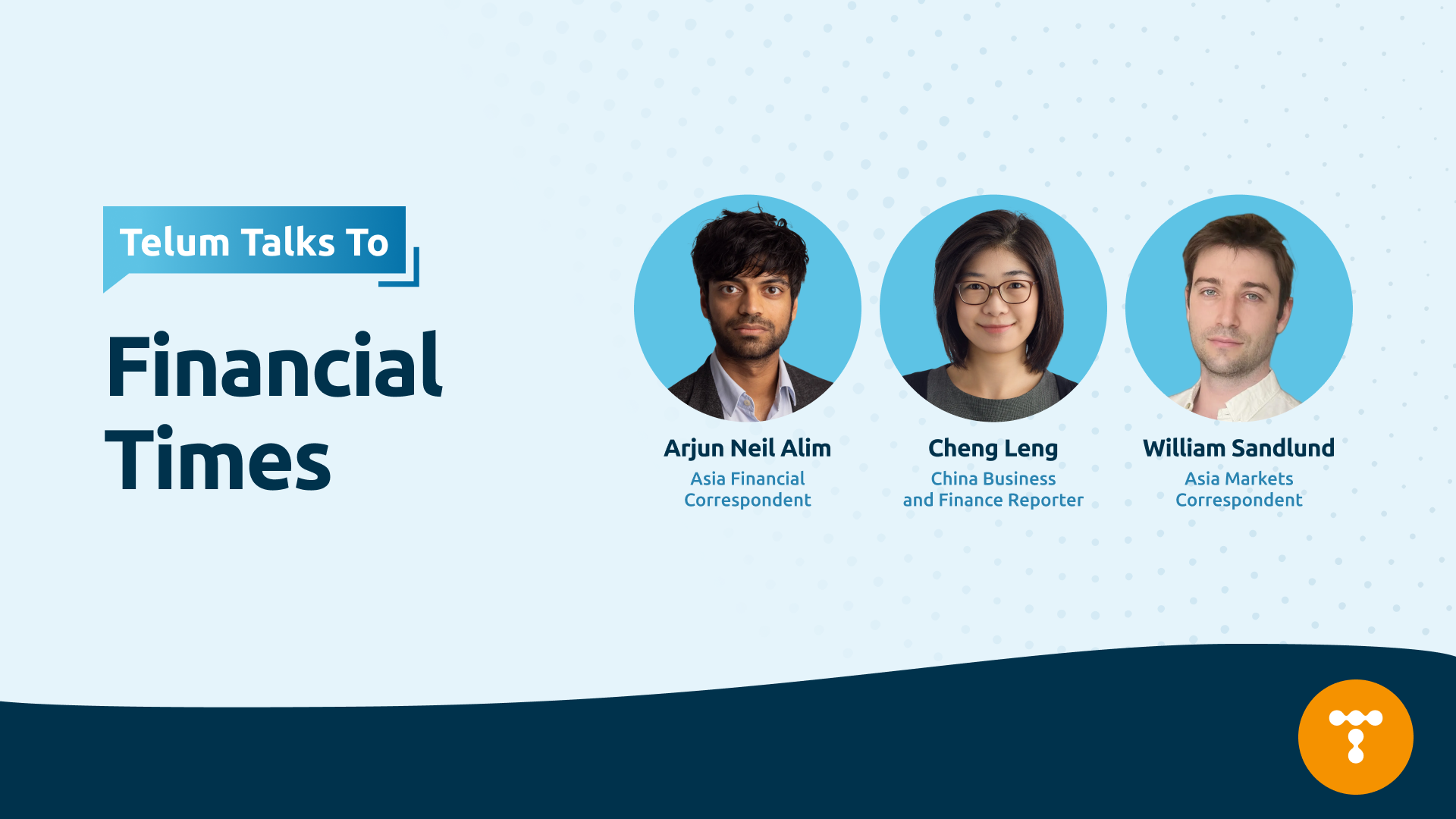
Telum Media hosted its latest Telum Talks event in Hong Kong on Wednesday, 30th July 2025, featuring Arjun Neil Alim, Asia Financial Correspondent; Cheng Leng, China Business and Finance Reporter; and William Sandlund, Asia Markets Correspondent at the Financial Times. The morning discussion was moderated by Telum Media's Annemarelle van Schayik, and was followed by a Q&A session and networking.
Held at the Financial Times' event space, the session featured key insights from the FT team on the publication's editorial structure and coverage priorities in Asia, how its journalists work with sources and pitches, and what the team looks for in terms of stories and angles.
The panellists shared key information about the kinds of sources that they talk to regularly, whether it's the asset managers that they get consistent market intel on, the academics and consultants that they turn to for sociopolitical analysis, or those that they reach out to for off-the-record viewpoints.
Arjun, Cheng, and William also divulged the topical and evergreen topics that they are currently focussing on, including the standing of traditionally strong performing sectors in Hong Kong, the intersection of money and power, and the development of the Chinese economy. They also shared tips and examples of how PR professionals can craft pitches around what Arjun described as 'the North Star' of the Financial Times to make for successful stories.
Stay tuned for more Telum Media events by subscribing to our News Alerts for the latest updates.
Events
Event wrap up: Telum Talks to: Financial Times
by Telum Media
29 July 2025 4:00 PM
2 mins read
Telum Media creating connections
Get in touch to learn more
Previous story
Edelman announces senior team updates
You might also enjoy
Feature
When The Executive Centre (TEC) entered Dubai in 2018, flexible workspaces were still relatively niche in the Middle East market. For Chelsea Perino, a Marketing and Communications Executive based in Hong Kong and her team, the challenge was twofold: establishing brand awareness while learning how business is done in the region.
That changed after Covid-19. While many global markets stalled, the region rebounded swiftly. With the rise of hybrid working, the flexible workspace solutions provider fundamentally flipped its business on its head.
The pace of change in the Gulf region is something industry leaders have noticed. Georgina Woollams, Founder and Managing Director of Katch International and whom expanded her agency from London to Dubai more than a decade ago, explained how approaches to brand building and communications have changed over the years as the market transformed:
“The UAE is probably one of the fastest-evolving countries in the world, so we have to adapt to stay on pace continually. With the growth of the country and a recent influx of people from across the globe, we are always finding ways to reintroduce clients to a new audience while simultaneously storytelling to those in the UAE who already know the brand.”
Relationship building in the Middle East and pitfalls to avoid
Chelsea quickly observed that business culture in the Middle East is highly relationship-driven.
Unlike in many Western markets, meetings often begin with personal conversations about family, daily life, or current events before shifting to commercial discussions.
“Making small talk before discussing business details shows that you care about the bigger story behind an initiative. Not doing so can come across as pushy or insincere,” she notes.
Going hand in hand with relationship building is the grasp of cultural nuances and the exhibition of cultural sensitivity. Yet, an often-overlooked aspect for foreign communicators is the sheer diversity of the region, both in terms of language and personas.
Chelsea highlighted the common misconception of treating the Middle East as a homogeneous market. Each territory has its distinct characteristics and media landscape. Dubai and Abu Dhabi, despite being part of the same country, maintain different business personalities. Saudi Arabia, Qatar, Azerbaijan, and Oman each possess unique cultural, economic, and media environments, with varying dialects of Arabic. She added that success in regional communications requires understanding of both English and Arabic media ecosystems.
Georgina pointed out that a 'pay to play' dynamic is prevalent in certain territories, which might be hard to get around, especially if you are in the real estate or trade industries.
“A lot of international people forget that the majority of the wealth in that region is sitting within the Arabic family holding - it would be naive not to take that side of the demographics seriously,” Chelsea observed.
Tailoring communication to different demographics
Beyond building relationships in person, understanding audiences’ preferred communication platforms across Middle Eastern countries is crucial for successful engagement. Each market has distinct preferences shaping both B2B and B2C communications that brands must adapt to.
While longer-form storytelling and business outlooks would be interesting to audiences of traditional media, social media communication in the region is undeniably on the rise. “X (formerly Twitter) usage in the region is high - it’s actually one of the preferred communications platforms - which is why it is important to consider opening branded channels to drive more tailored engagement when an organisation is expanding into the region,” Chelsea exemplifies.
Georgina echoes Chelsea’s sentiment on the importance of localising communication channels and their content to different audiences. On numerous occasions, she has seen international brands enter the market and think one rule fits all, but that is simply not the case. “For our clients, this is a journey of education, understanding what competitors are doing and how they are doing it right. We then adapt one of their campaigns culturally to show them the great results we can achieve, so they let us continue with this strategy.”
On the other hand, young people aged under 30 constitute more than half of the population across the Middle East and North Africa region, with recent estimates from the OECD placing this figure at around 55%. In this context, Georgina also advises PRs to “be ready to adapt; Generation Alpha are tech-led, so find ways to communicate with them in a manner they will respond to. Generation Z want to know you care, so you need to speak with authenticity.”
Advice for first-timers
When asked what guidance she would offer to international communicators entering this market for the first time, Georgina honed in on localisation and authentic engagement.
“It is essential to localise the content, build genuine relationships with specific communities, not just by sponsoring something, but by truly finding a way to engage with the audience you are targeting.”
Chelsea encourages brands to inform their marketing and communications campaigns through a competitive audit. A test-and-learn approach is also highly beneficial, she has found. Rather than crafting an extensive year-long strategy immediately, she recommends focusing on shorter cycles:
“For Q1, focus on specific initiatives and channels, assess what works, and use those insights to inform your strategy for Q2. If you find success with certain activities, amplify them; if something doesn’t resonate, pivot and explore new options.”
She also urged brands to think carefully about where they launch within the UAE, rather than defaulting to Dubai.
“Each Emirate has its own identity,” Chelsea explained. “Some are known for luxury and glamour, some for financial strength and investment, and others are emerging as entertainment hubs.
“Don’t automatically assume Dubai is the best starting point for your initiatives just because it’s the most familiar to an international audience.”
24 February 2026 6:58 AM
5 mins read
Moves
Zeno Group has appointed Khushil Vaswani as Managing Director of its Singapore office.
In this role, he leads the Singapore office, overseeing senior client relationships and driving integrated, multi-market work across the Asia Pacific region.
Khushil brings 20 years of agency experience, advising brands across financial services, FinTech, travel and hospitality, entertainment, and sports. He joins from Ruder Finn Era, where he handled operations across five Southeast Asian markets. Over the course of his career, Khushil has also led issues and crisis mandates across aviation, healthcare, online travel, and QSR sectors, as well as major events.
Commenting on the appointment, David Lian, Regional President, Zeno Asia, said, “Khushil is a modern agency leader who combines strategic depth with entrepreneurial drive. Especially at a time where more and more clients are requiring multi-market counsel in navigating a complex South-East Asia region, his proven track record in this area makes him exceptionally well suited to lead our Singapore business now. Khushil’s leadership will help us scale our capabilities, strengthen senior client partnerships, and further cement Singapore’s role as a regional growth engine for Zeno.”
24 February 2026 1:56 AM
1 min read
Moves
Jack Ng has started a new chapter at Votee AI, a deep-tech Sovereign AI infrastructure. As Head of Corporate Communications, he leads the global narrative for the company, which operates in Hong Kong, Toronto, Kuala Lumpur, and Ho Chi Minh City.
Jack brings close to two decades of experience to his latest role. Based in Hong Kong, his portfolio includes senior leadership roles in communications and marketing at HKU, APRU, and K11.
24 February 2026 1:19 AM
1 min read