PR News
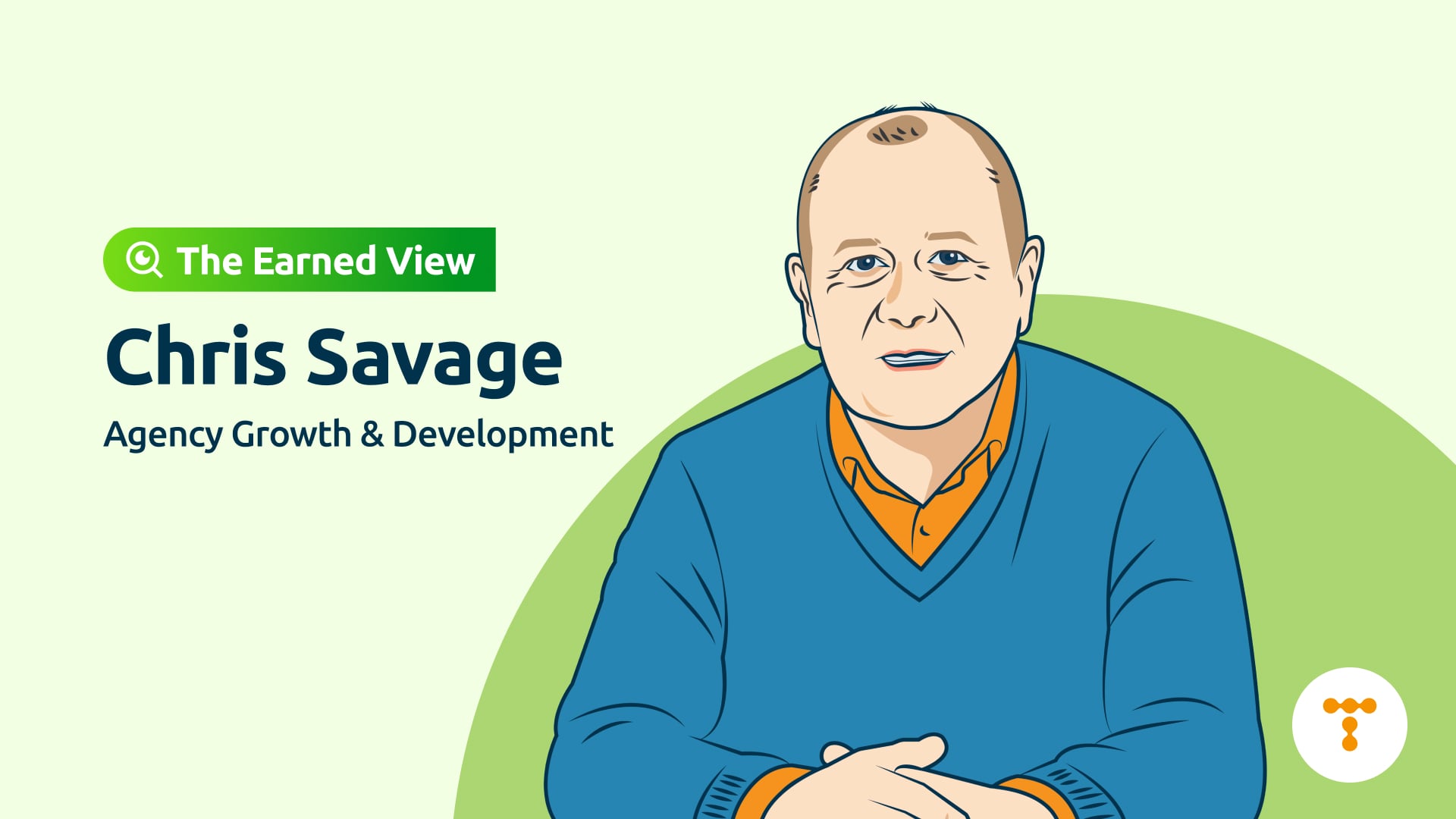
Chris Savage

'Chris Savage bites a dog.' Why profile is like Grandma’s chicken soup...

First, a story about why I bit the dog. Then a story about Geoff's Grandma. Both relate to why profile helps drive revenue growth.

Question: did you look twice at the 'Chris Bites Dog' headline? Did it startle a little? Intrigue you for a moment? Come on now, own up... most of you know it did.

That’s because it has 'tension'. Conflict.

'Dog bites man?' Who cares! 'Man bites dog?' What the heck! 'Chris Savage bites dog?' He's gone mad! Must read more.

In my last column, I outlined how Ph-arming (yes, yes: I wish Farming started with a P) is the fastest way to grow revenues. We have a one in two chance to sell something new... oops... to add new value and be paid for it... to an existing client. But only if we find real, urgent problems to help solve.

Profile is the fourth of The Savage Company’s now Nine (used to be Five, then Seven, then Eight) Doors to Revenue Growth. I've added another door since last month's column - Patter (as in sharp, compelling narrative about who we are and how we are different, special, and a genuine value-adder) - to the other eight doors: Positioning, Pleasing, Ph-arming, Profile, Pipeline / Prospecting , Pitching (converting), Push-Back, and Pricing.

But today, it’s all about growing Profile.

The secret = J.F.D.I.

Weird talking to a PR audience about profile. But it's a genuine case of 'plumber’s pipes.'

PR agencies are terrible at driving their own profile. The ones that do it best hire a PR specialist person to drive it for them. I don't care how you get it done. Just get it done. Or as Australian fitness trainer personality Michelle Bridges suggests: JFDI. I’ll leave it to your imagination to spell that out. If you can't work it out, look at the last paras of this column.

Why? Because it's like Geoff's Grandma's chicken soup.

"Grandma," asked Geoff. “Why do you keep making us eat this chicken soup? Will it do us any good?”

"Young Geoff,” said Grandma. “It might not do you any good, but it won't do you any harm."

We simply have to be on the client and prospect 'radar' at all times. We have to be top-of-mind. We must build reputation and positioning before a prospect contacts us. And we have to stand out from the crowd and get noticed.

Man bites dog. Always.

Now, this is going to be simplistic to many of you PR types. But how many agencies do this brilliantly? I’m going to outline here the proven recipe to ensure Profile is at the right level, always.

1. The wallpaper

We don’t need a Ferrari to take us on the profile journey. Flashy, temperamental, expensive. We just need a F.O.R.D. Put the key in the ignition. Start. And vroom vroom. It takes us from A to B and beyond.

The F = Features

Identify the key features in relevant media where your agency needs to have a profile in the next 12 months. Schedule your contribution to these. Make sure you are front and centre within them.

If it's a feature in a trade magazine / online newsletter about - for example and if relevant - driving sales in B2B consulting services (think legal, accounting, or corporate advisory clients), schedule the dates you need to submit a contribution. And JFDI.

The O = Opportunities

We news jack for our clients. Do it for ourselves. Trawl the issues of the day and insert an agency point of view into the narrative. Once a month is fine. Get your agency POV into the current affairs of the day. JFDI.

The R = Relationships

There are only five key trade journalists you need to develop close relationships with to ensure you become the 'go to' source for comment on industry developments or critical reputation and marketing issues that matter to your clients.

Build those relationships. Build goodwill equity. Be the go-to person. JFDI.

And the D = Developments

Pump out those releases. Two a month. New hires. Client wins. Awards. Our trade press will publish them. Then LinkedIn the heck out of them. JFDI.

2. Thought leadership mini-campaigns

We do it for clients. Do it for ourselves. Three times a year. It starts with our point of view about something relevant to client profile, reputation management, brand building, stakeholder relationships - whatever.

Then drive a profile blast over two weeks.

  • Speaking engagement: Give a speech. At a formal event, or create your own. Twenty clients in a room is still a 'speech'.

  • Media: “Executive X said today.” You've created news. Push out the media campaign highlighting the key elements of your speech, whether it was delivered to five people or 500. Target immediate, overnight media, as well as longer lead opportunities: weekly trades and supplements, in flight radio, and magazines.

  • Social media: Go hard. LinkedIn mainly. Push out video highlights of the speech and tiles of key points around your POV theme.

  • Direct ‘mail’: Send an EDM or email to your database (Databases are key: is yours up to date and regularly updated? Yes? What rubbish! Get to it and update that database every month). “Thought you might be interested in key comments I made today at a speech to...”

  • Boardroom lunches: Hold a couple. Six clients. Three prospects. A university professor. Use your POV as the topic of conversation.

Here’s the key.

Your target prospect might have been at the speech, read the newspaper online, seen the magazine article a month later, seen the LinkedIn post, received the EDM, or been at the networking event. Point is, you've touched them with your point of view message three, four, five times over a short period of the time.

Do that three times a year, and if you did a survey at year end about who is the expert in that POV, chances are high that it will be you!

And it’s highly time efficient too.


3. Awards

I love them. Enter them.

Awards for great work or agency of the year are the best. Being short-listed is as good as winning. Seriously. “Twice Academy Award nominated actress...” is just as powerful as 'winner'. It stays with you forever.

Judge them too. It's amazing how much you learn by being a judge, and it also gives you the opportunity to meet the other judges. Remember, the most important thing I have learnt in business: if you can develop relationships, anything is possible.

If you get short-listed, or win, it gives you powerful bait to get meetings with prospects. They want to see and learn about the best work or the best agencies. Don't underestimate the power of awards.

4. And all that jazz

Don't forget to lock in some big platform speeches, be on panels, or even (stay calm) sponsor the right events. Remember, 80 per cent of the secret to success is just turning up. Turn up.

Don't confuse Profile with Prospecting

My next column will be all about driving a proactive pipeline of new business opportunity.

It's one of the hardest things for busy, under-pressure agency leaders to do. But it is vital to agency success.

You get busy delivering a heavy workload - the late nights and cold pizzas. Then the projects end. You look around. Tumbleweeds blowing through the agency. The new revenue pipeline is sparse. Disaster! Driving pipeline involves another breed of outreach. Wait till next month for the magic.

Making sure though, that your agency profile is constant, crisp, differentiated, and 'future-fit' is a vital ingredient to creating an environment to sell within.

It's not magic. It's not rocket science. It's simply JFDI!

Just F**king Do It!

Oh, and remember: Man bites dog. Make sure it has tension and a bit of spice if you really want to cut through.

There you have it. Profile is front and centre to agency revenue growth. Is your agency profile robust enough? Are you JFDI-ing enough?

Next column we move on to our next of the Nine Doors to Revenue Growth. That's all about Prospecting!

Chris Savage is one of Asia Pacific’s pre-eminent creative communications industry leaders. Following a highly successful 25-year career in public relations, Chris launched The Savage Company in 2015, focused on helping business leaders energise growth. He has built and led some of the region’s biggest PR companies and groups, including as Australia CEO and Vice Chairman Asia Pacific of Burson-Marsteller, CEO of Ogilvy PR Australia, and COO of marketing content and communications group, STW Group (now WPP ANZ). Chris is also a shareholder and chairman of eight communications agencies.

Read more from our columnists in The Earned View

Previous story

PRCA APAC announces 2027 conference and awards

You might also enjoy

PRCA
Events

PRCA APAC announces 2027 conference and awards

PRCA APAC has launched the 2027 editions of the PRCA APAC Conference and PRCA Asia Pacific Awards.

Themed “The New Influence”, the PRCA APAC Conference will be held on 28th January 2027 at One Farrer Hotel in Singapore.

The conference will bring together senior communicators, agency leaders and in-house teams to explore what influence looks like today, and how communications can turn attention into trust and action.

The PRCA Asia Pacific Awards will be held on 9th April 2027 at One Farrer Hotel in Singapore.

The awards aim to recognise the people, teams, campaigns and partnerships that have made an impact across Asia Pacific. Categories include Reputation Management Award, Single Market Consultancy Award and Event / Launch of the Year Award.

Conrad
Moves

Conrad Singapore Orchard welcomes new marcomms director

Ferne Yap has been appointed Director of Marketing Communications at Conrad Singapore Orchard.

In the role, she oversees a suite of communications activities, including press relations, crisis management, integrated marketing, partnerships and events.

Ferne most recently served as Regional Director of Marketing at Amara Hotels & Resorts, where she led corporate branding, media engagement and marketing strategy across Singapore, Thailand and Mainland China.

Earned,
The Earned View

Earned, not owned: why your purpose may be the most important thing you’ll ever communicate

Most communications people have, at some point, been in the meeting where everyone agrees the organisation needs to rebuild trust, preferably by Thursday, and then turns to comms for the magic three words that will make years of accumulated stakeholder irritation sound like a refreshed strategic direction.

Reputation does not work like that, and most of us in the room already know it.

We talk about reputation as though it is ownable. It appears on risk registers, in brand valuations, and in executive scorecards, usually accompanied by a number that nobody is asked to defend. We build it, protect it, and restore it. We describe it as if it were a wall, a bank account, or a slightly temperamental piece of infrastructure.

The challenge here is that brand and reputation are fundamentally relational. They are none of those things.

Brand is the experience people have of us, whereas reputation is the judgement they reach. They sit in the space between what an organisation says, what it does, and whether anyone believes the two are related. An organisation controls its purpose, identity, speeches, submissions, and media lines. It does not control whether any of that is believed.

The highest claim

In every brand architecture any of us have ever drawn, purpose sits at the top. Everything descends from it. Positioning, proposition, personality, messaging, campaign, and the tone of voice document nobody reads. The apex claim is where the rest take their authority, which is precisely why it carries the widest exposure.

Positioning can be revised quietly. An organisation cannot revise its reason for existing without somebody noticing.

This is the trap. The higher a claim sits, the less falsifiable it feels in the writing and the more falsifiable it becomes in the operating. A proposition can be judged on whether the product does what it says. A purpose is judged on everything the organisation does, indefinitely, by anyone who cares to look. Which produces the observation nobody welcomes at the end of a long strategy day.

Some organisations do not have a messaging problem. They have an evidence problem. The words are clear enough and the positioning is coherent enough, but not enough has been done to make the apex claim believable. In that situation further communication makes matters worse, because it draws a brighter line around the distance between the story and the experience.

When purpose raises the stakes

Consider an organisation that publicly commits itself to protecting the communities affected by its operations. It builds that commitment into its stated purpose, reporting and external positioning. If its subsequent decisions cause significant harm to those same communities, the problem is no longer simply the decision itself. The organisation has also created the standard against which that decision will be judged, making the distance between the claim and the reality much more visible.

Now take an organisation that places trust at the centre of its purpose. If conduct later emerges that calls that trust into question, the purpose statement does not disappear into the background. It becomes part of the scrutiny.

This is what an unsupported apex claim does under pressure. It does not merely fail to assist; it supplies stakeholders with the language against which the organisation’s behaviour can be measured. The organisation may be perfectly capable of explaining itself, but where the conduct goes to the conditions under which it is permitted to operate, explanation does not reach that far down.

The same applies to a consumer brand that goes beyond promising a good product or service and instead claims to represent something larger: a community, a set of values, or a particular way of life.

Such claims can create enormous stores of goodwill, but they also raise the altitude from which any failure is judged. A service problem can become a values problem because the organisation itself has invited that comparison. An organisation that claims to represent something larger than itself also invites those it claims to represent to hold an opinion.

In each case, the apex claim does not cause the failure. It multiplies it and determines the language in which the failure is discussed. It is worth conceding what this argument selects for. The same elevation that multiplies exposure also creates accountability, and in each of these cases the claim can do useful work for years precisely because it is public and difficult to retract.

The lesson is not that organisations should claim less. It is that they should not claim beyond what they have built the means to carry.

What criticism is telling us

Scrutiny once arrived through recognisable channels. Journalists, regulators, analysts, and organised interests still matter, but they are no longer the only participants. Employees, customers, communities, and shareholders form coalitions quickly and publicly, and a local complaint can become national evidence of a pattern before the executive team has settled on a holding line.

This does not make every backlash meaningful, and it does not entitle every critic to win. Many are neither right nor fair. But dismissal is not a strategy, and treating criticism as noise is the most expensive available error, because criticism is frequently intelligence. Anger usually indicates that an expectation has been breached, and often it is an expectation the organisation created itself, at the top of its own architecture, some years earlier.

The instinctive question in the room is how to make it go away. The more useful question is what it tells us about the permission we thought we had.

Permission is contextual. An organisation can take a position on one issue and be rewarded, take an apparently similar position on another and be punished. It can satisfy its regulators and lose its community. It can be technically compliant and reputationally exposed. This is why the recurring debate about whether business should take a stand generates so much heat and so little use.

The question is narrower. Permission to speak is drawn from the same account as purpose, and the account is not always as full as the strategy deck suggests. What right does this organisation have to speak here, and what evidence supports the position it is taking?

Stakeholders are not assessing what is said when it is easy. They are watching what happens when purpose becomes inconvenient, when margins tighten, when a partner behaves badly, and when the thing at the top of the architecture sits directly opposite the thing that protects the quarter.

That is where reputation is made, and communications is rarely in that meeting.


The uncomfortable position

There is an awkwardness here for our industry, which is that the outcome clients most want is the one that cannot be sold to them.

Reputation cannot be supplied. What can be supplied is somebody prepared to say, early and in private, that a claim is not yet supported by the evidence, and that the claim in question is the one at the top. That is a different service from the one many of us were engaged to provide, and a less comfortable one to deliver.

It also means the familiar functional map has outlived its usefulness. Brand runs the promise, corporate affairs runs the story, public affairs runs the stakeholders, and issues management is summoned when the promise comes under load. Stakeholders are not briefed on the organisational chart. Employees compare the purpose statement with their working conditions. Communities compare it with the consultation process. Journalists compare it with the lived detail.

The organisation has separate functions. Reputation does not.

Why AI raises the stakes

All of this becomes more pressing as AI reduces the cost of producing communication to something close to nothing.

Purpose statements happen to be the easiest genre in corporate language, and a large language model will produce a very good one in seconds. It will be fluent, well structured, appropriately elevated, and entirely untroubled by whether the organisation has earned the right to say any of it. The apex claim, in other words, is now the cheapest thing in the architecture to write and remains the most expensive thing to support.

Speed is not judgement. Faster communication may simply mean the faster exposure of weak thinking, at scale and in excellent prose.

So the value moves. It moves away from production, where the machines are already competitive on a Thursday afternoon, and towards diagnosis, evidence, restraint, and interpretation. The question is no longer whether an organisation can say something quickly. It is whether it should, whether it can support it, and whether anyone will believe it.

The best advice is increasingly about what not to say, and when not to say it.

When trust breaks, the formula remains short. We are sorry, we are fixing it, we have changed. Each clause has to be true, and the third is checkable.

The burden of claim

There is a test for this, and it takes about an hour.

Claims are supported by one of three classes of evidence. Performance, which is verifiable delivery and which proves only what it measures. Testimony, which is what other people say when nobody has asked them and which cannot be self-supplied. And structure, which is a mechanism with standing to refuse, sitting outside commercial operations, that has visibly cost the organisation something it wanted.

The three are not interchangeable, and they are not a hierarchy of quality. They are a hierarchy of burden.

A claim about competence can rest on performance. A claim about character requires testimony. But a claim about why an organisation exists, which is what a purpose statement is, can only be carried by structure, because it is a claim about what the organisation will do when the claim becomes expensive. Nothing else answers that question in advance.

Almost every purpose statement is a claim of the third kind. Almost every purpose statement is defended with evidence of the second. That mismatch is not a communications failure. It is the failure, and communications simply happens to be where it becomes visible.

Which leaves three options rather than the usual one. Build the structure. Wait, and stop making the claim until it exists. Or lower the claim to the altitude the evidence actually supports.

That third option is almost never on the table, and it should be. Withdrawing a claim is treated as retreat when it is frequently just accuracy, and accuracy is cheaper than exposure. Holding a position you cannot support is not caution. It is exposure with better adjectives.

The shortest version of the test is this. Name the decision in the last two years where this claim cost the organisation money. Not effort, not attention. Money, or an opportunity foregone. If there is no such decision, the claim is running ahead of its evidence, and the only remaining question is when somebody notices.

Reputation is not a possession. It is permission. And permission has to be earned again and again, which takes rather longer than Thursday.

This column draws on Matt Thomas and William S. Harvey's, “Reputation and Social Purpose: How Organizations Can Maintain Legitimacy With Their Stakeholders”, in The Oxford Handbook of Social Purpose, Oxford University Press, 2026.

Matthew (Matt) Thomas is Founder and Chief Catalyst at Stake The Reputation Company, a Melbourne-based consultancy working across brand, reputation, communications, and public affairs. He has advised some of Australia’s largest private companies and has worked extensively with global organisations localising their storytelling and narratives for Australian audiences. His experience spans consumer, government, health, infrastructure, technology, and corporate reputation, including advisory work at all levels of government in Australia.

Matt’s work sits at the intersection of communications, behaviour change, and institutional strategy. He is also a contributor to the The Oxford Handbook of Social Purpose, writing on reputation, legitimacy, and the growing gap between organisational messaging and operational reality.

Read more from our columnists in The Earned View