

AI is everywhere. And it's way more complex than the world would like to believe. It's not just speed, maths, and science; it's also cultural nuances, languages, and thought patterns.
AI has already revolutionised science, medicine, and data. It can detect diseases earlier than human scientists can, accelerate drug discovery, and process information at a scale no human ever has. Yet at the same time, it's taken jobs (let's not pretend), fuelled disinformation, amplified bias, and eroded trust. It can create extraordinary efficiencies on one hand while creating entirely new risks on the other.
The contradiction is hard to ignore, and I often feel like we’re living out an episode of Netflix’s dystopian show, Snowpiercer. For those who haven’t seen it, it's a sort of Noah’s Ark carrying what’s left of humanity, but on a train, hurtling down precariously towards the unknown. Make no mistake - the AI gravy train has already left the station whether we like it or not.
How we control it, though, is what matters most now. Do we pull the emergency brake - is there even one? Perhaps slow down a little? Maybe put in place some well-thought-out policy?
Look at what’s happened with social media over the past few weeks with country after country banning it for underaged children. A decision - good or bad - I don’t know, but the very ban itself indicates we got it wrong.
The hows and whys
Many of us still question AI. Not the "ifs" and "whens" because AI is well and truly here; it's embedded in our workflows, our search engines, our social media feeds, and even our decision-making processes. There's no escaping that.
But the important questions that remain are "how" and "why."
The former is practical. How do we use AI responsibly? How do we build governance around it? How do organisations deploy it without sacrificing quality, ethics, or human judgement?
The latter is philosophical. Why are we so eager to automate certain parts of human endeavour? Why do we seem determined to optimise every aspect of our working lives? Is profit the only thing that matters? Why are we racing towards greater efficiency without stopping to ask what we might lose along the way?
I have so many questions. But perhaps the most critical of all - and one that will most likely take centre stage in coming years is: which skills are we prepared to accede to AI?
And herein lies the key to our survival.
The debate around AI often focuses on jobs. Which professions will disappear? Which industries will be transformed? Which roles will be automated? These are important conversations to be had of course, but they’re not the fundamental issue. What we really need to decide is which aspects of human capability we’re willing to outsource.
The time to act is now
Every technological revolution has involved some degree of delegation. We outsourced physical labour to machines (Industrial Revolution), memory to computers, and navigation to GPS.
But for the first time ever, we’re outsourcing what makes us distinctly human - cognition itself.
Research, summarising, analysis, pattern recognition, content creation, forecasting, and even ideation - tasks that are truly human - are now being performed by machines with increasing, and alarming, competence. The question is how far will we go? Where do we draw the line? Who draws that line?
Some people call it progress and some feel we’re shooting ourselves in the foot. But the majority probably fluctuate between the two, depending on how well our day went.
The challenge is that capability and wisdom are not the same thing. Just because AI can perform a task, it doesn’t mean it should.
The question organisations must ask themselves is not simply "can AI do this?" but "should humans stop doing this?" A significant difference. Because every skill we surrender eventually weakens us as individuals and as a collective.
How many of us can rattle off our four-times tables without having to think about it? Calculators reduced our ability to perform mental maths or even memorise with the efficiency of Small Wonder - remember her? Then again, depending on your generation, you might not even know what "mental maths" is or who Small Wonder is.
This is the same for computers and keyboards; writing for some is a challenge. Even conversations are a struggle within certain age groups. And we're here because somewhere down the line, we chose to surrender a skill, a talent, a gift - simply because we didn't view them as such. Perspective is often the greatest problem of all.
What happens when we stop researching? What happens when we stop analysing, questioning, or debating because AI can provide an answer in seconds? The risk is less that AI becomes more intelligent and more that humans become less capable.
Ethics in the world of PR
Last month, I penned a piece for ICCO’s 2026 World PR Report that unsurprisingly revealed a conveniently ignored problem and a credibility paradox within the Middle East’s PR industry.
It’s a problem that journalists spend most of their time fighting to uphold and is, ironically, the driving force behind PR's most sacred objectives - trust, credibility, and reputation.
I'm talking about ethics, of course, the absence of which, could plunge the entire PR métier into an existential crisis. Yet, it remains the white elephant in almost every PR room you walk into.
According to the report, the Middle East ranked lowest globally for signing up to industry codes of conduct and for believing it's the responsibility of PR agencies to advise clients against unethical behaviour.
Yet (and here’s the paradox), it ranked among the highest for believing that PR is more ethical than all other industries. Absolutely bonkers.
As PR firms take on more strategic influence, client expectations around accountability, governance, and ethical leadership will inevitably increase. In a trust-driven economy, ethical credibility will undoubtedly become prime currency.
Ultimately, the Middle East PR industry will have to learn how to integrate AI without compromising ethics, grow while maintaining credibility, and innovate without losing trust.
Hope for PR after all
And that, oddly, brings renewed hope to the industry.
At first glance, AI and advisory make strange bedfellows. While AI is built on algorithms, speed, and automation, advisory leverages judgement, relationships, and experience. The former processes information and predicts, while the latter interprets meaning and can advise ethically.
Despite these apparent contradictions, they may actually be the perfect partnership; particularly within the PR and communications industry.
For decades, communications professionals have found themselves caught between a rock and a hard place. Clients pay for strategic thinking, counsel, and creativity, yet vast amounts of time is lost to administrative tasks. Media monitoring, summarising articles, stakeholder listing, taking meeting notes - all necessary jobs, but rarely where the greatest value lies. They're the scaffolding around the work rather than the work itself, and it consumes an enormous proportion of professional time and energy.
But AI changes that equation.
For the first time, we have technology that's capable of absorbing much of that administrative burden. Research that once took hours now takes minutes, data analysis is churned up instantaneously, draft documents generated in seconds, and information organised, categorised and synthesised before you can fry your morning eggs sunny side up. The implications are profound, but not because AI replaces advisers; but because it allows advisers to spend more time advising.
There is a persistent narrative that AI will inevitably replace knowledge workers. I'm not sure. Of course, some roles will change, perhaps even dramatically, while some tasks could disappear altogether; but advisory work has always been about far more than information - it's about judgement. And judgement remains stubbornly human.
The best advisers don't just provide answers. They bring context, understand nuance, and navigate ambiguity. They recognise political dynamics, organisational culture, and human emotion. They know when a technically correct answer would be strategically poor. They know when a client needs reassurance rather than a long-winded explanation, and when silence is more powerful than a tepid response.
These aren’t data problems - they’re human problems. And human problems require human understanding.
Enter PR stage right. Communications is often misunderstood as a discipline about messaging, whereas, in reality, it's about people. And people are irrational, emotional, often even contradictory. They frequently make decisions that defy logic and evidence, and no algorithm can fully account for that complexity.
A crisis communication strategy is not a collection of smart words thrown together, it's a masterclass in psychology. Stakeholder engagement is not a spreadsheet, it's relationship management. And reputation is not a popularity contest, it's a collective perception shaped by trust, experience, and emotion.
AI can support these processes, inform them, and certainly accelerate them. But what it cannot do is fully replace them. At least not yet. Unless we allow it to. And this is why I believe the future belongs not to AI alone, nor to humans working independently of it, but to those who learn how to collaborate with it effectively.
Why questioning will always be our armour
Over the next decade, the most valuable professionals are unlikely to be those who reject AI, nor will they be those who embrace it without abandon and without question. Instead, they will be the people who understand where technology creates value and where human judgement must remain firmly in control.
They will know how to leverage AI as a tool without becoming dependent upon it. Harder said than done I know, but it will become more difficult to sacrifice as AI becomes more intelligent. The strong ones will use it to enhance thinking rather than replace it. And understanding that distinction might save us from another emerging AI risk that receives far less attention than it should - homogenisation.
As more people rely on the same models, the same prompts, and the same datasets, there is a danger that ideas become increasingly uniform. We're already seeing it and it's a Shakespearean tragedy. Content starts to sound the same, strategies begin to resemble one another, and creativity and originality fly out the window.
But equally when everyone has access to the same answers, competitive advantage shifts to interpretation, insight, and perspective - to human experience. In other words, it shifts towards the very qualities that advisory professionals have always brought to the table. The irony is striking.
The more sophisticated AI becomes, the more valuable uniquely human capabilities will become. All those so-called "soft skills" like empathy, judgement, curiosity, critical thinking, creativity, ethics, and leadership are now quite solid skills because they're strategic and difficult to automate. This is also why organisations should be careful about what they choose to delegate. The objective should not be maximum automation but maximum value. Sometimes that will mean batting over a task to AI while other times it might mean keeping humans firmly in the loop.
As AI capabilities accelerate, organisations will face increasingly complex decisions about governance, ethics, risk, reputation, and strategy. They will need people who can help them navigate uncertainty and see beyond the immediate efficiency gains, humans who understand both the opportunities and the consequences; people who ask difficult questions. Because AI, as we already know, is exceptionally good at providing answers.
What it still struggles with is determining whether we are asking the right questions in the first place. For now, that responsibility remains ours. And perhaps this is the most important lesson of all. The future is not a choice between humans and machines. It is a choice about the relationship we build between them, the boundaries we set, and the skills we agree to give up on.
With AI rooted in technology and advisory rooted in humanity, together they represent the most powerful combination available to modern organisations.
In an age increasingly defined by artificial intelligence, this partnership may prove to be not only valuable, but essential. Because while machines are becoming more capable, the world is not becoming any less human. And that, ultimately, is the sacred space in which advisory will live.
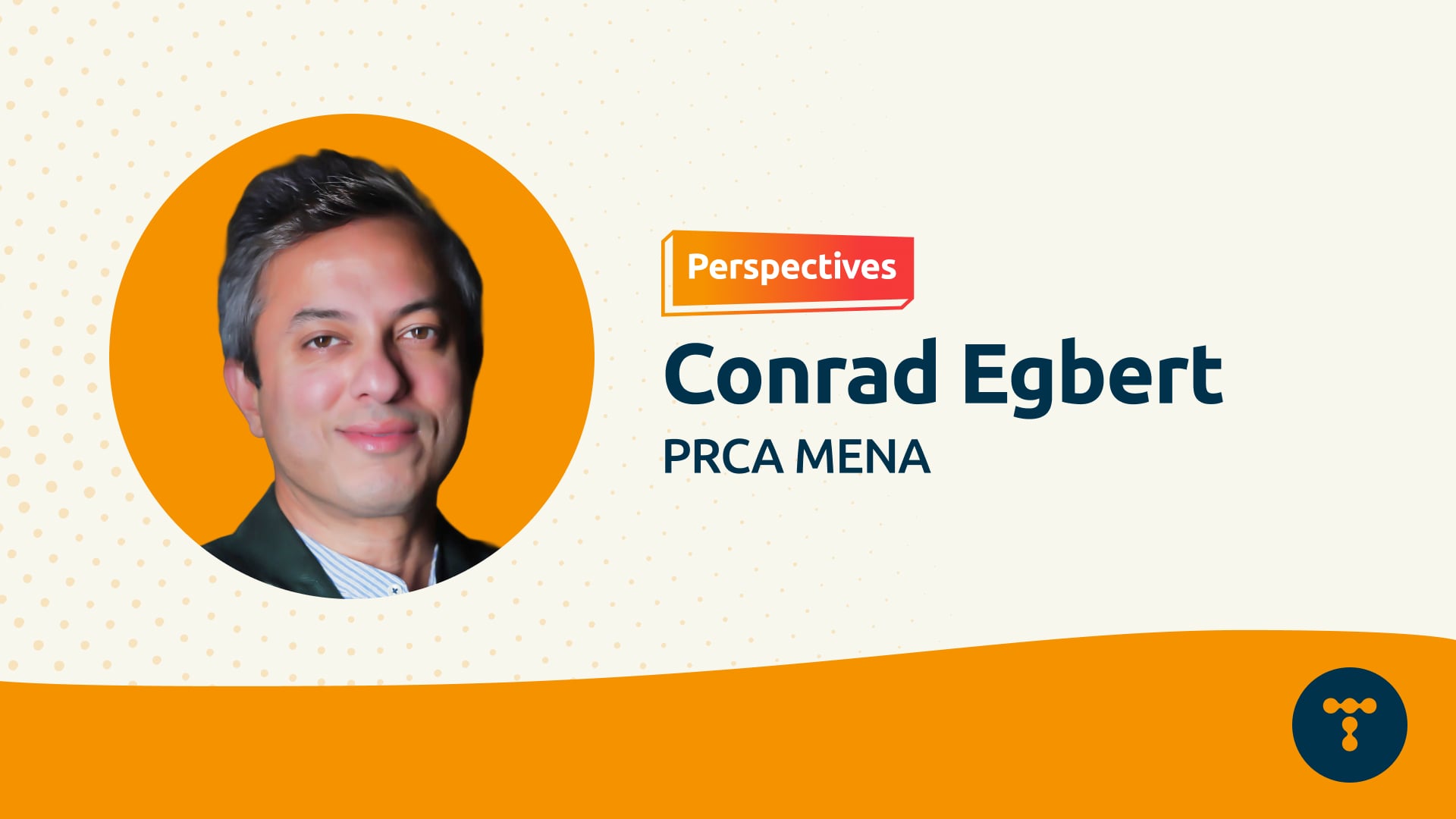
Perspectives' is a Telum Media submitted article series, where diverse viewpoints spark thought-provoking conversations about the role of PR and communications in today's world. This Perspectives piece was submitted by Conrad Egbert a UAE-based strategic advisor and Head of the PRCA MENA - the regional arm of the world's largest public affairs, public relations, and communications association (PRCA).
An award-winning former editor and journalist, he not only comes with over 25 years of experience and profound insights into media and communication across Europe, the Middle East and Asia, but has also provided strategic council to ministers, ambassadors, diplomats and C-suite executives across foreign ministries, European tourism boards and some of the most ambitious government projects in France, the UAE and Saudi Arabia. He holds a master's degree in philosophy, religion, politics and rhetoric from Denmark's University of Copenhagen.
.png)
-4.png)